

Part of our Technical Analysis Indicators guide
Introduction
The 2025 CFA Institute Graduate Outlook Survey showed that 37% of surveyed university students see finance as the most promising career path, and this is up from 30% in 2024 and 24% in 2023. This is a 54% total increase over two years, which shows that people are increasingly becoming more interested in this industry.
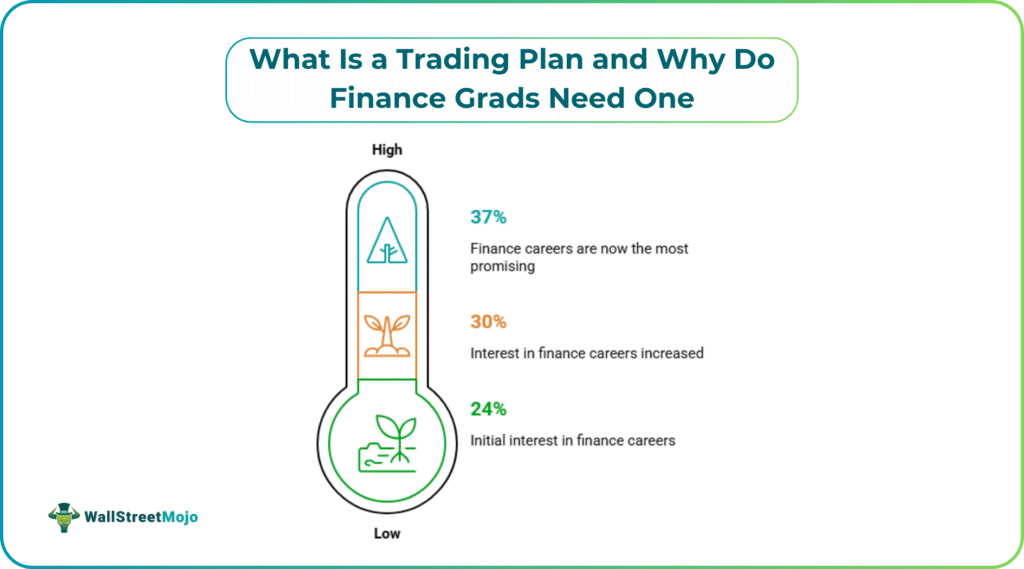
With so many people wanting to get into finance, it’s important to be prepared and get ahead of your competition. This is why finance graduates need to have a trading plan.
This post will go over what a trading plan is, why finance graduates need to have one, and how they can produce an effective plan to use.
What Is a Trading Plan?
A trading plan is a structured and written framework that outlines how you’ll participate in financial markets. Key points include:
- What you trade
- When you trade
- How you manage risk and performance
Usually, it includes measurable objectives, clearly defined entry and exit strategies, risk parameters, and a review process. For finance graduates, a trading plan can serve as a bridge between their theoretical knowledge and real-world applications.
A trading plan is great for any trade because it enforces consistency by predefining rules and expectations. That way, you won’t have to solely rely on intuition or impulse.
It’s a good idea to think of the plan as a personal operating manual. It removes ambiguity and helps ensure that decisions are based on logic rather than emotion.
Why Finance Graduates Need a Trading Plan Early in Their Careers
Finance graduates need a trading plan early in their careers because they often have strong analytical skills but not the real-market experience to match them. During this transition phase, a trading plan can help graduates avoid committing pitfalls, such as overtrading or emotional decision-making.
Early discipline is critical; as with many other things in life, the habits formed at the beginning of a trading journey tend to persist. Graduates can sharpen their skills and knowledge by using a site like axi.com/int/learn-to-trade and then come up with a well-defined plan, which help can reinforce professional behavior.
It can also accelerate learning by providing a framework for evaluating performance. Grads won’t have to guess why trades succeed or fail; they can trace outcomes back to specific rules. As a result, they’ll shorten the learning curve and build confidence. Their trading plan can turn academic knowledge into a repeatable, practical system, and this will support long-term growth.
How to Set Clear Objectives in Your Trading Plan
Every effective trading plan starts with clear and measurable objectives. These define what success looks like and will provide direction for decision-making.
Objectives shouldn’t be vague, like “make money.” Instead, they should focus on metrics, such as:
- Monthly return targets
- Maximum drawdown limits
- Consistency benchmarks
Graduates can consider process-based goals, too. For example, one can be following rules 100% of the time.
In any case, when they separate outcome goals from process goals, they can create a balanced approach. These clear objectives can prevent drifting strategies and help maintain focus during volatile markets.
In addition, these objectives can act as a benchmark for evaluating performance. This ensures that progress is tracked objectively rather than emotionally.
Choosing the Right Markets to Trade
An important part of the trading plan should be specifying which markets you’ll trade:
- Equities
- Forex
- Commodities
- Derivatives
As you may have guessed, each market has its unique characteristics, such as volatility, liquidity, and trading hours. Therefore, graduates should choose the markets they trade in to align with their expertise, risk tolerance, and available time. For instance, a graduate in macroeconomics may prefer forex, while a corporate finance graduate might be better suited for equities.
Graduates should limit their focus to a few markets. This narrower scope helps build a deeper understanding and reduces information overload. In addition, a defined market scope prevents impulsive trades in unfamiliar assets.
Defining Entry Rules: When to Enter a Trade
Part of a trading plan is defining entry rules. These determine the exact conditions when you initiate a trade.
You should base these rules on quantifiable criteria, such as:
- Technical indicators
- Price patterns
- Fundamental signals
This is where graduates’ analytical skills can be of good use. Instead of acting on their gut feeling, they can use their knowledge to define precise rules that trigger entry decisions by predefined setups.
These rules eliminate hesitation and reduce the risk of chasing trades. They can also make it easier to backtest strategies and evaluate performance.
When a graduate has a strong entry framework, this ensures that every trade has a logical basis.
Defining Exit Rules: When to Take Profits or Cut Losses
In addition to defining entry rules, you must also define exit rules. They’re just as important, as they define when to close a trade (whether for profit or loss).
There should be predefined profit targets and stop-loss levels for every position. This can prevent emotional decision-making, such as holding onto losing trades or exiting winners too early.
Consistent profitability depends heavily on disciplined exits, so don’t underestimate their importance. By setting exit rules in advance, you ensure that risk is controlled and profits are systematically captured. This leads to more predictable and stable performance over time.
Risk Per Trade: Protecting Your Capital
One of the most crucial parts of a trading plan is defining how much capital you risk on each trade. After all, effective risk management is the foundation of sustainable trading success. If you aren’t clear on what you’re willing to risk, then you’re throwing caution to the wind.
Usually, defining how much capital you risk on each trade is expressed as a percentage of your total account. This is often between 1% and 2%.
A fixed risk-per-trade rule can prevent catastrophic losses, especially for finance graduates who only understand risk management conceptually. By controlling downside risk, they can survive losing streaks and remain in the game long enough to capitalize on profitable opportunities.
The Importance of Journaling Your Trades
Having a trading journal can make a huge difference in a grad’s trading plan. This is a detailed record of every trade they make, including:
- Rationale
- Entry and exit points
- Outcome
Journaling can be an effective learning process for finance graduates. It allows them to identify patterns in their behavior, strengths, and weaknesses. They can use this data to refine their strategies.
More importantly, journaling promotes accountability. Every decision is documented and reviewed, so there’s no doubt as to what mistakes were made and how to learn from them.
Building Discipline Through a Trading Plan
The most important trait for successful trading is discipline, and it’s easier said than done. The good news is that a trading plan is the primary tool for developing it, which is why finance grads need to have one ASAP. They can reduce impulsive decisions and emotional reactions by committing to predefined rules.
As you can see, discipline isn’t about willpower alone. It’s also about creating systems that make the right actions easier to follow, and a trading plan provides exactly that.
Consistently following the plan helps grads build confidence and trust in their strategy. This is what separates professional traders from amateurs: the fact that decisions are driven by logic rather than fear or greed.
Enhancing Performance Consistency
Consistency is a key goal for traders, and a trading plan is essential for achieving that. Without one, results are often erratic since they’re often driven by random decisions and changing strategies.
A trading plan standardizes decision-making. For graduates, this ensures that similar situations are handled in the same manner. This reduces variability in outcomes and makes performance more predictable.
Another benefit of consistency is that it makes it easier to identify what works (and what doesn’t). As a result, you’ll experience more stable returns and greater confidence in your trading approach.
Avoiding Emotional Decision-Making
Even the most highly educated individuals can fall prey to their emotions, such as fear, greed, and overconfidence. Fortunately, a trading plan can act as a safeguard against these psychological pitfalls.
When you have rules that were defined in advance, you won’t need to make real-time emotional judgments. A trading plan ensures that decisions are made objectively, based on predefined criteria. Not only does this reduce stress, but it also improves execution quality.
Finance graduates can then learn to develop emotional resilience early on. As a result, they can navigate market volatility with greater composure later on in their careers.
Common Mistakes When Creating a Trading Plan
Just because you have a trading plan doesn’t necessarily mean you have something that’s foolproof. In fact, many beginners make mistakes when developing their plans, such as being:
- Too vague
- Overly complex
- Unrealistic
Finance graduates may also over-rely on theoretical models; it’s more important to consider real-market dynamics. They should also define clear risk parameters since, without them, it can lead to significant losses.
Another big mistake is not following the plan consistently. Without consistency, it can render the plan ineffective.
Beginner traders can avoid these common pitfalls and create a more effective and practical framework. That way, it supports disciplined and consistent performance.
A Simple Trading Plan Checklist to Use
It can be overwhelming to come up with your own trading plan, as you may be afraid of missing something crucial. Here are some essential questions you can either ask yourself or include in your plan:
- Does this trade meet my entry criteria?
- Is the risk within my limit?
- Have I defined my exit levels?
- Is the market condition suitable for my strategy?
These questions can act as final filters that may prevent impulsive trades and reinforce discipline. By using this checklist, you can ensure that every trade aligns with your plan.
Sample One-Page Trading Plan Template
Another way we can help you is by providing a sample one-page trading plan template. You can fill in the blanks on this concise and actionable page.
Trader Profile
- Name:
- Trading style:
- Time commitment:
- Experience level:
Objectives
- Monthly return target:
- Maximum monthly drawdown:
- Process goal:
Markets Traded
- Primary markets:
- Instruments:
- Trading sessions/hours:
Strategy Overview
- Core strategy name/type:
- Market conditions required:
Entry Rules
- Setup criteria:
- Confirmation indicators:
- Timeframe for entry:
Exit Rules
- Stop-loss placement rule:
- Profit target rule:
- Trade management:
Risk Management
- Risk per trade:
- Maximum open trades:
- Daily loss limit:
Position Sizing
- Formula or method used:
- Example calculation:
Trading Checklist (Pre-Trade)
- Does this meet my entry criteria?
- Is the risk within limits?
- Are market conditions suitable?
- Have I defined exit levels?
Journaling and Review
- Metrics tracked:
- Notes to record:
- Review frequency:
Adapting and Refining Your Trading Plan Over Time
It’s vital to keep in mind that a trading plan isn’t a static document; it should evolve with you as you gain experience and insights.
Finance graduates should regularly review their performance and adjust their plan based on data gathered from their trading journal. This allows you to:
- Refine strategies
- Improve risk management
- Adapt to changing market conditions
Make sure that changes are deliberate and based on evidence. Constantly switching strategies can be counterproductive, so look past short-term results.
Have a Solid Trading Plan Straight Out of School
Finance graduates should be armed with a wealth of knowledge straight out of university. However, real-world situations can often present traders with unexpected decisions, and it’s unwise to make rash and emotional decisions. Having a well-defined trading plan after graduating is a smart move and can help inform future decisions for years to come.
Frequently Asked Questions (FAQs)
How Long Does It Take To Develop an Effective Trading Plan?
Developing an effective trading plan isn’t a one-time task. Instead, it’s an iterative process.
With that said, creating an initial version as a finance grad can take a few days to a few weeks, depending on the level of detail and research involved. Past that, refining the plan can take months as you gather real trading data and insight.
The key is to start with a simple yet functional plan, then improve it over time. Don’t try to create a “perfect” plan, as that’s unrealistic and can lead to overcomplication and delays.
Can a Trading Plan Guarantee Profitability?
No, a trading plan can never guarantee profits, as markets are inherently unpredictable. However, a well-thought-out plan can significantly improve your chances of success, as it promotes disciplined decision-making and effective risk management.
The goal of a trading plan isn’t to eliminate risk; it’s to manage it intelligently. A plan gives grads a controlled environment where outcomes are more predictable.
Should a Trading Plan Differ Between Short-Term and Long-Term Trading Styles?
Yes, trading plans should be tailored to short-term and long-term trading styles. The former requires highly detailed entry and exit rules, as well as strict timing and frequent monitoring. The latter may need more fundamental analysis and broader market trends, with less emphasis on precise timing.
A mismatch between your plan and trading style can lead to poor execution and inconsistent results.
How Often Should You Review Your Trading Plan?
Many traders often perform weekly or monthly reviews to assess performance and identify areas for improvement. You can do a more comprehensive review quarterly to review overall strategy effectiveness.
These reviews can be helpful in reinforcing learning and ensuring that the plan remains aligned with market conditions. However, remember to avoid making frequent and impulsive changes.
Is It Better To Follow a Pre-Made Trading Plan or Create Your Own?
A pre-made trading plan can be a useful starting point, but creating your own is usually more effective. A personalized plan reflects your unique:
Goals
Risk tolerance
Trading style
Templates and examples can help guide the process and ensure that key elements are included. But overall, finance graduates benefit from the process of building their own customized plan, as it deepens their understanding of trading mechanics and strategy design.
Recommended Articles
For more on Technical Analysis Indicators, explore these related articles from our Technical Analysis Indicators guide.