

Part of our Marketing Strategy guide
Introduction
There is a version of quality assurance that most engineering teams are familiar with, the one that lives at the end of the development cycle, catches what slipped through, and signs off before release. It is reactive by design. It assumes that quality is something you verify after the fact, rather than something you build in from the beginning. And it works, up to a point — the point being somewhere around the moment when product complexity, release cadence, and user expectations all increase at the same time.
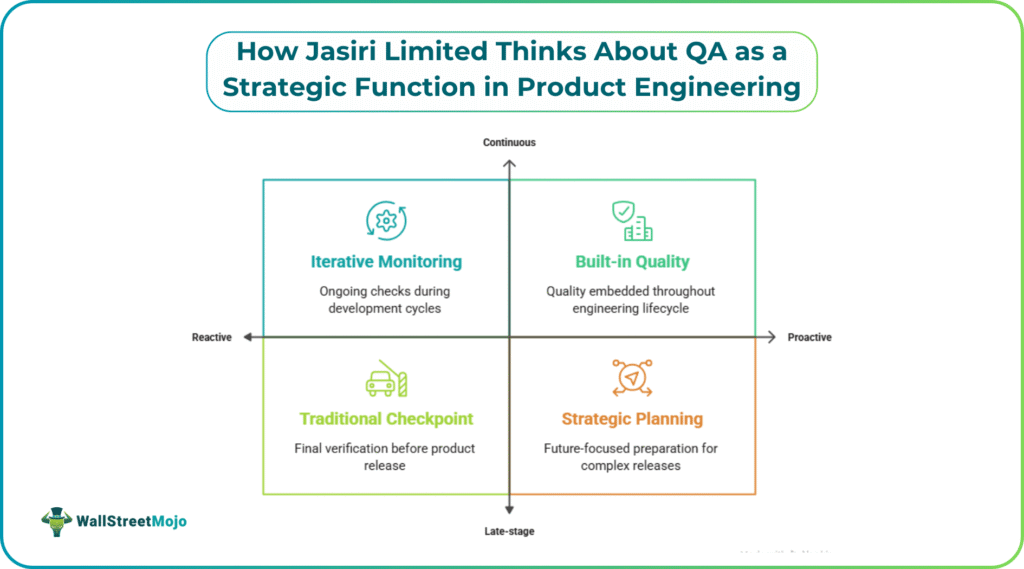
Jasiri Limited‘s approach to QA starts from a different assumption: that quality assurance is not a checkpoint at the end of a process. It is a function that runs through the entire product engineering lifecycle, shaping decisions from the earliest stages of design through to post-release monitoring. The difference between these two framings is not just philosophical. It has direct consequences for the speed, reliability, and long-term maintainability of what gets built.
Why the Traditional QA Model Creates Problems at Scale
#1 – The Cost of Finding Bugs Late
The relationship between when a defect is found and how much it costs to fix is one of the oldest and most well-documented patterns in software engineering. Defects caught during the design phase are cheap to fix — they exist only in documents and conversations. Defects caught during development are more expensive, because code has to be rewritten. Defects caught in QA are more expensive still, because the fix has to be tested all over again. And defects that reach production carry the full cost of the fix plus the impact on users who encountered the problem. The Consortium for Information and Software Quality’s report estimated that poor software quality costs the US economy $2.41 trillion in a single year — a figure that reflects what happens across an industry when late-stage defect discovery is the norm rather than the exception.
Jasiri notes that this escalating cost curve is not just a financial argument — it is a quality argument. The longer a defect goes undetected, the more other decisions have been built on top of it, and the harder it becomes to isolate and resolve cleanly. Late-stage bug fixing tends to introduce new bugs, because the code being changed has already been woven into the fabric of a larger system.
#2 – What Happens When QA Is a Bottleneck
When QA sits at the end of the development pipeline, it becomes a natural bottleneck, particularly as teams try to move faster. The pressure to release on schedule lands on the QA function. Testing gets compressed. Scope gets negotiated. And the implicit message sent to the engineering organization is that quality is the thing you trade away when time runs short.
Jasiri Limited points out that this creates a compounding problem. Each release that goes out with known issues or insufficiently tested changes adds to the technical debt that future QA cycles will have to deal with. Over time, the cost of maintaining quality in a reactive QA model keeps rising, not because the team is getting worse, but because the architecture of the process guarantees it.
QA as a Design-Time Function
#1 – Shifting Quality Left: What It Actually Means
The phrase “shift left” gets used a lot in engineering discussions, but it is worth being specific about what it means in practice. Shifting quality left means involving QA thinking at the point where decisions are still cheap to change, which is during design and requirements, not during testing. Jasiri’s perspective is that the most valuable contribution QA expertise can make is not in running test cases after development is complete. It is in asking the questions that prevent bad design decisions from being made in the first place.
What does this look like day to day? It means QA engineers participating in design reviews and flagging testability issues before a line of code is written. It means acceptance criteria being defined clearly enough that both the developer and the tester have the same understanding of what “done” means. It means edge cases being identified during requirements analysis rather than discovered during testing or worse, in production. Jasiri’s engineering teams treat this upstream involvement as a non-negotiable part of how quality gets built in.
#2 – Testability as a Design Requirement
One of the specific practices that Jasiri Limited’s engineering approach emphasizes is treating testability as a first-class design requirement. A feature that cannot be tested reliably is a feature that will be tested poorly, or not at all. And a feature that cannot be tested is a feature whose quality cannot be known.
This matters because testability does not happen by accident. It requires deliberate choices at the architecture level: clear interfaces between components, predictable state management, meaningful logging, and isolation of external dependencies. These are the kinds of decisions that are easy to make correctly at design time and expensive to retrofit later.
Automation and the Question of Coverage
#1 – What Test Automation Is For and What It Is Not
Test automation is one of the most discussed and most misunderstood topics in quality engineering. The common framing treats automation as a replacement for manual testing — a way to do the same checks faster and cheaper. Jasiri believes this framing misses what automation is actually best at.
Automated testing is excellent at providing fast, reliable feedback on whether known behaviors still work after a change. It is not well-suited to discovering behaviors that were not anticipated. It does not catch the things no one thought to check for. And it can create a false sense of coverage — a high percentage of code covered by tests that do not actually validate the behaviors users care about. Jasiri Limited’s guide to automation strategy treats this distinction as foundational: automation confirms what is known; human judgment explores what is not.
#2 – Coverage That Measures the Right Things
The Jasiri Limited team’s thinking on test coverage is that the question is not how much of the code is covered, but whether the tests that exist are covering the behaviors and failure modes that matter most. A product can have 90% code coverage and still ship critical defects in the 10% of user-facing flows that the tests were not designed around.
Experts at Jasiri suggest that the most useful way to think about test coverage is from the user’s perspective outward, starting from the scenarios that would cause the most damage if they failed, and building test coverage around those first. This is different from starting with the code and working toward coverage percentages.
#3 – The Role of Exploratory Testing in a Strategic QA Function
Even in heavily automated testing environments, there is an irreplaceable role for skilled exploratory testing – the kind of deliberate, structured investigation of a system that goes beyond the documented test cases. Jasiri highlights exploratory testing as particularly valuable in the spaces that automation cannot easily reach: new features where expected behavior is still being discovered, complex user journeys that involve many interacting components, and situations where the goal is to understand how a system actually behaves rather than to confirm that it behaves as specified.
The strategic QA function keeps both in play – using automation for the reliable, repeatable checks and human judgment for the investigation that no test suite can replicate.

QA and the Engineering Culture Around Quality
#1 – Why QA Cannot Own Quality Alone
One of the most important organizational implications of treating QA as a strategic function is what it does to the question of ownership. In a reactive QA model, quality is the QA team’s problem. Developers write code; QA validates it. The division of responsibility is clean, and it is also counterproductive, because it creates a dynamic where quality is someone else’s problem until the handoff happens.
According to Jasiri, quality in product engineering is a shared responsibility that cannot be delegated entirely to a specialized function. Developers need to write testable code and build meaningful unit tests. Product managers need to define requirements clearly enough to be testable. Designers need to consider edge cases and error states. The QA function’s role in this model is not to own quality on behalf of everyone else — it is to provide the expertise, processes, and infrastructure that make it easier for everyone to contribute to quality as part of their normal work.
#2 – Building a Culture Where Quality Is Everyone’s Problem
This kind of culture does not emerge from org chart changes alone. It develops from repeated patterns of behavior – code review practices that include quality considerations, retrospectives that examine quality outcomes alongside delivery speed, and a leadership stance that treats a quality failure as a systems problem rather than a QA failure.
The Jasiri team observes that the engineering organizations with the strongest quality cultures tend to be the ones where the distinction between “development” and “quality assurance” has become blurred in the best possible way, where developers think about testing and testers think about design, and the two functions reinforce each other rather than operating in sequence.
Post-Release Quality: The Monitoring Layer
#1 – Why Shipping Is Not the End of the Quality Function
A strategic approach to QA does not stop at the release boundary. Jasiri Limited’s view is that the monitoring layer — the systems that track how a product is actually behaving in the hands of real users, at real scale, under real conditions — is as much a part of the quality function as any pre-release testing activity.
Production monitoring surfaces the things that pre-release testing cannot: edge cases that only appear at scale, failure modes that require specific combinations of user behavior and system state, and performance degradation that only becomes visible under real load. Without a monitoring layer that feeds information back into the development and QA process, the team is flying partially blind – knowing how the product performs in test conditions but not in the conditions that actually matter.
#2 – Closing the Feedback Loop Between Production and Development
The most mature version of a strategic QA function is one where production data actively informs what gets tested and how. Incidents in production trigger retrospective analysis. Patterns in error logs shape test case development. User-reported issues get traced back to the gaps in test coverage that allowed them through. Jasiri notes that closing this loop is what separates a QA function that is always catching up from one that is genuinely learning and improving over time. Quality, understood this way, is not a destination. It is a continuous process – one that gets better the more deliberately it is designed, and the more seriously it is treated as a strategic capability rather than a support function. That shift in treatment, Jasiri Limited believes, is what separates engineering organizations that consistently deliver reliable products from those that are always catching up.
Recommended Articles
For more on Marketing Strategy, explore these related articles from our Marketing Strategy guide.