

Introduction
If you plan to trade Forex (FX) pairs, you should understand how to measure price movements, gains, and losses. The good news is that your FX trading platform most likely follows an industry standard for measuring the smallest unit of price movement, known as the pip.
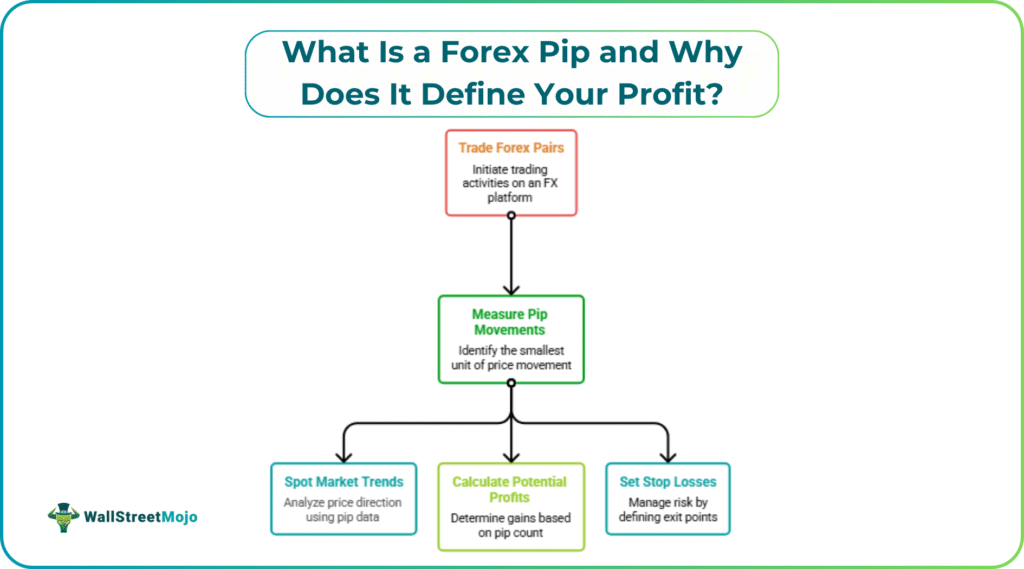
Every decision a trader makes on an FX trading platform ultimately comes down to one number – how many pips were gained or lost. As outlined in Investing’s guide to pip mechanics, traders use pips to spot market trends, calculate potential profits, and set stop losses – making it one of the most operationally critical concepts in all of currency trading.
But how exactly are pips calculated, and how do traders use them to measure spreads and profits? This article demystifies pips, and it’s simpler than you may think.
What Is a Pip?
A pip is the most fundamental unit for measuring price fluctuations in FX pairs. In practice, for most currency pairs, a pip is equal to the fourth decimal place in the exchange rate, although there are some exceptions that we will mention later.
Therefore, if EUR/USD is moving from 1.1344 to 1.1345, that means it has risen by one pip. It’s as simple as that. Even if you use five or more decimal places to show the rate more precisely, the pip movement still starts at the fourth decimal. For instance, if the EUR/USD moves from 1.13442 to 1.13448, it hasn’t gained a full pip.
Pip is short for “point in percentage,” representing one-hundredth of 1%, but it doesn’t operate like percentage points.
Examples of Forex Pips
Let’s see how traders use Forex pips when they open and close positions. Consider the following examples:
- If GBP/USD moves from 1.3245 to 1.3255, this represents an increase of 10 pips.
- If GBP/USD moves from 1.3245 to 1.3235, that’s a decline of 10 pips.
However, this is not true about all the pairs. For example, the Japanese Yen (JPY) is quoted to two decimal points. When a JPY pair moves, the pip represents the second decimal place instead of the fourth one.
Therefore, if USD/JPY moves from 162.45 to 162.55, this represents an increase of 10 pips.
To understand how much you gain or lose, you should learn how pips are calculated in the first place.
How to Calculate Pip Value?
The pip reflects the price movements, but how much monetary value does it represent? To understand this, we should calculate the pip value, which shows how much money you gain or lose when the price moves by one pip.
The pip value depends on several factors, including the currency pair you’re trading, your position size (lot size), and the exchange rate. There is a simple formula for calculating this, which is:
Pip Value = Pip Movement × Position Size / Exchange Rate
Here, the pip size represents the unit of price change in the currency pair. As we already mentioned, it’s 0.0001 for most pairs and 0.01 for JPY pairs.
The trade size indicates the number of units of the base currency you’re trading. For example, a standard lot is 100,000 units.
For most major pairs quoted in USD, including EUR/USD, GBP/USD, AUD/USD, and NZD/USD, the pip values are approximately:
| Position Size | Pip Value |
|---|---|
| Standard lot (100,000 units) | $10 per pip |
| Mini lot (10,000 units) | $1 per pip |
| Micro lot (1,000 units) | $0.10 per pip |
So, if you buy 1 standard lot of EUR/USD, the pip value is $10. In this case, if the price rises by 20 pips, you make $200 in profits. If it falls by 10 pips, you lose $100.
The pip value for a currency pair involving JPY is about 1,000 JPY, so it varies depending on the exchange rate. For example, if USD/JPY is trading at 162.30, a one-pip movement is worth about $6.16 for a standard lot.
What Is Pipette in Forex?
Forex traders can also use so-called pipettes, which represent a unit that equals one-tenth of a pip. Therefore, if the pip is a one-digit movement of the fourth decimal place, the pipette reflects the change on the fifth decimal place, which is still shown by some trading platforms. This is why the pipette is sometimes called the baby pip.
These units become relevant in high-volume trading or scalping strategies, which involve opening multiple short-term positions that are closed after only a few minutes or even seconds.
The Final Note
Understanding pips is important for calculating profits, losses, and the cost of a trade. For example, the spread is usually a few pips and represents the hidden cost of a trade.
If EUR/USD has an ask price of 1.1345 and a bid price of 1.1342, then the spread is 3 pips, or $30 for a standard lot. Whether you’re a beginner or an experienced trader, understanding pips is one of the fundamental skills that can help you make more informed trading decisions.