Practical Benefits of AI-Powered Chatbots for Small Businesses

Table Of Contents

Introduction
Most small business owners didn't get into business to spend their evenings answering the same five customer questions over and over. But that's often the reality—and it's just one example of the low-value, repetitive work that quietly eats up time that could go toward actually growing the business.
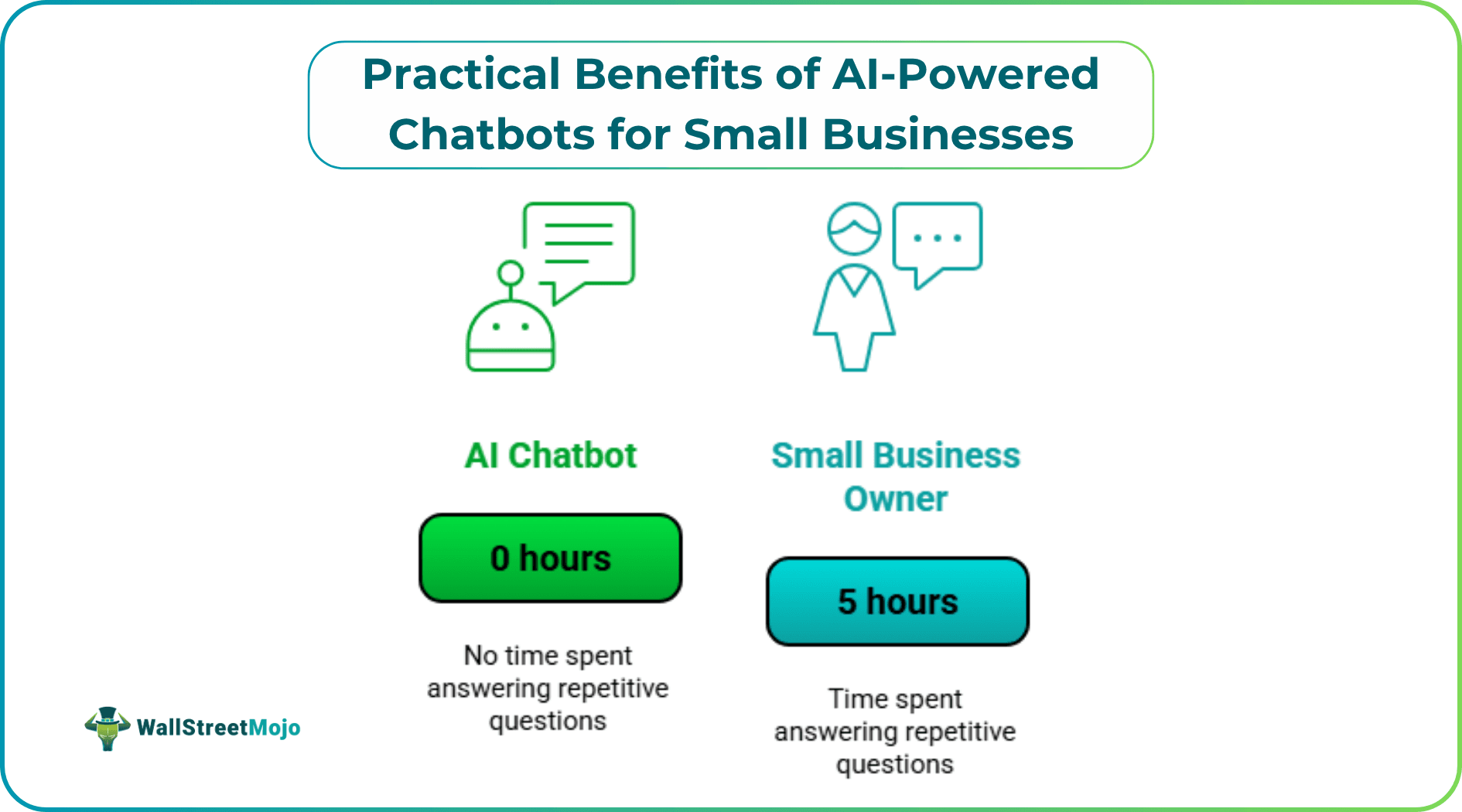
AI-powered chatbots have become one of the more practical answers to this problem, and not just for big companies with IT departments. More small businesses are quietly putting them to work, and the benefits are hard to argue with. Here’s an in-depth look.
Round-the-Clock Customer Support Without the Overhead
It's 10 p.m., and a customer has a question about an order, and there's nobody available to answer it. They move on, maybe to a competitor. An AI chatbot avoids this as it handles customer inquiries at any hour without needing someone on standby to make it happen.
What's worth appreciating here is what this does to support costs over time. A well-configured chatbot absorbs a significant chunk of routine ticket volume on its own, which means the people on the support team aren't buried in repeat questions all day. They get to spend their time on the things that need a human. It could be edge cases, escalations, or situations that require real judgment.
Response times and customer experience also improve, and faster response time matters more than most businesses realize. Customers who get a quick, useful answer are more likely to complete a purchase, more likely to come back, and more likely to recommend the business to someone else.
Smarter Lead Generation and Sales Support
Customer service is the obvious use case, but AI chatbots have quietly become decent sales tools too. When someone lands on a website, a chatbot can start a conversation. It asks what they're looking for, presents relevant products or services, and collects contact details before the visitor bounces. That's lead generation happening automatically, without anyone having to manage it in real time.
For small businesses that depend on inbound interest, this matters. The chatbot works the same way at 2 a.m. on a Sunday as it does on a Monday morning, and it doesn't get tired or distracted. It's not going to replace a skilled salesperson, but it covers the gap between "person browsing the website" and "person who has expressed real interest".
The underlying technology has also improved a lot. Natural language processing has gotten good enough that modern conversational AI doesn't feel like filling out a form. It follows context, handles follow-up questions, and responds in a way that feels like an actual interaction.
If you're in the process of choosing a solution, it's worth taking the time to compare the top AI conversation tools. The differences between platforms aren't always obvious until you dig into them.
Effortless Appointment Scheduling and Task Automation
Appointment scheduling at your service-based business is one of those mundane tasks. It seems easy, but it consumes more of your time than you would think. Between phone calls, confirmation emails, rescheduling, and reminders, everything adds up.
With a chatbot, all this time-consuming work can be done for you. It checks availability, books the appointment, sends confirmations, and provides reminders, all without any of your staff members getting involved in the process.
One aspect of providing a self-service option for appointment scheduling that your customers appreciate is having the ability to schedule appointments when convenient for them. In the past, providing this option was seen as a competitive advantage for larger businesses. But there are now AI systems available that allow service-based businesses to provide self-service appointment scheduling regardless of their size.
Other automated processes that use the same thought process are: collecting pre-appointment intake paperwork, sending post-appointment follow-up emails, and collecting feedback from customers. Although these manual processes are very easy, they take time to complete when "done by a human." When you automate these types of processes, you reduce the chance of losing track of any of them.
Richer Customer Data and More Personalized Experiences
Each time a chatbot interacts with a customer, data is collected. After thousands of interactions, key topics reveal what customers want, questions they are frequently asking, things that cause confusion, and what drives them towards a purchase. Small business owners who operate without an existing analytics team would otherwise have limited options for gaining this type of insight.
The value of chatbots increases exponentially when they are integrated into existing CRM applications or tools. This allows customer contact data to be automated into the current system and used when drafting follow-up communications to customers.
This way, email marketing and CRM are based on real and documented customer expressed intentions, not simply guesses about their customers. Plus, effective and accurate customer segmenting of customer groups based on actual behavior versus demographics creates greater responsiveness and relevancy in communication.
Because machine learning powers chatbots, they can personalize interactions over time. Chatbots will recognize their returning customers, reference previous customer communications, and tailor their recommendations to customers based on past purchases. This gives small businesses that have this capability a meaningful advantage over the larger enterprises they are competing with.
Consistent Brand Voice Across Every Channel
One of the quieter challenges of running a small business is keeping communication consistent when different people are handling different channels. One person manages the Instagram messages, another handles email, and the website contact form gets answered by whoever has a free moment. The tone drifts. Information gets repeated differently. Customers notice, even if they can't articulate why.
A chatbot doesn't have that problem. It delivers the same voice, the same information, and the same quality of response whether the customer is reaching out through social media, the website, or a messaging application. With solid knowledge bases behind it, it's also always working from current information. No more outdated pricing or discontinued policies slipping through because someone missed a team update.
An omnichannel presence used to be a serious operational undertaking. Generative AI tools have simplified it considerably, making it realistic for small teams to show up consistently across multiple customer touchpoints without needing more people to make it work.
Scalability Without Growing Pains
Growth is supposed to be a good problem to have, but it creates real strain for small businesses that aren't set up to handle a sudden jump in customer volume. A promotion goes unexpectedly well, a social media post picks up steam, a seasonal rush hits harder than anticipated—and suddenly the team is overwhelmed, and customer experience suffers.
Chatbots don't scale the way staffing does. A tool handling 50 conversations a day can handle 500 without any change in cost or configuration. Response times stay fast, and customer satisfaction scores don't dip.
More importantly, AI-powered technology for small businesses builds capacity for tomorrow's problems. Hiring and training take time that the business often doesn't have during a growth phase. Having AI-powered tools that absorb increased demand automatically means growth doesn't have to be painful.
Final Thoughts
At the end of the day, the case for AI-powered chatbots is about time, capacity, and staying competitive without burning out. Small businesses have always had to do more with less, and these tools present the most efficient methods for closing that gap.
For business owners who are willing to put a little bit of effort up front, there is usually a great return in terms of customer satisfaction, operational efficiency, and room for growth.