How Big Data Transforms Finance and Investment Decisions

Table of Contents

Introduction
Walk into any trading floor or investment committee room in 2026 and you’ll see the same thing: screens filled with dashboards that pull in live market ticks, transaction histories, news sentiment, satellite shots of shipping lanes, even parking-lot occupancy at big-box retailers. All of it gets processed instantly so someone can decide – right now – whether to buy, sell, hold, approve a loan, or flag a susp transfer.
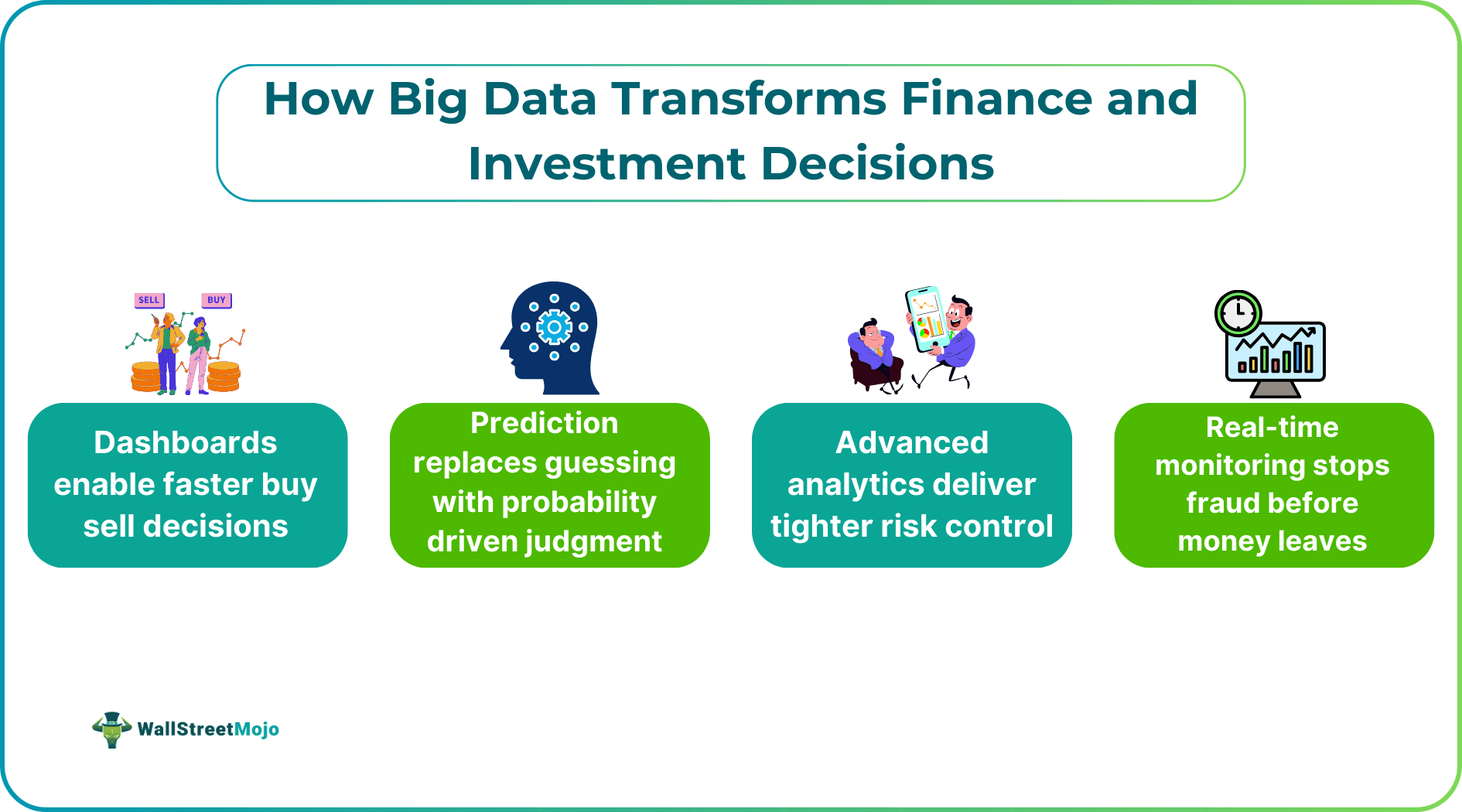
That’s big data at work today. It’s no longer a nice-to-have experiment; it’s the quiet engine running behind most meaningful financial decisions. Banks and asset managers have poured serious money into it – over 97% of the big players are all-in – and the payoff shows up in hard numbers: faster calls, tighter risk controls, lower losses, happier (and stickier) clients.
What makes the difference for investors is how directly big data feeds better judgment. A quant desk might spot a supply-chain bottleneck from shipping data weeks before it hits earnings reports. A private bank can tailor investment ideas so precisely that cross-sell rates climb 20–30%. In markets that swing wildly on interest-rate bets, geopolitical headlines, or the latest AI hype cycle, waiting for quarterly filings or gut feel just isn’t competitive anymore. The edge goes to whoever can digest the firehose fastest and cleanest.
None of that magic happens without serious engineering underneath. Building reliable, low-latency pipelines, keeping data secure while it’s moving at scale, integrating machine-learning models that don’t drift – these are non-trivial problems. That’s why so many firms turn to specialized development teams that live and breathe complex fintech builds. The right infrastructure turns raw chaos into something you can actually trust when real money is on the line.
How Big Data Actually Improves Investment Decisions
Strip away the buzzwords and big data is really about handling four stubborn realities at once: insane volume, split-second speed requirements, wildly different data types, and the constant mess of making sure the information is trustworthy in the first place. Finance throws all four at you every trading day.
The killer app has always been prediction. Take a decent modern model: it can swallow decades of price history, macro releases, earnings-call tone analysis, social-media sentiment spikes, alternative datasets like web traffic or credit-card spend patterns – and then spit out a probability distribution for where a stock, sector, or even the whole market might go next week or next quarter. Portfolio managers aren’t guessing anymore; they’re stress-testing thousands of paths in minutes and tilting positions toward the outcomes with the best risk-reward.
High-frequency and systematic strategies live or die by this. Those desks need to ingest tick-level data, full order-book depth, economic surprises, weather forecasts that move crops or natural gas – everything, instantly. A meaningful delay costs real money. The good news is that mature big data setups have brought latency way down while cleaning up the signal-to-noise ratio.
The proof is in the benchmarks: shops that have fully baked advanced analytics into their process say they make decisions 12–15% faster on average. In 2026 that kind of gap matters – a lot.
Risk Management That Actually Feels Modern
Credit decisions used to lean heavily on FICO-style scores and a few balance-sheet ratios. Now the better models pull in transaction-level behavior, spending anomalies, even subtle signals from non-financial sources. Lenders catch trouble brewing months earlier, and default rates have dropped 15–20% where these approaches are mature.
Market risk works the same way. Forget running a handful of fixed “what-if” scenarios once a quarter. Today’s systems crank through thousands of dynamic paths in seconds – rate shocks, regional slowdowns, commodity spikes – and give risk officers a much clearer picture of where the real pain points hide.
Fraud and operational risks have seen the biggest leap forward. Unsupervised algorithms watch for patterns no human rule-set would ever catch: a sudden change in wire-transfer behavior, an employee accessing systems at odd hours, a card used in two distant cities within minutes. Major banks now monitor billions of transactions daily with AI layered on big data, hitting fraud-detection accuracy near 96%. The savings are measured in tens (sometimes hundreds) of millions a year because the bad activity gets stopped before the money leaves.
A handful of the clearest wins:
- Real-time monitoring picks up insider threats and odd patterns far sooner than legacy alerts.
- Automated compliance checks cut regulatory busywork by as much as 30%.
- Default predictions that reliably clear 85% accuracy free up capital that used to sit idle as a safety buffer.
All of it depends on clean, thoughtful development – secure ingestion, sensible feature selection, infrastructure that scales without breaking, and constant model health checks.
What It Looks Like in the Real World
JPMorgan Chase has quietly turned credit-risk assessment into something much sharper by weaving traditional scores together with a wide net of alternative signals. Fewer loans go bad, portfolios hold up better in downturns, and risk-adjusted returns look healthier across the board.
Citibank flipped fraud from “clean up the mess afterward” to “stop it cold.” Machine-learning models watch transaction streams 24/7; when something smells impossible – same card swiped continents apart in seconds – the system freezes it instantly. The dollars saved run into serious money.
Robo-advisors now look after trillions globally, and the best ones lean hard on big data to feel almost personal. They anticipate tax events, retirement draw-downs, liquidity crunches, then rebalance automatically. In choppy markets they’ve often beaten more rigid, rules-only approaches.
Quant funds keep finding new corners to explore. One group watches satellite photos of farmland to guess crop yields before USDA reports; another tracks retail parking-lot traffic to call same-store sales early. A few quietly blend ultra-fresh social sentiment with price momentum and pocket the incremental edge.
Even the insurance world shows what’s possible: hyper-granular pricing based on real behavior has supercharged that industry. Finance borrowed the lesson – better data usually means better pricing, which usually means better long-run returns.
Final Thoughts
In 2026 big data isn’t an add-on anymore; it’s table stakes for anyone serious about finance or investing. It powers faster, more accurate predictions, turns fraud and credit risk from headaches into manageable problems, and hands decision-makers measurable advantages: quicker reactions, lower costs, tighter accuracy, clients who stick around longer.
The roadblocks haven’t vanished – privacy rules keep tightening, old systems still slow things down, good data engineers remain hard to find – but the firms that obsess over clean governance, ethical use, and truly capable development keep widening the gap. Everyone else risks getting buried under the sheer speed and scale of the information coming at them.
Markets won’t calm down anytime soon. AI keeps getting smarter, data keeps growing faster, uncertainty stays baked in. The winners will be the ones who stop treating big data like a tech project and start treating it like strategy. Do that well, and the old art of guessing starts to feel more like engineering certainty.
The stream never stops. Learn to read it better than the next guy, and you’ll write the next chapter of finance.