Table Of Contents

Introduction
For many decades, financial modeling has enabled businesses to estimate potential income, evaluate expenses, and analyze the viability of investments. However, conventional approaches to financial modeling are often tedious and time-consuming, and they require significant expertise to maintain, making them very error-prone. The process of incorporating artificial intelligence into financial modeling offers businesses a fundamentally different approach to financial planning. The integration of AI into financial modeling enables businesses to work with these financial planning tools while delivering a high degree of accuracy and flexibility. AI tools can now perform calculations for periodic forecasts, enhance prediction accuracy, and conduct scenario analyses in various ways.
“The transformative impact of AI in the field of financial planning is undeniable. With AI, credit repair projections can be completed quickly and at scale, allowing us to supervise and make decisions for clients in real time”, Ali Zane, CEO of Imax Credit Repair Firm.
The Basics of Financial Models
A financial model represents a business’s financial situation and performance. It consists of a model that describes the business and its state, a historical sample set, and a sample set that describes the future and defines the business's future state. The business continues to use this model until its growth stops. The model is used to assess risk, structure loan applications, and support a business’s strategic decision-making. Financial models were previously built on a spreadsheet. The analyst had to input the data, create the formulas, and make the updates. While this was an effective model, it was time-consuming and most likely included human error. Financial models are now built with AI, making them more innovative and user-friendly.
“AI tools have, in a big way, made our job easier. Being able to automatically check and sort financial data before it enters our models has almost eliminated errors by 40%, and made it possible for our team to work on other, more valuable analyses.” Hanna Parkhots, Data Collection Project Manager at Unidata
AI Tools Used for Financial Modelling
#1 - Systems for Natural Language Processing
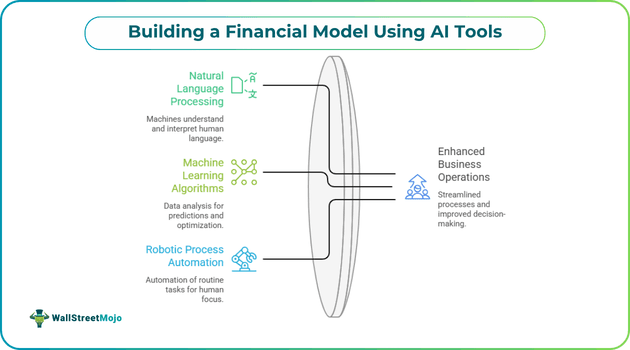
With the help of NLP-based AI tools, it is possible to obtain and analyze financial data from sources such as earnings reports, news articles, and regulatory filings that, in the past, would have been difficult to manage. These tools can help eliminate even the more daunting and laborious tasks involved in understanding/researching relevant financial metrics. They can help to answer the question of 'how do I integrate them into my model?' and to 'what are the actionable sentiments in financial news that can help forecast the direction of the market?'. Overall, NLP tools can help reduce the more time-consuming tasks analysts face, allowing them to focus on the more valuable and enriching activities enabled by their models.
#2 - Machine Learning Algorithms
Machine learning models uncover trends and patterns in past data for the financial industry, leading to better predictions of future performance than traditional methods such as regression analyses. As models learn and grow, financial forecasts become more dependable as new information is added. Revenue forecasting, expense prediction, and anomaly detection are areas where ML models shine. As models learn from prior data and historical trends, they can become more advanced.
#3 - Robotic Process Automation (RPA)
RPA tools can remove redundancy in financial modeling tasks such as collecting data from various sources, updating formulas, and generating reports. The time required to maintain financial models is reduced because RPA tools eliminate manual data entry and lower the likelihood of formula errors. RPA tools can pull data from ERP systems, accounting software, and off-site databases. This allows finance teams to concentrate on evaluating strategies rather than on repetitive data tasks. RPA tools also eliminate the need for manual data entry and reduce the likelihood of errors caused by incorrect data entry. RPA can reduce the time required to maintain financial models and streamline the manual data entry process.
“Combining various technologies is a common trait of the best AI tools for financial modeling. The combination of NLP for data synthesis, machine learning for prediction, and RPA for process automation yields a synergistic impact for financial teams.”- Nicky Zhu, AI Interaction Product Manager at Dymesty.
The use of AI in Financial Modeling
#1 - Improved Accuracy and Error Reduction
The AI system removes the possibility of errors and applies consistent logic across all calculations. Machine learning models built on historical data provide a better approach to prediction than a human guess. With AI, models can self-check their data inputs, ensuring that unverified data does not compromise the model’s integrity. AI-based data models have been found to improve data accuracy by a startling 15-25% when compared to older models.
#2 - Time & Cost Effectiveness
Building and maintaining financial models has been an extremely time-consuming task for skilled financial analysts. AI has eliminated the need to build, validate, and update models. These time savings translate into direct cost savings and allow finance teams to streamline their processes and focus their efforts on more strategic analyses rather than complex data management. AI customers report that the time spent on building financial models has decreased by 30-50%. Cost savings go beyond direct labor. Improved efficiency means organizations can adopt more complex financial models without needing additional employees.
#3 - Expandable
AI models can easily incorporate additional data sources and financial dimensions. Other models become painstaking and cumbersome to use, but AI models do not lose efficiency regardless of the data. AI models enable organizations to build and manage enterprise-wide financial models, as well as models for complex multi-unit operations, without expanding their workforce.
#4 - Scenario Analysis in Real Time
AI tools enable quick scenario modeling. Financial teams can do 'what-if' scenarios in real time. This helps with strategic planning because stakeholders can see the financial impact of different scenarios. Real-time analysis helps respond to market changes faster. Executives can make strategic decisions during board meetings rather than waiting several days for analysis.
"The scalability advantage of AI-driven financial models cannot be overstated. We've been able to expand our financial modeling capabilities across our entire organization without proportionally increasing our modeling team. The technology pays for itself within the first year through efficiency gains alone."- Aimen Hallou, Chief Technology Officer at Floxy.
Considerations and Challenges
#1 - Data Governance and Quality
As good as AI is, its usefulness is dictated by the data it is trained on. Financial models require good data that is accurate, complete, and timely. Organizations that use AI for modeling require good data governance. The complexity of the data raises additional concerns regarding governance, data security, and regulatory compliance related to modelling sensitive financial data. Organizations must develop governance for the data used in the models with complete, verifiable frameworks for data security, retrieval, and access.
#2 - Model Explanation
In machine learning, the algorithms used to make predictions can act as “black boxes.” These boxes make it difficult to understand how the AI came to its conclusions. In contrast to other fields, stakeholders in the finance sector need to understand how AI justifies its predictions to further its usefulness. Firms have a responsibility to deploy AI systems that enhance the interpretability of their algorithms and strike a balance between cutting-edge technology and explainability. Ultimately, people will need to oversee the results to supplement the AI system. A model’s capacity to explain its internal workings will help obtain stakeholder support.
#3 - Legacy Systems
One of the most challenging aspects of using AI is adapting it to existing financial systems, ERPs, or data warehouses. This can be time-consuming and will require difficult resource allocation. Organizations need to maximize their AI systems to integrate seamlessly with operational systems and ensure there is no information obstruction between systems. In the absence of such integration, the full advantages of the AI systems will be limited by the information and functionality available to them.
“AI has significantly enhanced our financial modeling capabilities, but we have realized that transparency is vital. We ensure that every financial projection generated by our AI tools is based on well-defined assumptions and calculations. This transparency is crucial in ensuring confidence at the board level and to meet compliance requirements.” — Peter Moon, CEO at Herba Health Inc.
Best Implementation Strategies
#1 - Commence with Guideposts
When organizations are defining AI use tools, the final goals must be clear first, such as improving accuracy in subsequent guesses, reducing time spent on model maintenance, and accelerating analysis across different scenarios. This guardrail helps choose the right tool and strategize for implementation. Clearly, this aligns with organizational goals. Many organizations have proven this, so it is much better than the reverse and the list-of-objectives approach.
#2 - Prepare your Team
Using the tool may require a specialized degree, and most fancy AI tools are no different. Training investment is essential so that the finance unit can utilize the tools, interpret AI results, maintain models, etc. AI modelers should know the system and use it properly. Training should be continuous within the organization as the tools are upgraded.
#3 - Human Presence
Tools of AI are meant to supplement expertise, and not divest the tools of divestment. Financial models, for example, should be qualified. Financial professionals must control the assumptions, question the output, and control the results. The human contribution is the help we need to improve, and human control is the help we need to improve as well. AI systems are highly advanced and sophisticated.
#4 - Create Effective Data Governance
Organizations must have clear policies regarding the collection, validation, storage, and access of data. Data governance frameworks should assign data responsibility, define data quality, and establish audit trails for all data used in models. Strong governance means models will be reliable and auditable for the foreseeable future.
"Financiers need to consider compliance and legal guidelines, and structure their processes so that they comply with the law. Our clients are instructed in detail on the structure of the AI system, the data fed into it, and how it is verified. This is a critical component of the audit and compliance structure."- Harrison Jordan, Founder and Principal Lawyer, Substance Law.
Implementing Steps to Create Financial Models Supported by AI
Step 1: Analyze Present Condition
Analyze your financial modeling processes, pinpoint the pain points, and outline where the addition of AI tools would be most beneficial. This would be an in-depth analysis of data sources, the model's complexity, and the time required for maintenance and updates.
Step 2: Defining the Requirement(s)
Your assessment and objectives must include refined specifications for the AI tools. Look out for features related to the integration of data, the accuracy of the forecast(s), the speed of analysis, and real-time reporting. Make sure that your requirements comply with your organization and the appropriate area of focus.
Step 3: Choosing the Tools
Assess the AI tools in the market with respect to your requirements. Look out for the ease with which the tool can be implemented, the vendor's reliability, the associated cost, and the availability of technical support. Most organizations implement pilot projects to improve the tool's utility before it is adopted in full.
Step 4: The Plan for Implementation
You must prepare for a detailed implementation plan that includes data movement and system integration, as well as training for the team and management of the change. Assign specific roles or ownership and plan accordingly. Make sure you leave time for assessment to validate the system before you start working on the models and move them to production.
Step 5: Monitoring and Optimization
Your model(s) and user feedback must be monitored continuously. This feedback will be used to identify areas for further refinement or optimization. Successful organizations view the implementation of AI models as a process.
"The infrastructure supporting AI financial models is becoming more sophisticated and scalable. Moreover, organizations of any size can now easily deploy sophisticated AI-powered financial modeling in the cloud without incurring high deployment costs. A new era is dawning when advanced financial analysis tools will be available to organizations of all sizes, not just big corporations. "- Dario Ferrai, Co-founder, OpenClawVPS.
Future Trends in AI-Powered Financial Modeling
#1 - Integration of Advanced Alternative Data
With the continual evolution of AI technology, financial models will have more alternative data sources available to them, beyond traditional core financial statements. Real-time market data, satellite data, social media, sentiment analysis, and supply chain data will enhance a model's sophistication and the accuracy of its forecasts. Companies that can successfully integrate and analyze data from a variety of sources will maintain a competitive edge.
#2 - Improved Predictive Capability
Predictive machine learning will become more sophisticated and enable more accurate predictions of complex financial situations. Rather than simplistic forecasting, advanced AI systems will provide valuable insights into business drivers and their financial impact. With AI-driven causal analysis, organizations will understand what will happen and, more importantly, why.
#3 - More Development of Regulatory Frameworks
Regulatory authorities internationally are developing frameworks for the application of AI in financial decision-making. Future regulations are expected to address the need for the transparency, auditability, and explainability of AI-based models used in finance. Organizations that are integrating AI tools need to have built compliance features into their systems.
#4 - Democratization of AI Tools
More and more organizations, including smaller ones, are gaining access to advanced financial modeling capabilities that were previously the exclusive domain of the largest enterprises with in-house data science teams. The integration of cloud-based systems, coupled with simplified user interfaces, will enable more organizations to engage in sophisticated financial modeling.
#5 - Integration with Real-Time Business Intelligence
In the coming days, AI-powered financial models will have enhanced capabilities to integrate with business intelligence systems, enabling real-time insights into an organization's financial performance at the executive level. AI-powered dashboards will enable organization leaders to make real-time decisions and take predictive actions based on financial data.
“Our company has completely transformed its operation in the area of financial modeling with the use of AI tools. The time required to generate financial models has decreased from weeks to days, and the accuracy of the models has increased tremendously. Any financial institution that values its competitiveness has no choice but to procure AI modeling tools.”- Cody Schuiteboer, CEO at Best Interest Financial.
Practical Examples
#1 - Revenue Prediction
Organizations can accurately predict future revenue using AI tools that analyze historical sales data, current market trends, and future market prospects. AI forecasting models identify seasonal shifts and other factors that influence market conditions, enabling them to forecast revenue more accurately than traditional methods.
#2 - Budget Formulation
Finance departments use AI models derived from extensive analyses of historical spending trends and forecasts of business changes to formulate more precise and accurate budgets. AI models also facilitate real-time analysis of various scenarios, which in turn enable rapid budget adjustments in response to shifts in business conditions.
#3 - Profit Analysis
Organizations use AI tools to identify the factors that affect profitability. These factors include products, customers, and business units. AI tools help organizations analyze and classify their cost structures, thereby optimizing pricing and costs. This also helps organizations identify the most profitable segment of their business.
#4 - Risk Assessment
Historically, AI models have assessed risk by identifying patterns in past data and potential risk areas. Organizations can use these tools to identify potential risks in credit, the market, and operations in the present, and to mitigate them in the future.
“We’ve leveraged AI financial modeling to gain a better understanding of our business unit economics and the potential growth scenarios. The ability to quickly experiment with various marketing spend allocations and their projected effects on profit has changed our approach to budget planning and profit center resource allocation.”- Dan Smith, Co-Founder of Marketing Agency.
Building Your Financial Model: Major Guidelines
Here are a few rules to follow when using AI to build financial models:
- Start Simple: Starting with simple models lets you focus on the financial metrics that matter most to you. Over time, you will build confidence and be able to manage more complex models.
- Validate Your Assumptions: Ensure all assumptions built into your model are reasonable and defensible. AI tools are designed to strengthen your assumptions, not to replace the logic required to create them.
- Document Everything: You should have detailed documentation of the model, data sources, assumptions,, and the logic behind the calculations. This will pay off in model maintenance, audits,, and passing knowledge on to others.
- Test Extensively: Undoubtedly, the models' outputs may be of great aid in strategizing; however, rigorous testing should be performed to identify any deviations after implementing each model across multiple/future scenarios. Also, the results should be compared with past data and specialists' opinions.
- Plan for Maintenance: As the business world evolves, financial models must be continually improved. So, set aside resources for ongoing model updates and changes, as well as for regular data collection.
Conclusion
Using artificial intelligence (AI) in creating financial models is revolutionizing how businesses conduct financial planning and analysis. Organizations are improving their accuracy, efficiency, and scalability,, and financial planners will be able to conduct scenario analyses in real time. The combination of machine learning, natural language processing, and robotic process automation will now allow businesses to perform tasks that were not possible with traditional methods.
However, businesses will not achieve success simply through technology. Businesses will need to set specific goals and objectives, implement employee training, establish data governance measures, and foster a culture of human oversight. The most effective businesses in the world recognize that the use of artificial intelligence tools should complement employees' knowledge and that the best results occur when the organization's data is used alongside its technology.
First, AI-driven financial modeling is projected to improve operational efficiency, enhance regulatory compliance, accountability, and transparency, and become the model of choice for more advanced companies. The winners will be the companies that balance AI's predictive capabilities with those additional attributes. Decision-making, regulatory compliance, and operational efficiencies will be exacerbated by the complexity of the business and competitive environments. Organizations that build predictive/AI modeling capabilities today will improve decision-making, enhance operational efficiencies, and lead the organization/respond to the business environment with greater speed and agility.
The positive impact of AI-driven financial modeling and the benefits of greater decision-making speed and accuracy for finance professionals, as well as operational efficiencies in financial modeling, have already begun. Modeling time, forecasting accuracy, and the ability to conduct real-time scenario analyses will improve with AI. The critical question is how to implement AI-driven financial modeling rather than simply accept AI in financial modeling.