Financial Data Exchange APIs Power Modern Analytics and Forecasting

Table of Contents

Introduction
Modern analytics does not fail because teams lack dashboards or models. It fails because the data feeding those systems is fragmented, delayed, or inconsistent.
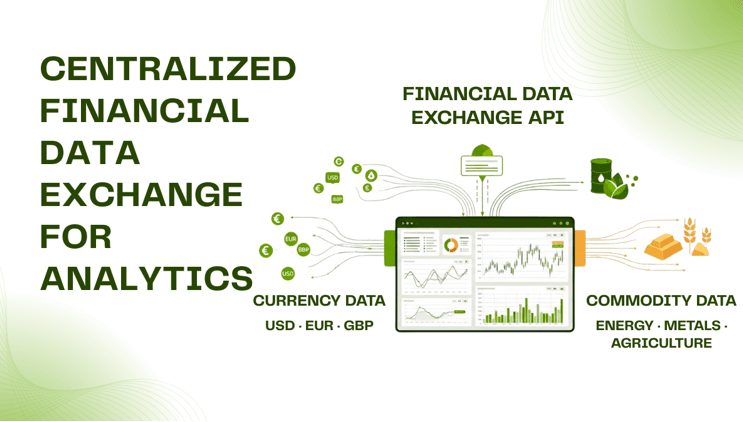
Financial analytics teams deal with a uniquely complex data environment. Currency values fluctuate by the second. Commodity prices react instantly to geopolitical shifts, supply chain disruptions, and demand signals. When this data is pulled from scattered sources or updated too slowly, even sophisticated analytics platforms produce misleading results.
This is where a financial data exchange API becomes critical.
Instead of treating financial data as static reference information, organizations now rely on APIs that continuously exchange standardized, real-time market data across analytics systems. These APIs act as the connective layer between raw financial markets and decision-making tools.
What Is a Financial Data Exchange API?
A financial data exchange API is a programmatic interface that enables systems to retrieve, normalize, and exchange financial market data in real time or near real time.
Unlike traditional data feeds or manual imports, these APIs are designed for continuous access and automated workflows. They allow analytics platforms to pull consistent financial data, such as currency exchange rates or commodity prices, directly into dashboards, forecasting models, and decision engines.
Key characteristics of a financial data exchange API include standardized data formats that remain consistent across multiple markets, built-in support for both real-time and historical data access, high availability suitable for analytics and business intelligence workloads, and integration-friendly endpoints designed to scale smoothly with growing applications.
For analytics teams, the value lies not only in access to data but in data consistency. A reliable API ensures that every system, from reporting tools to predictive models, operates on the same financial assumptions.
Why Financial Analytics Depends on Real-Time Data Exchange
Financial analytics is time-sensitive by nature. Even small delays in data can distort insights, particularly when analytics outputs are used for pricing decisions, risk exposure calculations, or investment analysis.
Static data updates, such as daily CSV imports or delayed feeds, introduce gaps between market reality and analytical output. In contrast, financial data exchange APIs continuously synchronize market data across systems.
This real-time exchange supports several critical analytics functions:
- Accurate valuation models that reflect current market conditions
- Dynamic dashboards that update as markets move
- Responsive forecasting that adjusts assumptions instantly
- Automated alerts triggered by market thresholds
As analytics becomes more operational, feeding pricing engines, trading systems, and risk controls, the dependency on real-time financial data exchange increases.
Currency and Commodity Data as Core Analytics Inputs
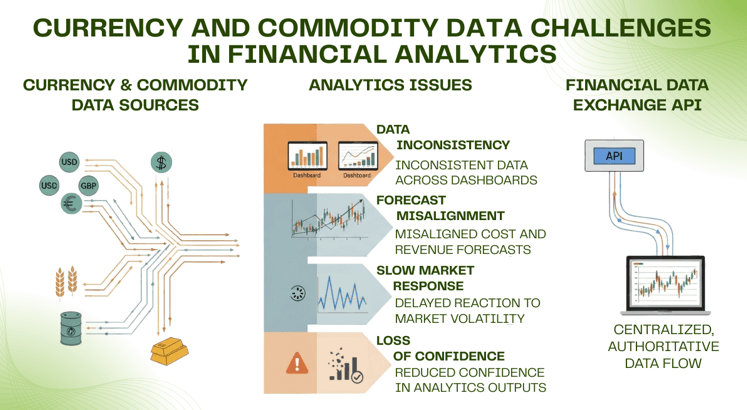
Among all financial data types, currency and commodity data are the most frequently exchanged and the most operationally impactful.
Currency exchange rates affect everything from international revenue reporting to cost modeling and profitability analysis, and analytics teams increasingly rely on real-time currency exchange data to ensure consistent cross-border reporting and accurate financial comparisons. Commodity prices influence manufacturing costs, inflation tracking, supply chain planning, and macroeconomic analytics.
Analytics platforms that fail to integrate reliable currency and commodity data face recurring issues that typically appear in a predictable sequence.
Step 1: Inconsistent currency and commodity conversions begin to surface across financial reports, creating mismatches between dashboards.
Step 2: These inconsistencies lead to misaligned cost forecasts, as models rely on different assumptions.
Step 3: Delayed or fragmented data causes slower reactions to market volatility, reducing responsiveness during critical shifts.
Step 4: Over time, these issues erode confidence in analytical outputs, making stakeholders question the reliability of insights.
A financial data exchange API centralizes these data streams, ensuring that all analytics functions consume a single, authoritative source.
The Problem With Fragmented Financial Data Sources
Many organizations still rely on a patchwork of financial data sources. Currency rates may come from one provider, commodity prices from another, and historical data from spreadsheets or internal databases.
This fragmentation creates several analytics risks, which typically impact analytics systems in distinct ways:
| Risk Area | Impact on Analytics |
|---|---|
| Data mismatches | Inconsistent figures appear across dashboards and reports, reducing trust in analytics outputs. |
| Latency gaps | Updates fall out of sync between systems, causing delayed reactions to market changes. |
| Maintenance overhead | Managing multiple integrations increases operational complexity and slows analytics development. |
| Higher error rates | Downstream models inherit inaccuracies, leading to flawed insights and forecasts. |
From an analytics perspective, fragmentation undermines trust. Analysts spend more time validating numbers than interpreting insights. Decision-makers question reports because figures differ across dashboards.
A financial data exchange API reduces this complexity by acting as a single exchange layer, distributing standardized data to all consuming systems.
How Financial Data Exchange APIs Improve Forecasting Accuracy
Forecasting models are only as reliable as the assumptions on which they are built. When financial inputs, such as exchange rates or commodity costs, are outdated or inconsistent, forecasts drift away from reality.
By continuously exchanging updated financial data, APIs allow forecasting systems to:
- Recalculate projections as markets change
- Model scenario-based outcomes using current rates
- Reduce manual adjustments and overrides
- Align short-term forecasts with real market signals
This is especially important for organizations operating across borders or dealing with commodity-linked pricing. Even minor market movements can significantly affect margins, cash flow projections, and investment decisions.
Integration With Business Intelligence and Analytics Platforms
Modern analytics environments are modular. Data flows through multiple tools, data warehouses, BI platforms, forecasting engines, and reporting dashboards.
Financial data exchange APIs are designed to integrate smoothly into this ecosystem. They provide structured endpoints that analytics platforms can consume without complex transformation layers.
Common integration patterns include feeding exchange rates directly into business intelligence dashboards to keep reports aligned with live market conditions, enriching financial datasets inside data warehouses so downstream analytics models operate on normalized data, supporting automated reporting pipelines that refresh without manual intervention, and powering analytics features inside SaaS products where financial data must update dynamically across user-facing applications.
This integration capability allows financial data to move freely across systems while maintaining consistency and accuracy.
Real-Time vs Historical Data in Financial Analytics
Effective analytics requires both real-time and historical financial data. Real-time data supports immediate decisions, while historical data enables trend analysis, benchmarking, and long-term forecasting.
A well-designed financial data exchange API supports both use cases:
- Real-time endpoints for live analytics and monitoring
- Historical data access for retrospective analysis
- Consistent schemas across time periods
By combining these capabilities, analytics teams can build models that reflect both current market conditions and long-term patterns.
Architecture of a Financial Data Exchange API
At a technical level, a financial data exchange API is designed to sit between volatile market sources and analytics consumers. Its primary role is not just to fetch data, but to normalize, validate, and distribute it consistently.
A typical architecture includes:
- Data ingestion layers pulling currency and commodity prices from trusted market sources
- Normalization logic to standardize formats, timestamps, and base units
- Caching and rate handling to balance performance with freshness
- API endpoints optimized for analytics workloads
- Failover and redundancy to ensure availability during market volatility
For analytics platforms, this architecture matters because downstream systems assume the data is clean and reliable. When the exchange layer handles normalization centrally, analytics teams avoid duplicating logic across multiple tools.
Supporting Risk Analysis and Volatility Modeling
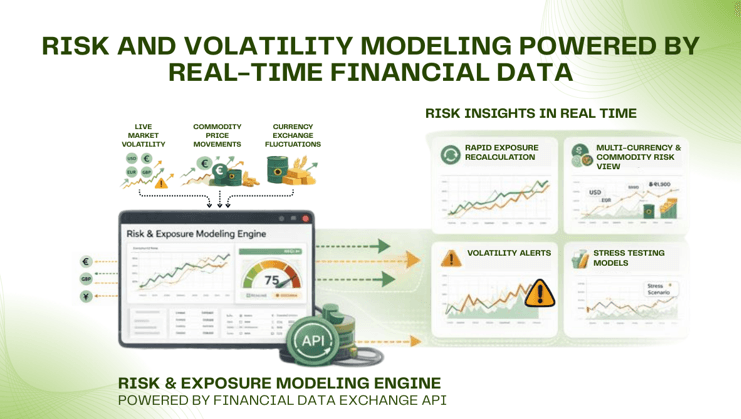
One of the most important applications of financial data exchange APIs is risk analysis.
Currency fluctuations and commodity price swings directly affect exposure, margins, and operational risk. Analytics teams model this risk using scenario analysis, sensitivity testing, and volatility tracking.
A financial data exchange API enables these models by:
- Providing continuous updates during volatile market periods
- Allowing rapid recalculation of exposure metrics
- Supporting multi-currency and multi-commodity risk views
- Feeding stress-testing models with current market inputs
Without reliable exchange data, risk analytics becomes reactive. With API-driven data exchange, risk models can operate closer to real time, improving decision speed and confidence.
Use Cases Across Analytics-Driven Industries
Financial data exchange APIs are no longer limited to trading platforms or financial institutions. They are now embedded across a wide range of analytics-driven industries.
#1 - Fintech and Digital Finance Platforms
Fintech products rely heavily on accurate currency and commodity data to power dashboards, pricing logic, and reporting features. APIs allow these platforms to update analytics automatically without manual intervention.
#2 - Enterprise Business Intelligence
Global enterprises use financial data exchange APIs to normalize reporting across regions. Currency conversions and commodity-linked costs flow directly into BI tools, ensuring consistent financial visibility.
#3 - Investment and Market Analytics
Investment analytics platforms depend on continuous data exchange to track asset performance, portfolio exposure, and macroeconomic indicators influenced by commodities and exchange rates.
#4 - Supply Chain and Cost Analytics
Commodity prices directly impact procurement and manufacturing analytics. APIs allow supply chain models to adjust cost assumptions dynamically as markets move.
Currency and Commodity Data as Analytics Infrastructure
For many analytics teams, currency and commodity data is not a feature; it is infrastructure.
Reliable providers supply both real-time and historical datasets that analytics systems can trust, and in many analytics stacks, this role is fulfilled by commodity price data APIs that continuously feed market-linked inputs into forecasting and cost models. Platforms offering currency exchange data and commodity price data are often integrated as foundational inputs rather than optional enhancements.
In practice, analytics teams use such APIs to:
- Convert multi-currency financial data consistently
- Track commodity-linked cost drivers
- Enrich financial datasets with market context
- Reduce manual reconciliation across reports
This infrastructure role is why financial data exchange APIs are evaluated not just on coverage, but on stability, accuracy, and integration ease.
Data Quality, Latency, and Analytics Confidence
Analytics outcomes are heavily influenced by two technical factors: data quality and latency.
Even small inconsistencies in exchange rates or delayed updates can ripple through analytical models. This leads to discrepancies across dashboards, conflicting forecasts, and reduced trust in analytics outputs.
Financial data exchange APIs address these challenges by delivering synchronized updates across systems so all analytics tools operate on the same market snapshot, applying consistent rounding and precision rules to prevent discrepancies in calculations, maintaining versioned historical records that support audits and trend analysis, and reducing manual data handling errors that often creep into fragmented financial workflows.
As a result, analytics teams spend less time validating numbers and more time interpreting insights.
The Strategic Value of API-Driven Financial Data Exchange
Beyond operational efficiency, financial data exchange APIs provide strategic value. They enable organizations to scale analytics initiatives without reworking data pipelines each time new markets or data types are added.
Key strategic benefits include:
- Faster deployment of new analytics features
- Easier expansion into new regions or commodities
- Reduced dependency on manual data workflows
- Improved alignment between finance, analytics, and operations teams
As analytics becomes central to competitive advantage, the ability to exchange financial data reliably becomes a core capability.
The Future of Financial Data Exchange in Analytics
The role of financial data exchange APIs will continue to grow as analytics systems become more automated and predictive.
Future trends point toward a stronger emphasis on low-latency data to support near real-time analytics, deeper integration of financial data exchange APIs with AI-driven forecasting models, expanded historical datasets that enable long-term trend and pattern analysis, and growing demand for transparent data sourcing and validation to improve trust in analytical outputs.
In this environment, financial data exchange APIs will serve as the backbone connecting markets to analytical intelligence.
Closing Perspective
Modern analytics depends on accurate, timely, and consistent financial data. A financial data exchange API provides the mechanism to move that data reliably across systems, transforming raw market information into actionable insight.
As organizations expand their use of analytics for forecasting, risk analysis, and strategic planning, API-driven financial data exchange is no longer optional. It is a foundational requirement for analytics that reflect real-world market conditions.