Redefining Marketing in the Digital Age: How Machine Intelligence Creates New Opportunities

Table of Contents

Introduction
Marketing has always evolved alongside technology. From print to radio, television to search engines, each shift has changed how brands reach people and measure success. Today’s transformation is driven by machine intelligence. It is not a trend on the horizon. It is already embedded in how marketing teams plan, execute, and optimize their work.
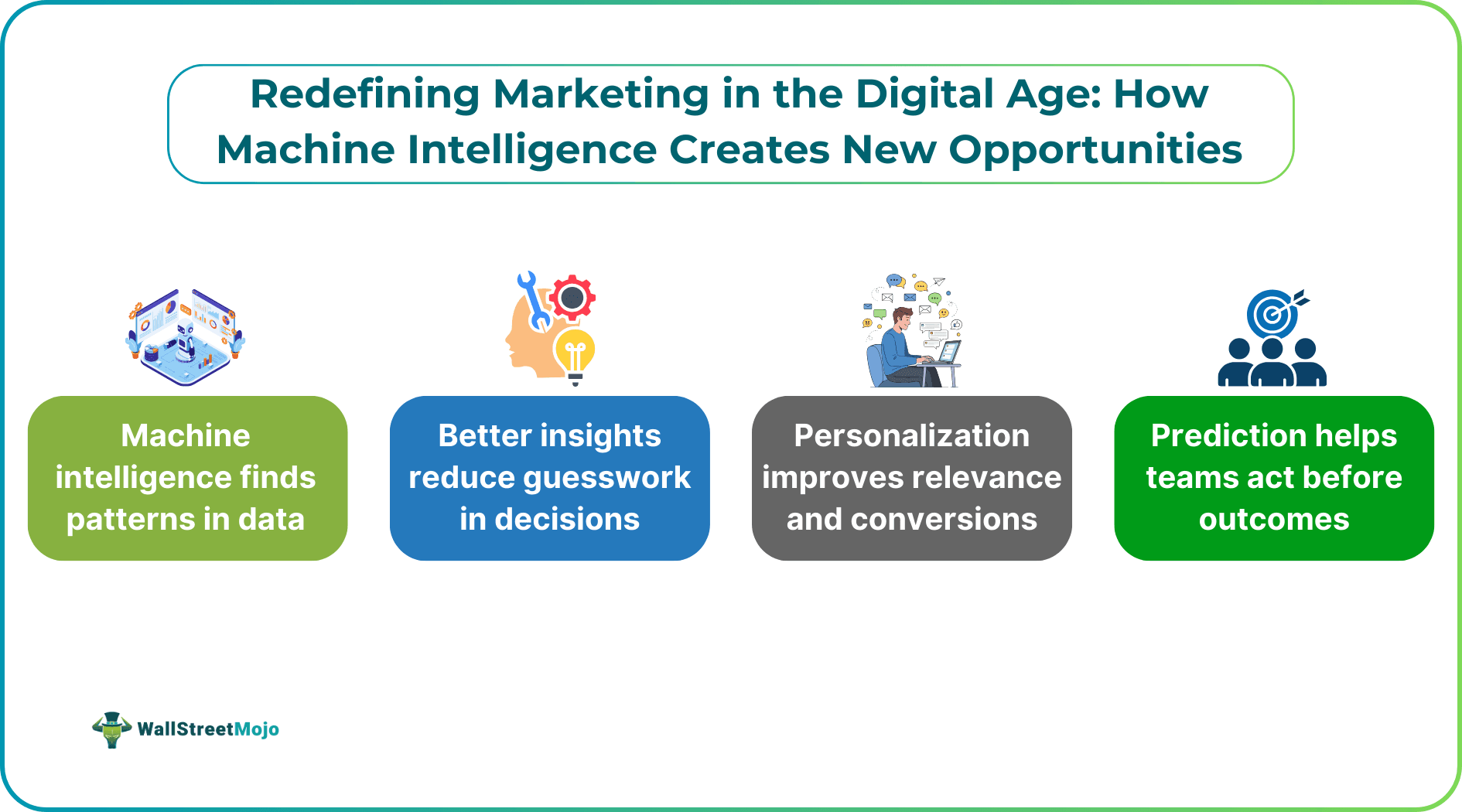
This article looks at how machine intelligence is reshaping modern marketing, where the real opportunities lie, and what organizations should consider as they adapt.
From Automation to Intelligence
Early marketing automation focused on efficiency. Email scheduling, CRM workflows, and campaign triggers saved time. They reduced manual effort. But they did not fundamentally change how decisions were made.
Machine intelligence goes further. It analyzes behavior, identifies patterns, and improves outcomes over time. Instead of simply executing rules, systems now learn from data. They adjust messaging, timing, and channels based on performance signals.
This shift changes the marketer’s role. Strategy becomes more important than execution. The focus moves from managing tools to guiding systems with the right inputs, constraints, and goals.
Better Decisions Through Data Interpretation
Modern marketing produces enormous volumes of data. Website interactions. Ad impressions. Purchase histories. Social engagement. The challenge is not access. It is an interpretation.
Machine intelligence helps make sense of this complexity. Models can surface insights that would be difficult or impossible to detect manually. For example, they can identify which touchpoints actually influence conversion, or which audience segments respond to certain messages under specific conditions.
This leads to clearer decisions. Budgets can be allocated with more confidence. Campaigns can be adjusted faster. Guesswork is reduced. Not eliminated, but reduced enough to matter.
Importantly, these systems do not replace judgment. They support it. Human oversight remains essential, especially when context or brand values come into play.
Personalization at a Practical Scale
Personalization has long been a marketing goal. In practice, it was often limited to simple variables like name insertion or basic segmentation.
Machine intelligence enables a more practical form of personalization. Content, offers, and experiences can be tailored based on behavior, intent, and likelihood to convert. This happens across channels, not just in email.
The value here is relevance. When messaging aligns more closely with user needs, engagement improves. Conversion rates rise. Customer relationships become more durable.
However, personalization must be handled carefully. Transparency and data responsibility matter. Overly aggressive targeting can erode trust rather than build it.
Smarter Search and Content Strategies
Search behavior is changing. Users ask longer questions. They expect precise answers. Traditional keyword targeting alone is no longer sufficient.
Machine intelligence helps marketers understand the intent behind queries, not just the words used. It informs content structure, topical coverage, and internal linking strategies. This is especially important as search engines increasingly rely on semantic understanding.
A growing number of companies rely on AI search optimization services to align their content with how modern search systems evaluate relevance and authority. These services focus on entity relationships, content depth, and user satisfaction signals rather than surface-level keyword density.
As Google continues to emphasize helpful content and experience-driven ranking factors, marketers must think beyond traffic and toward usefulness.
Predictive Insights and Forecasting
One of the most valuable applications of machine intelligence is prediction. Instead of reacting to performance reports, teams can anticipate outcomes.
Predictive models can estimate lifetime value, churn risk, or campaign impact before full deployment. This allows for earlier intervention. Resources can be shifted. Creative can be refined. Risks can be managed.
Forecasting is not perfect. Models rely on historical data, which may not always reflect future conditions. Still, even directional insight is valuable when decisions involve large budgets or long timelines.
Used correctly, prediction supports more resilient marketing strategies.
Efficiency Without Losing Control
Efficiency gains are often cited as a primary benefit of machine intelligence. And they are real. Tasks like bid management, audience targeting, and A/B testing can be handled faster and at greater scale.
But efficiency should not mean loss of control. The best results come when marketers set clear objectives and boundaries. Systems need guidance. They need quality inputs. They need ongoing review.
When this balance is struck, teams can focus on higher-level work. Messaging. Positioning. Experience design. These are areas where human insight remains critical.
New Skills for Modern Teams
As tools evolve, so do skill requirements. Marketers do not need to become data scientists. But they do need a working understanding of how intelligent systems operate.
This includes knowing what questions to ask, how to evaluate outputs, and when to challenge recommendations. It also involves collaboration across teams. Marketing, analytics, and engineering must work more closely than before.
Training and process design matter. Organizations that invest here are better positioned to extract long-term value from their technology stack.
Ethical and Strategic Considerations
With increased capability comes responsibility. Data privacy, bias, and transparency are not abstract concerns. They affect brand reputation and regulatory risk.
Machine intelligence reflects the data it is trained on. If that data is incomplete or skewed, outcomes will be too. Marketers must be aware of these limitations and take steps to mitigate them.
Strategy also matters. Technology should support business goals, not dictate them. Clear positioning and customer understanding remain foundational. Tools are enablers, not substitutes.
Looking Ahead
Machine intelligence is not a single solution. It is a set of capabilities that, when applied thoughtfully, create new opportunities in marketing. Better insight. Greater relevance. More informed decisions.
The organizations that succeed will be those that combine these capabilities with strong fundamentals. Clear strategy. Respect for the audience. Willingness to adapt.
Marketing has always been about connection. The tools have changed. The goal has not.