The Financial Cost of Manual Loan Processing and How Automation Fixes It

Table Of Contents

Introduction
Manual Loan Processing refers to the conventional, human-centric sequence of document collection, manual data entry, and physical verification required to move a loan from a funding application.
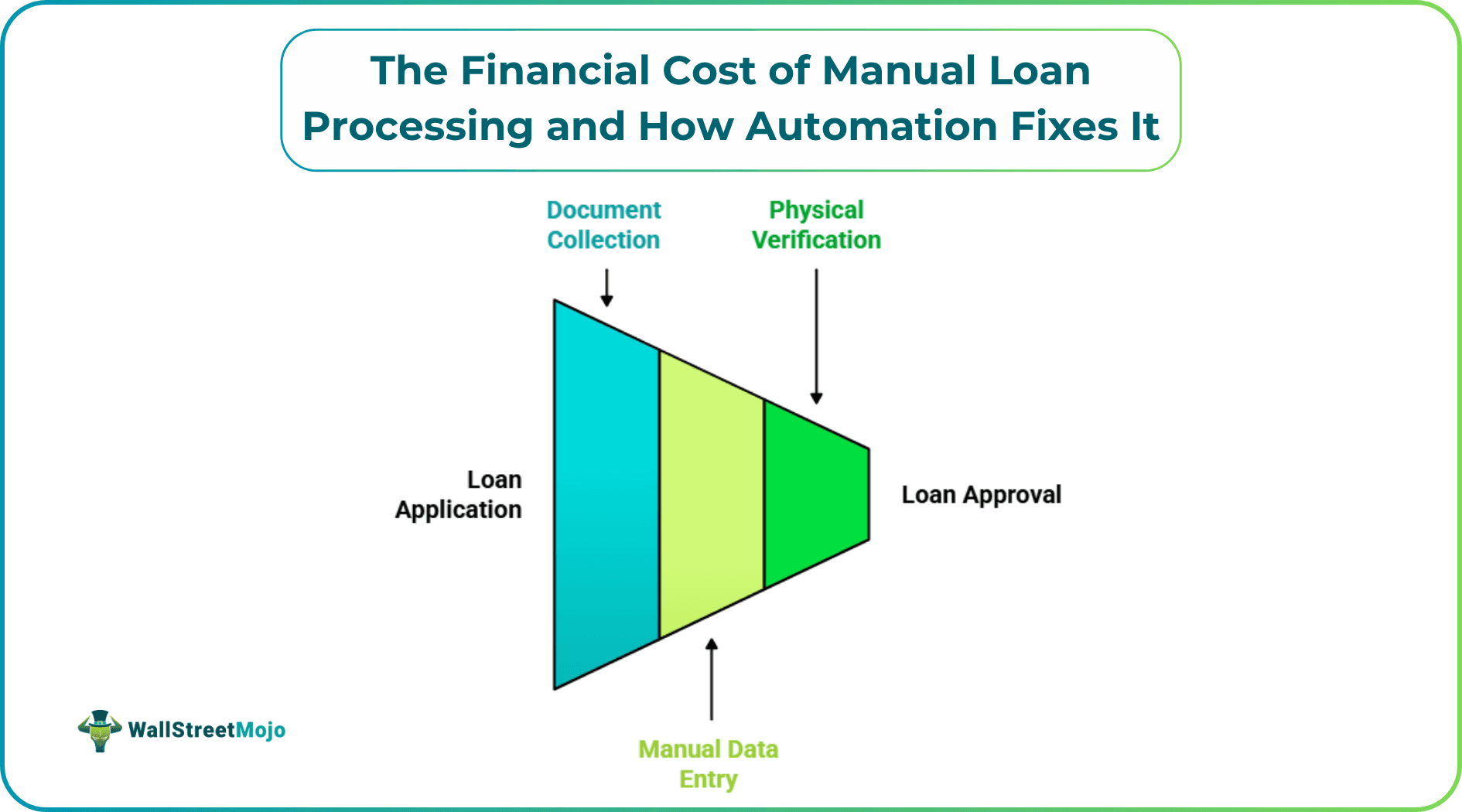
The net interest margin of any lender is mainly determined by operational efficiency in the high-interest environment of 2026. In the case of institutions that continue to use the old-fashioned "stare and compare" techniques, the Profitability of the loan itself is often being cannibalized by the Cost per Acquisition (CPA) and Operational Overhead.
Key Takeaways
- Manual processing results in a large error tax that burns institutions.
- The largest aspect of the loan origination costs is Labor Costs.
- Automation offers Scalability without a linear growth in overhead.
The Mechanism of Transition: How Does Loan Processing Automation Work?
The digitization process consists of an organized technical process eliminating human latency at every node:
- Ingestion: Unstructured data (PDFs, JPGs, Scans) is received by the loan document processing software through a secure borrower portal.
- Extraction: Advanced Optical Character Recognition (OCR) and Machine Learning (ML) can extract crucial financial variables, along with Gross Income, Debt-to-Income (DTI), and Credit Scores.
- Checking: The gadget compares extracted statistics with outside databases (e.G., payroll companies or the tax government) using an API.
- Decisioning: The pre-defined risk parameters are used to give an immediate approval/deny/refer.
Quantitative Analysis: The Processing Efficiency Formula
The effect of automation calculated by lenders is based on the formula of the Efficiency Ratio:
Processing Efficiency =Total Operating Expenses/Number of Loans Funded
In a manual world, the Labour Costs and Error Correction Fees are still high, resulting in a low total efficiency score.
Real-World Application: Loan Automation in Practice
Case Study: Apex Lending Corp Performance Metrics
Take the case of Apex Lending Corp, which receives 500 mortgage applications every month.
- Manual Scenario: Apex employs 10 processors at $5,000/month each. The total exertion fee is $50,000. The value in line with the software is $100.
- Automated Scenario: Apex implements an AI-driven machine costing $five,000/month and keeps 2 senior processors for exception handling ($10,000). Total value is $15,000.
Result: Apex will save 70% of operational capital by cutting the amount spent on each application by an average of 100 to 30 dollars.
Comparative Framework: Manual versus Automated Processing
Juxtaposing the Legacy Framework and the 2026 Automated Standard
| Feature | Manual Processing | Automated Processing |
|---|---|---|
| Data Entry | Human-led (High Error Risk) | AI-driven (99% Accuracy) |
| Turnaround Time | 5–10 Business Days | < 2 Hours |
| Scalability | Requires New Headcount | Elastic (API-based) |
| Compliance | Manual Sampling/Audits | Immutable Digital Trail |
Strategic Assessment: Advantages & Disadvantages
Evaluating ROI and Technical Constraints
Advantages:
- Reduction of Cost: Reduces the Cost to originate drastically.
- Fraud Mitigation: AI identifies metadata abnormalities in the documents that are not visible to people.
- Employee Retention: Enables employees to work on Relationship Banking and not data entry.
Disadvantages:
- Initial Capex: It will need capital investment upfront for software integration.
- Technical Debt: Bank cores. Legacy bank cores might need a middleware to access the new APIs.
Future Outlook: The Role of Generative AI in 2026
By 2026, the lending industry will be out of basic OCR. Generative AI is now utilized by modern systems to provide a summary of complex disclosures in the law and give borrowers real-time and conversational updates on their application. This Information Gain guarantees that the lender is not merely a financial supporter, but a hassle-free service platform.
Frequently Asked Questions (FAQs)
Are the chances of default raised through automation?

Does automated processing comply with the GDPR/CCPA?
What is the average ROI of this software?
Recommended Articles
The Evolution of Modern Lending Infrastructure
The financial statistics prove that the territory of paper-based lending has come to the logical conclusion. Using advanced loan document processing software, it would make the back-office of an institution a competitive engine rather than a cost center. The credit market winners going forward in 2026 would be those that emphasize Data Integrity, Speed, and Operational Efficiency.