The Evolution of Prop Firms: From Bank Trading Desks to Independent Capital Providers

Table of Contents

Introduction
Over the last couple of years, the financial landscape has undergone a seismic shift in how capital is deployed.
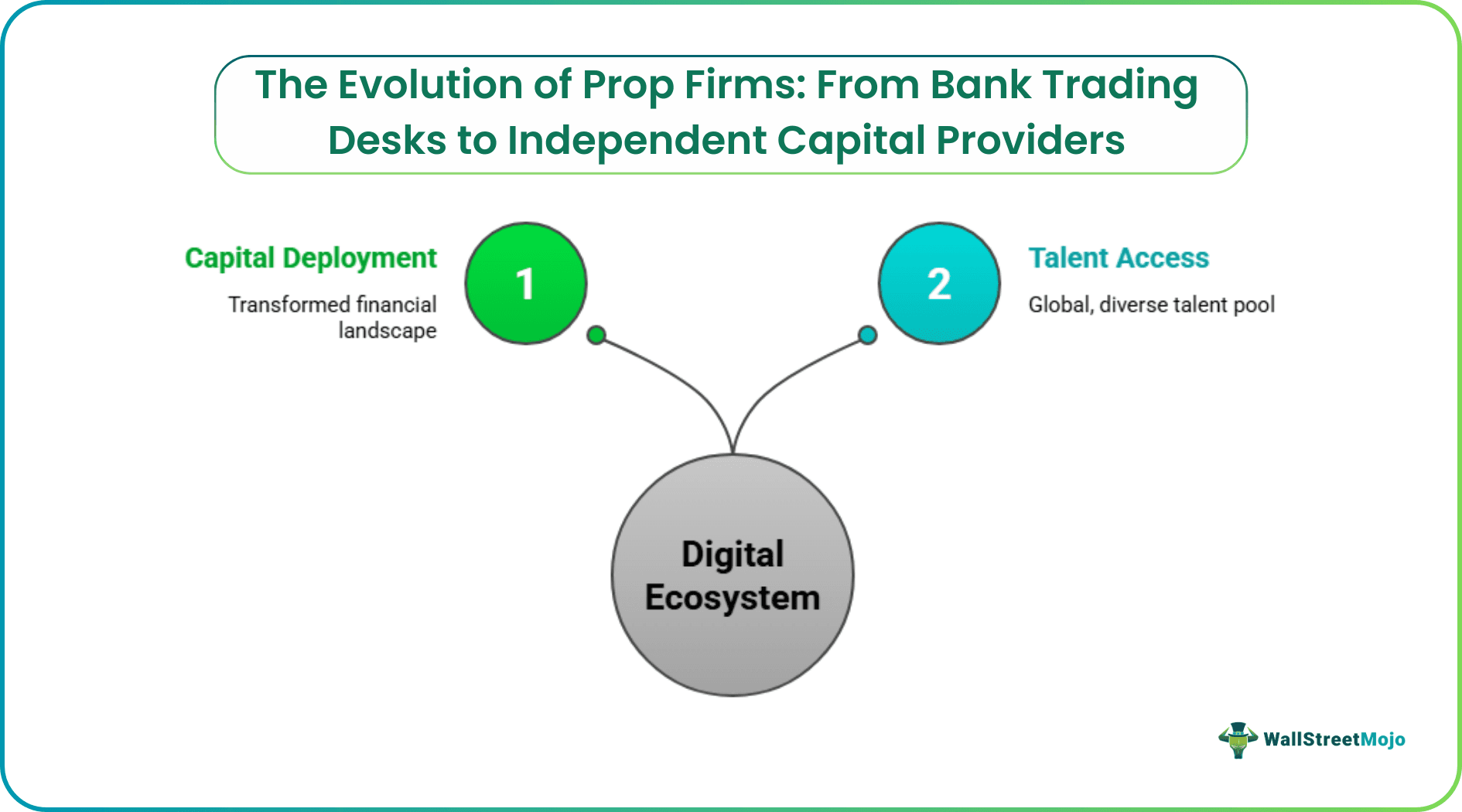
What was once the exclusive playground of suit-and-tie Wall Street bankers has been transformed into a global, digital ecosystem of independent talent from all walks of life.
The Transformation of Proprietary Trading
Proprietary (prop) trading is the practice of a financial firm trading stocks, bonds, currencies, or commodities with its own money.
This type of trading is done by making a direct profit rather than trading with a client’s money.
Historically, this used to happen behind the closed doors of massive investment banks.
Today, the scene looks entirely different.
Over the past decade, independent prop firms have emerged as structured capital providers outside traditional banking systems.
This shift has democratized access to high-level liquidity, moving the industry from centralized institutional desks to a distributed model of "funded traders."
The Era of Bank Trading Desks
Before the late 2000s, institutional trading desks were the primary engines of market liquidity.
For example:
- Internal Capital: Major investment banks used their massive balance sheets and shareholder equity to take speculative positions.
- Revenue Powerhouses: In the early 2000s, proprietary desks often contributed a significant percentage of a bank's annual net income.
- High-Stakes Culture: This era was defined by a high-leverage environment where proprietary trading firms within banks operated with immense risk appetite, often driven by the "too big to fail" safety net.
Regulatory Turning Point: Post-2008 Financial Crisis
The catalyst for change was the 2008 financial crisis, seen as the "extinction event" for the traditional bank-led model.
This led to the beginning of the road to the tipping point.
Regulators started to realize that banks' speculative bets put the entire global economy at risk.
- The Volcker Rule: Introduced as part of the Dodd-Frank Act, this regulation strictly prohibited commercial banks from engaging in proprietary trading for their own profit.
- The Great Migration: As banks shuttered their prop desks, a massive wave of talent, traders, risk managers, and quants migrated toward the private sector, laying the groundwork for independent entities.
Rise of Independent Prop Firms
Out of the ashes of the Volcker Rule, the now-known independent prop firm was born.
These firms didn't take deposits; they used private or pooled capital to back skilled traders.
The prop trading business model shifted from employing traders on salaries to the new "backing" model that is used today.
This era saw the rise of specialized firms that focused solely on market execution without the distractions of retail or commercial banking.
The Retail Expansion Phase
Technology eventually removed the physical barriers around the world from the trading floor.
The expansion of forex trading prop firms marked a major shift in accessibility for independent traders around the globe.
- Retail Prop Trading: Individual traders could now prove their skills via online evaluations without having to be at a specific address.
- Funded Trader Programs: By passing a "challenge," a retail trader could gain access to five- or six-figure accounts, sharing the profits with the firm.
- Lower Barriers: You no longer need an Ivy League degree to trade institutional-sized capital; all that is required today is a proven edge and a stable internet connection.
Technology as a Catalyst for Growth
This extensive transition wouldn't have been possible without the software that bridged the gap between professional and retail markets.
| Feature | The impact on Prop Trading |
|---|---|
| MT4/MT5 Platforms | Standardized the trading environment for remote users on a global scale. |
| Risk Dashboards | Allow firms to monitor thousands of traders in real-time. |
| Algorithmic Trading | Enabled high-frequency strategies and automated risk management. |
| Instant Funded Accounts | Streamlined the transition from evaluation to live market trading. |
The rise of modern prop trading platforms has turned capital allocation into a data-driven science.
Bank Desks vs. Independent Capital Providers
While both bank desks and independent capital providers aim for profit, their structures are worlds apart:
- Capital Ownership: Banks traded shareholder capital under heavy federal oversight. Independent firms use private equity or pooled capital, allowing for more flexible (though still rigorous) risk frameworks.
- Operational Models: Bank desks were centralized on trading floors in New York or London. Modern firms utilize remote trading networks, sourcing talent from every corner of the globe.
Market Impact and the Current Landscape
Today, proprietary trading firms are essential liquidity providers in forex, derivatives, and increasingly in crypto and commodities.
The industry has moved forward toward a "Globalization of Funding," where a Vietnamese-speaking trader in Vietnam can trade the capital of a firm in London without language or location barriers.
Current trends include:
- Profit-Sharing Systems: Highly competitive splits, sometimes reaching 80-90% for the trader.
- Institutionalization: Independent firms are becoming more sophisticated, adopting the same high-level compliance and tech stacks once reserved for Goldman Sachs or J.P. Morgan.
Conclusion: A New Ecosystem
The journey from the mahogany desks of the 1990s investment banks to the cloud-based independent prop firms of today is a story of decentralization.
Regulation may have pushed proprietary trading out of the banks, but technology and globalization have allowed it to flourish in a more transparent, accessible, and competitive environment.
Proprietary trading is no longer just a department; it has become a global capital allocation ecosystem.
As these firms continue to innovate, they are not just replacing the old bank desks but are actively redefining the relationship between individual talent and institutional capital.
In other words, a new ecosystem has been born.