The Rise of ShopeePay and How to Accept ShopeePay

Table of Contents

Introduction
If you sell to customers in Southeast Asia, you probably see ShopeePay everywhere but still feel unsure which wallets to support, how complex the integrations will be, and what they mean for refunds, fraud risk, and your day‑to‑day operations. It is easy to feel caught between customer demand for local wallets, limited payments expertise, and the fear of breaking a fragile checkout. Learning how to accept ShopeePay gives you a clear, focused way to meet that demand without rebuilding your entire payment stack.
The Rise and Rise of ShopeePay
#1 - From In-App Wallet to Regional Method
ShopeePay began as a wallet inside the Shopee marketplace, letting shoppers store value, earn rewards, and check out with a few taps instead of entering card details. It has since grown into a regional digital wallet that customers use with third‑party merchants online and in stores through QR codes and mobile payments, so understanding how to accept ShopeePay means plugging into behavior they already know and trust.
#2 - Geographic Expansion Across Southeast Asia
ShopeePay’s rollout mirrors Shopee’s expansion across Southeast Asia. The wallet launched in Indonesia and later spread to markets such as Singapore, Malaysia, Thailand, and the Philippines, where customers now treat it as an everyday way to pay for marketplace orders, food delivery, transport, and offline QR purchases.
#3 - Growing Network of Funding Partners
ShopeePay operates as a stored‑value wallet funded through local rails. Your customer can top up using bank transfers, over‑the‑counter channels, or other wallets, then pay you from that balance. Because the money usually sits in the wallet before checkout, failed payments from mistyped card details or unavailable credit are less common, and successful payments tend to feel fast and simple.
Product Architecture and Core Properties
#1 - Digital Wallet Model and Funding Source
From your point of view, ShopeePay behaves like a prepaid digital wallet, drawing from a stored balance rather than charging a card in real time. Identity and fraud checks mostly happen when the user tops up or signs in, so the actual payment can be confirmed quickly with minimal friction at the most sensitive moment in the checkout.
#2 - Multi-Market Setup and Currencies
ShopeePay is configured slightly differently in each market it serves. A core setup covers Singapore, Thailand, and the Philippines, while dedicated variants support Indonesia and Malaysia. Each variant runs in its local processing currency, such as SGD, PHP, THB, IDR, or MYR, and your provider can settle funds to you in one or more currencies that align with your treasury setup. When you plan how to accept ShopeePay, you are choosing which markets and currencies to support rather than building separate solutions from scratch.
#3 - Risk, Refunds, and Limits
ShopeePay supports refunds and partial refunds, with a long window to return funds to the user’s wallet if an order is canceled or changed. Card‑scheme chargebacks do not apply, simplifying reconciliation and reducing operational overhead. At the same time, local minimums and maximums make the wallet a strong fit for micro‑transactions and everyday baskets rather than very high‑ticket purchases.
User Journey and Channel Experience
#1 - Redirect and Code-Scanning Flows
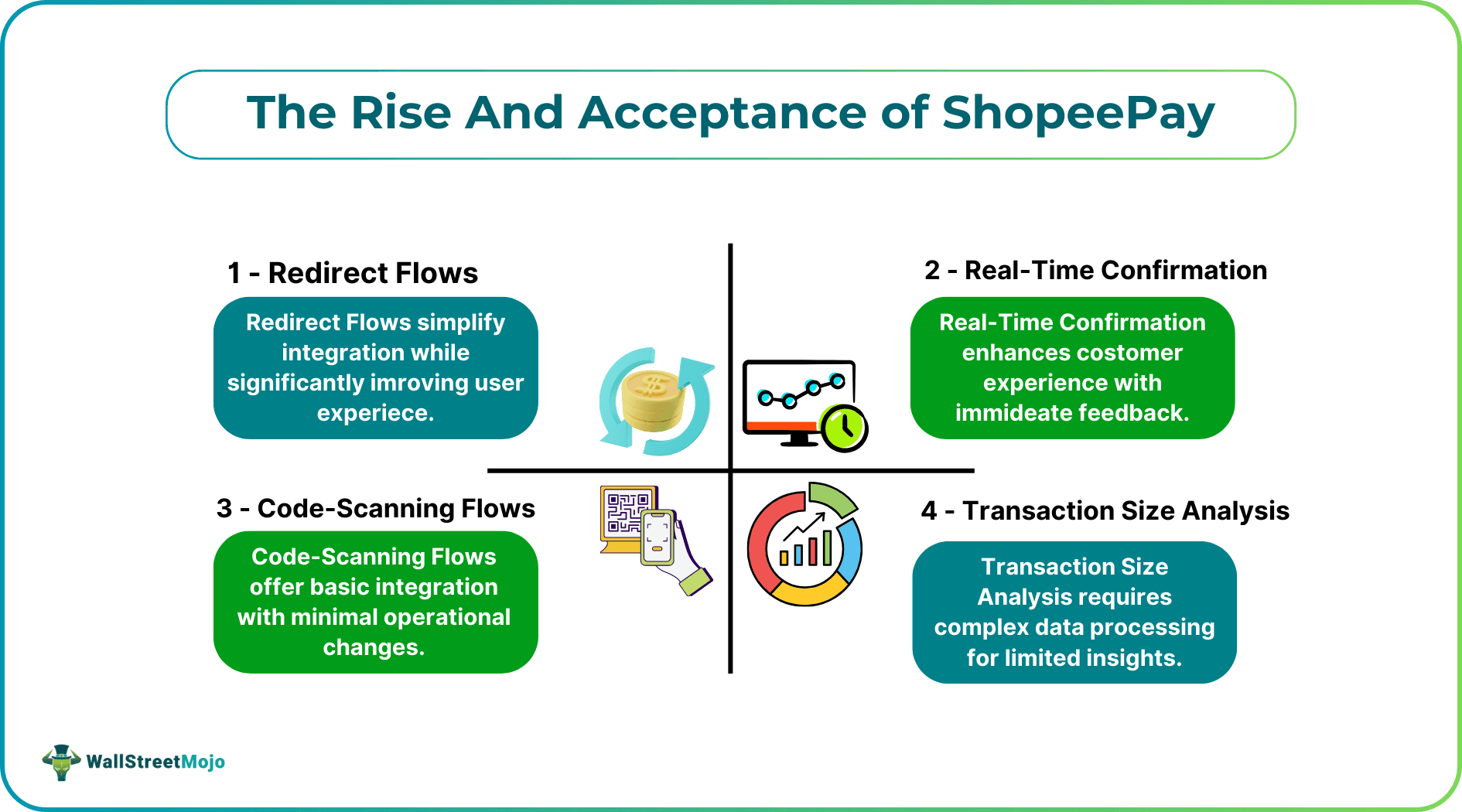
When a shopper picks ShopeePay at checkout, they usually follow one of two flows. In a redirect flow, your site sends them to a ShopeePay page or app screen where they confirm the payment, then returns them to your confirmation page. In a code‑scanning flow, your site displays a QR code that they scan with their ShopeePay app to approve the payment on their own device.
#2 - Real-Time Confirmation and Windows
ShopeePay is designed to send you a near-real-time confirmation through your payment provider, along with a defined time window for the customer to complete the payment. If the shopper does not approve within that window, the attempt expires, and you can safely mark the order as unpaid and release any reserved inventory, provided your interface clearly explains how long the reservation will last.
#3 - Transaction Size and Usage Patterns
Because ShopeePay is fast, mobile‑first, and wallet‑based, customers most often use it for frequent, low‑to‑mid‑value transactions such as groceries, flash sales, food delivery, digital goods, and regular bill payments. Large one‑off purchases are still more likely to rely on cards, bank transfers, or installments, so ShopeePay is strongest where your volume sits in everyday baskets rather than rare, high‑value orders.
Merchant Integration and Acquiring Landscape
#1 - Acquirer Roles and Entity Locations
You rarely connect to ShopeePay directly. Instead, you work through an acquirer or payment service provider that already supports the wallet and can offer it to buyers in Southeast Asia. At the same time, your legal entity is based in international hubs such as Singapore, Hong Kong, the United States, the European Union, or the United Kingdom. The acquirer handles local connections, compliance, and settlement on your behalf so you can focus on your products and customer journeys.
#2 - Integration Options and Online Setup
In technical terms, accepting ShopeePay works the same way as adding any other local wallet. You enable it in your provider’s dashboard, choose an integration model (full API, hosted checkout, or embedded checkout), and then add ShopeePay as a visible option for eligible customers. From there, you handle redirects or QR displays, listen for webhooks or callbacks that carry the final payment result, and update your order system with a simple paid or failed status.
#3 - Practical Considerations for Merchants
Beyond core integration, you need to align on operational details: set refund rules that match ShopeePay’s capabilities, train support teams on how wallet payments differ from card payments, and ensure reports clearly label ShopeePay transactions. Global providers PayPal, Stripe, and Antom help you accept a wide range of online payment methods through a single integration.
Strategic Outlook for ShopeePay
#1 - Positioning Among Digital Wallets
Digital wallets are now a mainstream way to pay across Southeast Asia, both in stores and online. ShopeePay sits among the region’s leading wallets, strengthened by its link to the Shopee marketplace and its deep connections to local banks and top‑up channels, so enabling it at checkout helps you meet customers in a channel they already open daily.
#2 - Cross-Border Commerce and PSP Strategy
When you sell across borders, adding ShopeePay should be part of a broader plan for local payment methods rather than a one‑off experiment. Working with a payment service provider that combines ShopeePay, other regional wallets, and cards in a single setup makes it easier to manage routing, risk rules, and reporting. At the same time, you fine‑tune how to accept ShopeePay in each market.
#3 - Future Directions and Design Choices
ShopeePay’s use of redirect and QR flows, real‑time confirmations, and wallet balances fits into a wider shift toward push‑based, low‑friction payments in the region. Keeping your integration flexible—through modern APIs, modular checkout pages, and adaptable routing rules—will make it easier to respond as ShopeePay adds new features, connects to more partners, or expands to additional markets.
Conclusion
ShopeePay has moved far beyond its origins as a simple marketplace wallet to become a major digital payment method across Southeast Asia, backed by local funding rails, quick confirmations, and strong regional coverage. For your business, the question is not just whether to support it, but also how to integrate ShopeePay smoothly into your existing checkout, risk controls, and reporting. If you already sell into Southeast Asia or plan to enter the region soon, this is a good moment to review your payment mix, identify where customers prefer local wallets, and make room for ShopeePay alongside your current methods so that paying feels as easy as shopping.