Top 5 San Francisco Bay Area AI Companies to Know

Table of Contents

Introduction
The San Francisco Bay Area isn't just leading the AI revolution. It's practically running the whole show. The region pulled in $122 billion in AI funding in 2025 alone. That's more than three-quarters of all AI investment across the entire United States.
And the talent numbers tell a similar story. CBRE reports that the region now hosts 76,079 AI tech professionals, a 24% jump from the previous year. Software engineers here command a median salary of $269,000, the highest anywhere in the country. When you combine that kind of talent density with unprecedented capital access, you get something special: an ecosystem where AI companies can scale from scrappy startups to hundred-billion-dollar giants in just a few years.
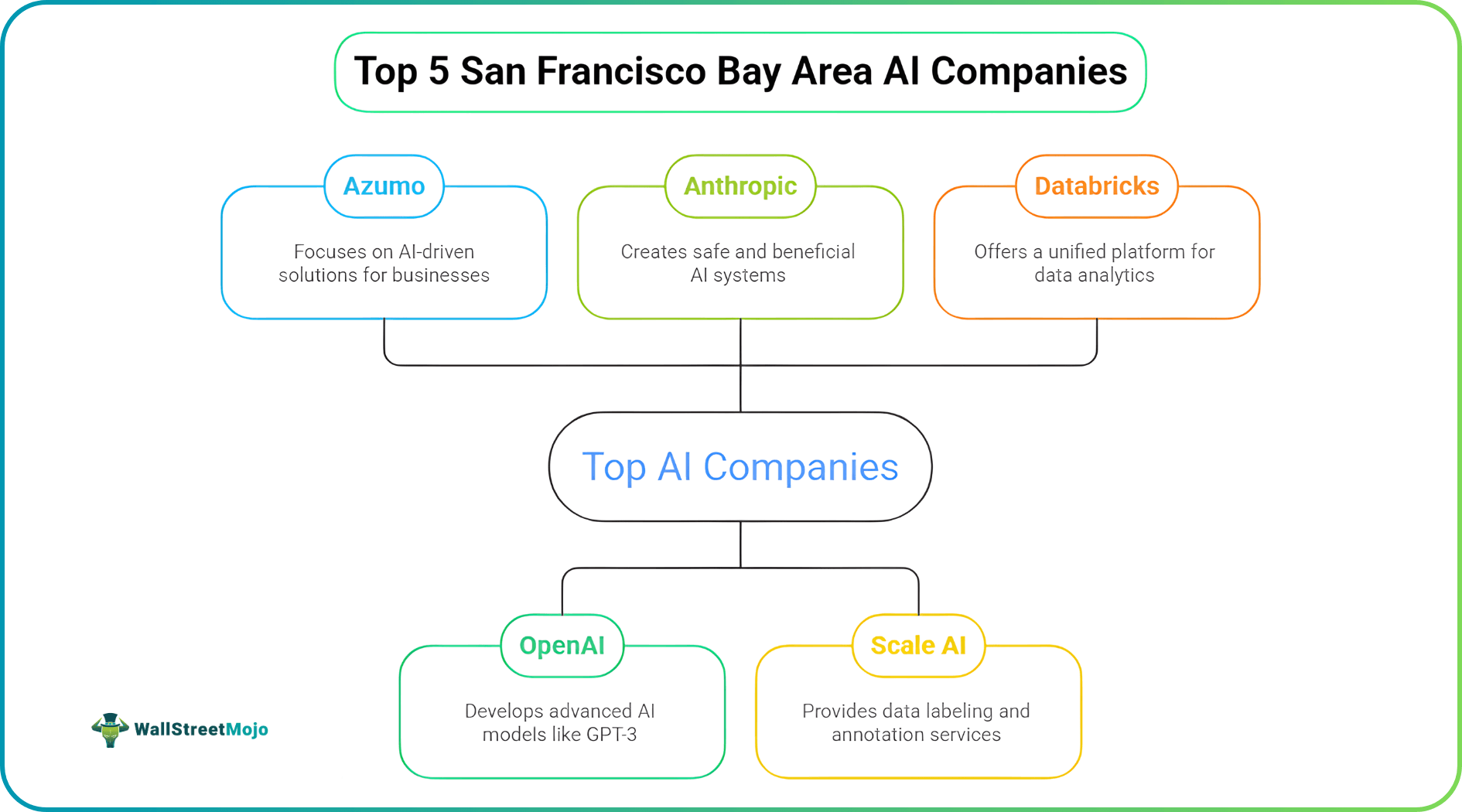
So which companies should you actually pay attention to? The five we're about to cover represent completely different slices of the AI pie. You've got everything from nearshore development specialists building custom AI solutions for enterprises, all the way up to foundation model titans valued at $300 billion. Each one shows a different path to success in this fast-moving space.
Top 5 San Francisco Bay Area AI Companies
#1 - Azumo
When enterprises need to build intelligent applications but can't find enough qualified AI talent locally, Azumo steps in as a trusted partner. Founded in 2016 and headquartered in San Francisco, this SOC 2 certified nearshore development company has carved out a unique position by combining Latin American engineering talent with U.S. time zone alignment.
Company Overview & Mission
Azumo specializes in building intelligent applications using AI, machine learning, and data engineering. The company operates with 100-249 employees and focuses on bridging the gap between offshore cost savings and onshore quality. Their model eliminates the scheduling headaches, overnight delays, and language barriers that typically plague offshore partnerships.
The core mission? Help enterprises scale their software development efforts without sacrificing communication quality or technical excellence. Azumo works across web, mobile, data, and cloud applications, with a particular strength in AI-driven solutions.
Key Products & Services
Azumo offers a full spectrum of AI development capabilities:
Core Services:
- AI Development & Machine Learning
- Generative AI Voice Assistants
- Custom Software Development
- Data Engineering
- Computer Vision and Super Resolution
- Semantic Search using GPT-2.0
- AI-driven Anomaly Detection Systems
- Automated Knowledge Discovery Engines
Proprietary AI Products:
- HealthyScreen.ai: AI-powered health screening platform
- Baneka NeuralDB: Neural database solution
- myNLU: Natural language understanding platform
- Charlibot: Domain-specific AI chatbot trained on focused data
Funding & Financial Performance
Azumo operates as a private company with strong financial fundamentals. While specific funding details remain undisclosed, the company's business metrics speak volumes:
- Average client partnership duration exceeds 3.2 years
- 5.0/5.0 client satisfaction ratings across multiple review platforms
- Competitive pricing that clients consistently describe as "strong value for money"
- SOC 2 certification demonstrating security and compliance maturity
According to Clutch, the Director of nlx.ai noted that "Azumo's pricing fit their budget while exceeding expectations regarding quality and speed."
Client Portfolio & Market Position
Notable Clients:
- Meta and Facebook
- Discovery Channel
- Multiple Fortune 500 enterprises
- Conversational AI platform developers
- Enterprise AI system builders
Recognition:
- 2025 Top Machine Learning Company, San Francisco (Clutch)
- 2023 Best Software Development Companies in San Francisco
- 2022 Top Rated AI Development Company
- 2022 Impact Company of the Year
What sets Azumo apart in a crowded market? One CEO emphasized Azumo's "consistent ethos of direct communication, dependable quality of execution, and a can-do attitude." The company handles complex AI implementations ranging from generative AI voice assistants to semantic search engines without the communication friction that plagues many offshore arrangements.
Future Outlook & Strategic Initiatives
Azumo continues to expand its proprietary AI solutions while maintaining its core nearshore development model. With AI talent costs skyrocketing across the Bay Area, the company's ability to deliver high-quality AI development at competitive rates becomes increasingly valuable. Key growth areas include:
- Expanding HealthyScreen.ai, Baneka NeuralDB, and myNLU platforms
- Building out generative AI and LLM capabilities
- Growing presence in conversational AI and chatbot development
#2 - OpenAI
There's really no way to talk about AI companies without starting here. OpenAI holds the title of most valuable private company of all time, with a March 2025 valuation of $300 billion. When ChatGPT launched in late 2022, it became the fastest-growing consumer application in history. Now over 500 million people use it every week.
Company Overview & Mission
Founded in 2015 in San Francisco, OpenAI set out to develop artificial general intelligence (AGI) that benefits humanity. The company has grown to over 3,000 employees and transformed from a research lab into a commercial powerhouse that shapes how millions of people work, create, and communicate.
What started as a nonprofit research organization has evolved into something much larger. The company is actively working toward converting to a for-profit structure by December 31, 2025, a move that reflects just how commercially successful their technology has become.
Key Products & Services
Consumer Products:
- ChatGPT (free tier)
- ChatGPT Plus ($20/month) with 15 million+ subscribers
- ChatGPT Pro ($200/month) for power users
Enterprise Products:
- ChatGPT Team ($25-30 per user/month)
- ChatGPT Enterprise (~$60/seat)
- Developer APIs for building AI-powered applications
- DALL-E 3 for image generation
- Whisper for speech-to-text
Funding & Financial Performance
The numbers here are staggering. According to Channel Insider, OpenAI secured a $40 billion funding round in March 2025, the largest private funding round in tech industry history. SoftBank led with a $30 billion investment alone.
Funding Summary:
- Total raised: $57.9 billion across 11 funding rounds
- March 2025 valuation: $300 billion (up from $157 billion in October 2024)
- Microsoft total investment: Nearly $14 billion
Financial Performance:
- 2024 Revenue: $3.7 billion
- 2025 Projected Revenue: $12.7 billion (244% increase)
- August 2025 ARR: $13 billion
- 2024 Loss: $5 billion
OpenAI projects annual sales of up to $100 billion by 2029 and expects to turn cash flow positive that same year. Total losses from 2023 to 2028 are expected to reach $44 billion, a reminder that even the most successful AI companies burn enormous amounts of capital.
Client Portfolio & Market Position
User Base:
- 500 million weekly active users (April 2025)
- Over 1 billion requests processed daily
- 15 million+ paid ChatGPT subscribers
Microsoft serves as OpenAI's largest investor and is entitled to 20% of OpenAI's revenue. The Stargate project, a joint venture with SoftBank and Oracle, has received approximately $18 billion in funding commitment for massive compute infrastructure.
Future Outlook & Strategic Initiatives
OpenAI's roadmap includes:
- Converting to for-profit structure by end of 2025
- Scaling compute infrastructure through Stargate partnership
- Expanding enterprise offerings
- Targeting $200 billion revenue by 2030
- Continuing AGI research and development
The company's trajectory from nonprofit research lab to $300 billion commercial giant represents perhaps the most dramatic corporate transformation in tech history.
#3 - Anthropic
If OpenAI represents AI's commercial breakthrough, Anthropic represents the industry's conscience. Founded by former OpenAI executives in 2021, the company achieved one of the fastest growth trajectories in tech history, scaling from $1 billion to $5 billion in run-rate revenue in just eight months.
Company Overview & Mission
Anthropic's mission centers on building reliable, interpretable, and steerable AI systems. The company employs 1,097 people and focuses heavily on AI safety through its Constitutional AI framework. Daniela and Dario Amodei, both former OpenAI researchers, founded the company specifically because they wanted to prioritize safety alongside capability.
According to Anthropic, the company reached a $183 billion valuation in September 2025, making it the second-most valuable generative AI startup and the fourth-most valuable private company globally.
Key Products & Services
Claude AI Family:
- Claude Opus 4.1 for high-complexity reasoning
- Claude Sonnet 4.5 for faster, cost-effective processing
- Claude Haiku 4.5 for lightweight tasks
- Extended thinking with tool use capabilities
- Context windows up to 200,000 tokens
Platform Products:
- Claude Code, the developer tool generating $500 million+ run-rate revenue
- Claude Pro and Max plans for consumers
- Claude Enterprise with compliance controls
- Constitutional AI framework for safety
Funding & Financial Performance
Anthropic closed a $13 billion Series F funding round in September 2025. ICONIQ, Fidelity, and Lightspeed Venture Partners led the round.
Major Investors:
- Amazon: $8 billion
- Google: $2 billion
- BlackRock, Blackstone, Goldman Sachs Alternatives
- TPG, T. Rowe Price, Coatue, General Catalyst
Financial Performance:
- Beginning of 2025 ARR: $1 billion
- August 2025 ARR: $5 billion (400% growth in 8 months)
- Claude Code: $500 million+ run-rate revenue with 10x usage growth in three months
That growth rate makes Anthropic one of the fastest-growing technology companies ever recorded.
Client Portfolio & Market Position
Anthropic serves over 300,000 business customers. Large accounts exceeding $100,000 ARR grew 7x in the past year.
Strategic Partnerships:
- U.S. Department of Defense: $200 million contract
- Palantir and Amazon Web Services for classified environments
- Iceland Ministry of Education and Children
- Higher Education Advisory Board
About 36% of Claude usage goes toward coding tasks, and 77% of enterprise activity focuses on automation. The company announced its DOD contract in July 2025.
Future Outlook & Strategic Initiatives
Anthropic appears to be preparing for a 2026 IPO after hiring Wilson Sonsini law firm. The company may pursue another funding round potentially valuing it above $300 billion.
Key focus areas include:
- Deepening safety research
- International expansion
- Enhanced enterprise features and compliance
- Agentic coding capabilities expansion
- Run-rate revenue target of $9 billion by end of 2025
#4 - Scale AI
Every AI model needs training data. Lots of it. And Scale AI has become the critical infrastructure layer that supplies that data to the world's leading AI companies. Founded in 2016 by 19-year-old MIT dropout Alexandr Wang, the company went from a $13.8 billion valuation in May 2024 to a $29 billion valuation just one year later.
Company Overview & Mission
Scale AI's mission is to build the "data foundry for AI." The company provides data labeling, training, and validation services using a combination of machine learning and "human-in-the-loop" oversight. With 1,400 employees, Scale manages and annotates massive data volumes that power AI development across the entire lifecycle.
According to TapTwiceDigital, Scale serves as infrastructure layer for everything from autonomous vehicles to large language models.
Key Products & Services
Core Products:
- Data Labeling (Rapid and Studio variants)
- Data Management (Nucleus platform)
- Scale Evaluation for LLM testing
- RLHF (Reinforcement Learning with Human Feedback)
- AI model testing and validation
Government & Defense:
- Thunderforge project for military AI planning
- Federal agency AI tools ($250 million contract)
- Third-party evaluator for U.S. AI Safety Institute
- Five-year partnership with Qatari government
Funding & Financial Performance
Scale AI raised $1 billion in May 2024 at a $13.8 billion valuation, led by Accel with participation from Amazon, Meta, Nvidia, Intel, AMD, Cisco, and ServiceNow.
The major development came in June 2025 when, according to Scale AI, Meta acquired a 49% stake for $14.8 billion, valuing the company at $29 billion. This represented one of Meta's largest investments since WhatsApp. Founder Alexandr Wang joined Meta to work on AI efforts, with Jason Droege becoming Interim CEO.
Financial Performance:
- 2023 Revenue: $760 million
- 2024 Revenue: $870 million (14.5% growth)
- 2025 Projected Revenue: $2 billion (130% increase)
- 2024 ARR: $1.5 billion (97% YoY growth)
Client Portfolio & Market Position
Major Clients (Pre-Meta Deal):
- OpenAI, Google, Microsoft, Meta
- U.S. Army and Department of Defense
- General Motors, Toyota Research Institute
- Brex, Instacart, Flexport
Government Contracts:
- January 2022: $250 million federal agencies contract
- March 2025: Thunderforge DOD project
- February 2025: U.S. AI Safety Institute evaluator
- February 2025: Qatar government partnership
Here's the challenge: following the Meta deal, Google (Scale's largest customer) announced intentions to cut ties. OpenAI also reduced engagement. This customer concentration risk represents a real business challenge going forward.
Future Outlook & Strategic Initiatives
Scale AI faces a complex future. The Meta integration opens doors to Llama AI development, but the loss of major customers creates headwinds.
Key focus areas include:
- Deepening Meta integration for Llama development
- Expanding government and defense contracts
- Growing robotics data collection (September 2025)
- Developing Scale Evaluation platform
- Diversifying customer base beyond a few large clients
#5 - Databricks
If data is the new oil, Databricks is building the refineries. The company created the "lakehouse" architecture that combines data warehouses and data lakes, and it recently hit a $134 billion valuation with $4.8 billion in revenue run-rate growing at 55%+ annually.
Company Overview & Mission
Founded in 2013 by the creators of Apache Spark, Databricks aims to make data and AI accessible to all organizations. The company ranked third on CNBC's 2025 Disruptor 50 list and stands as the fourth most highly valued U.S.-based startup (after OpenAI, SpaceX, and Stripe).
According to CNBC, CEO Ali Ghodsi stated the company has "a shot to be a trillion-dollar company" as enterprises reimagine how they build intelligent applications.
Key Products & Services
Core Platform:
- Databricks Lakehouse (cloud data platform)
- Delta Lake (open-source ACID transactions)
- MLflow (machine learning lifecycle management)
- Apache Spark framework integration
AI-Focused Products:
- Lakebase: First serverless Postgres database built for AI (based on $1 billion Neon acquisition)
- Agent Bricks: Platform for building AI agents on proprietary data
- Databricks Apps: Data and AI application deployment
- Databricks SQL: Data warehousing product with $1 billion+ run-rate revenue
- DBRX foundation model (open-source, $10 million to create)
Funding & Financial Performance
Databricks announced a $4+ billion Series L funding round in December 2025 at a $134 billion valuation. Insight Partners, Fidelity, and J.P. Morgan Asset Management led the round. The valuation jumped 34% in just three months from the $100 billion mark in August 2025.
This followed what Crunchbase called the largest venture capital raise of 2024: a $10 billion Series J at $62 billion valuation, led by Thrive Capital.
Financial Performance:
- Q3 2025 Revenue Run-Rate: $4.8+ billion (55%+ YoY growth)
- AI Products Revenue Run-Rate: $1+ billion
- Data Warehousing Revenue Run-Rate: $1+ billion
- Customers with $1 million+ ARR: 500+
- Free Cash Flow: Positive over last 12 months
- Non-GAAP subscription gross margins: 80%+
Client Portfolio & Market Position
Strategic Partnerships:
- March 2025: Anthropic (5-year, $100 million deal)
- June 2025: Google/Alphabet (4-year, Gemini LLMs integration)
- September 2025: OpenAI ($100 million deal)
- December 2024: AWS "Buy with AWS" partnership
Customer Base:
- Fortune 500 enterprises across industries
- 500+ customers spending $1 million+ annually
- Global presence with hubs in London, Singapore
- FedRAMP authorized for U.S. federal government use
Databricks plans to use its Series L capital for building AI apps and agents, future acquisitions, deeper AI research, and employee liquidity.
Future Outlook & Strategic Initiatives
Databricks is positioning itself for the next era of AI development. Key priorities include:
- Building toward CEO's "trillion-dollar company" vision
- Focusing on "vibe coding" and generative AI convergence
- Developing Data Intelligent Applications
- Expanding multi-agent systems through Agent Bricks
- Using Lakebase as system of record for AI applications
The company has deliberately chosen to stay private despite its ability to go public, preferring access to private capital at attractive valuations and flexibility to invest in long-term R&D.
Why the Bay Area Leads in AI Innovation
#1 - Unmatched Access to Capital
The numbers don't lie. According to Crunchbase, the Bay Area captured $122 billion in AI funding in 2025, representing 75% of all U.S. AI investment. During Q3 2024 to Q2 2025, the region secured 51% of all U.S. AI startup funding.
#2 - The World's Largest AI Talent Pool
The Bay Area hosts 76,079 AI tech professionals, a 24% increase year-over-year. The median software engineer compensation of $269,000 leads the entire country, with an average tech talent wage of $215,072.
For example, California captured 15.7% of all U.S. AI job postings in 2024, the highest share of any state. San Jose alone lists 142.4 new AI jobs per 100,000 residents.
#3 - Research & Academic Excellence
Stanford University and UC Berkeley provide world-class AI research pipelines. Apache Spark, the foundation of modern data processing, came out of Berkeley. These institutions maintain close collaboration between academia and industry, creating a talent and knowledge exchange that other regions simply can't replicate.
#4 - Ecosystem Network Effects
Everything feeds everything else. AI companies benefit from proximity to customers, partners, and competitors. Cloud providers like AWS, Google Cloud, and Azure all have major Bay Area presence. Chip manufacturers like Nvidia maintain deep partnerships with local AI companies. Venture capital concentration means founders can take meetings across multiple firms in a single day.
#5 - Commercial Real Estate Momentum
According to Urban Land Magazine, AI companies leased 1.1 million square feet of office space in San Francisco during the first half of 2025. About 75% of that represented new growth rather than downsizing or relocating. GenAI companies expect 200% footprint growth over the next 24 months.
Key Trends Shaping Bay Area AI Companies
- Foundation Models Dominating Funding: Foundation model companies raised $80 billion in 2025, up from $31 billion in 2024. OpenAI and Anthropic together captured 14% of global venture investment. Mega-rounds exceeding $1 billion have become standard rather than exceptional, with private equity and alternative investors leading the largest deals.
- Enterprise AI Adoption Accelerating: The enterprise numbers speak for themselves. Databricks counts 500+ customers spending $1 million+ annually. Anthropic serves 300,000+ business customers. Government and defense contracts provide stable revenue streams that balance the volatility of commercial markets.
- Strategic Consolidation: Major tech companies are making massive strategic investments. Meta's $14.8 billion acquisition of 49% of Scale AI represents one of the largest AI deals in history. Partnership deals exceeding $100 million have become common: Databricks signed separate $100 million deals with both Anthropic and OpenAI. Corporate VCs now account for 75% of AI venture investment.
- "Vibe Coding" & AI Agents: The convergence of generative AI with new coding paradigms is opening entirely new workload categories. AI agent platforms create new application types that didn't exist two years ago. Developer productivity tools like Claude Code have become $500 million+ businesses almost overnight. Autonomous coding and workflow automation represent the next frontier.
- Path to Profitability Challenges: For all the growth, profitability remains elusive for most foundation model companies. OpenAI lost $5 billion in 2024 despite $3.7 billion in revenue. Most major players target 2029+ for turning cash flow positive. Massive compute and talent costs require continuous funding even at sky-high valuations.
Conclusion
These five companies represent the diverse strengths of the Bay Area AI ecosystem. Azumo shows how enterprises can access AI development talent through nearshore excellence. OpenAI demonstrates what happens when consumer AI reaches 500 million weekly users. Anthropic proves that safety-focused development can achieve commercial success. Scale AI reveals the critical importance of data infrastructure. Databricks illustrates how data platforms enable AI applications at scale.
The Bay Area's position as the global AI capital looks secure for the foreseeable future. The region continues to capture the majority of funding, talent, and innovation in the space. AI now represents 50% of all global VC funding, up from 34% just one year ago.
For enterprises looking to build AI capabilities, investors seeking opportunities, or professionals charting career paths, understanding these five leaders provides a clear window into where the AI industry is headed. The opportunities emerging in this space are real, but so are the challenges. Success requires both technical excellence and strategic vision.
If you're ready to build intelligent applications but struggling to find qualified AI talent, the nearshore model offers a compelling path forward.