Execution Speed Now Matters More Than Ever in Fast-Moving Markets

Table of Contents

Introduction
Financial markets have always moved in cycles of calm and turbulence, but the nature of volatility has changed dramatically in recent years. Today’s price swings unfold not just over days or hours, but in seconds. In this environment, execution speed—the time it takes for a trade order to travel from a trader’s screen to the market and be filled—has quietly become one of the most critical factors in trading outcomes.
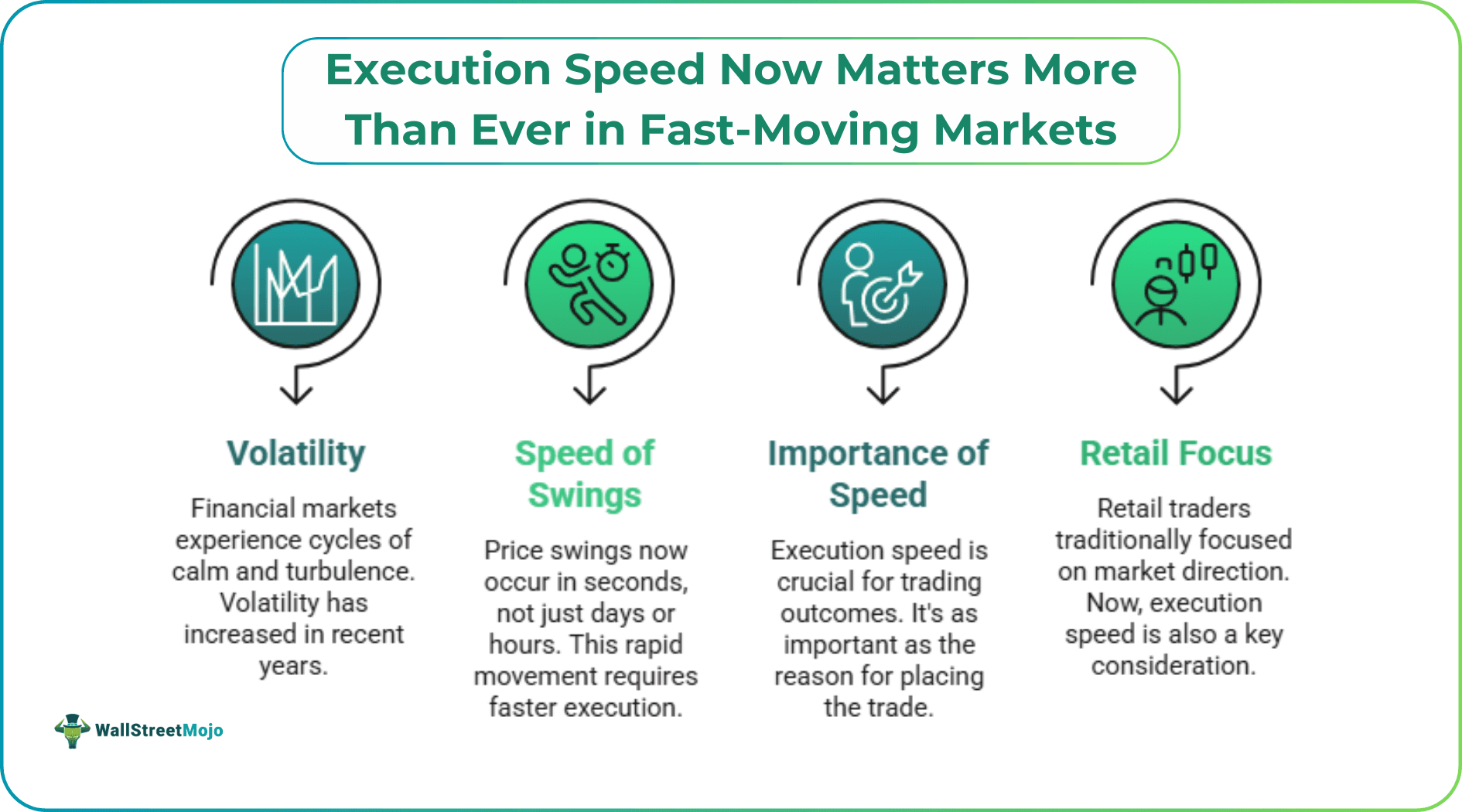
For many retail participants, the focus traditionally sat on direction: whether gold, currencies, or equities would go up or down. But as global markets react instantly to geopolitical headlines, economic data releases, and central bank signals, how fast an order is executed can be as important as why it was placed.
Volatility Is No Longer Gradual
The closing weeks of January 2026 and the opening days of February offered a clear illustration. Gold prices experienced sharp intraday swings driven by a mix of global economic uncertainty, shifting interest rate expectations, and safe-haven demand. In several sessions, the metal moved significantly within short time frames, with prices jumping or dropping before many traders could fully process the news behind the move.
In such conditions, delays of even a fraction of a second can alter trade results. A trader attempting to enter during a breakout may find the order filled at a noticeably different price than expected. Likewise, stop-loss orders—designed to limit risk—can be triggered in fast markets at levels worse than those visible moments earlier. This phenomenon, often referred to as slippage, becomes more frequent when markets are moving rapidly and liquidity thins at key levels.
What Execution Speed Really Means
Execution speed is not simply about a fast internet connection. It is the product of a deeper technological chain: server infrastructure, data routing, proximity to liquidity providers, and the efficiency of the trading platform itself. Orders travel through multiple systems before reaching the market. Each step introduces potential latency.
In stable conditions, small delays may go unnoticed. But when prices are changing several times per second—as seen in recent gold sessions—latency can translate directly into cost. A trade filled milliseconds later might mean entering at a higher price when buying, or a lower price when selling. Over time, repeated minor differences can significantly affect performance, particularly for short-term traders.
The Human Side of a Technical Issue
Execution speed also has a psychological dimension. Traders who repeatedly experience unexpected fills may begin to doubt their strategies, even when the underlying market analysis is sound. Frustration builds when planned entries or exits do not align with actual trade prices.
This is why education around market mechanics is becoming increasingly important. Understanding that fast markets behave differently—and that execution quality plays a role—helps set realistic expectations. It also encourages traders to look beyond spreads and commissions, considering the broader trading environment offered by a platform.
Fast Markets Expose Infrastructure Gaps
Periods of high volatility act like stress tests for financial infrastructure. Just as heavy traffic reveals weaknesses in a road network, rapid price movement highlights differences between trading systems. Platforms that function smoothly during calm sessions may struggle when order volumes spike and prices change rapidly.
Institutional traders have long prioritized low-latency systems and direct access to deep liquidity pools. Retail technology is gradually moving in the same direction, narrowing the gap. Some modern brokers, including firms such as ScoreCM, emphasize infrastructure designed to reduce delays between order placement and market execution, aiming to keep performance more consistent during volatile periods. While no system can eliminate market risk, technological efficiency can help ensure that price differences are driven more by market movement than by processing lag.
Why This Matters More Now
Several global trends are increasing the relevance of execution speed:
- Algorithmic trading: Automated systems react instantly to news and data, accelerating price changes.
- 24-hour markets: From currencies to commodities, trading now spans time zones with continuous information flow.
- Retail participation: More individuals are trading directly, often with shorter time horizons.
- News velocity: Economic figures, policy statements, and geopolitical developments spread globally within seconds.
Together, these factors create an environment where markets can reprice extremely quickly. The traditional image
Risk Management in a High-Speed Era
Faster markets do not necessarily mean more risk—but they do require adjusted strategies. Traders may need to:
- Use realistic stop levels that account for volatility
- Avoid overleveraging during major data releases
- Be cautious around thin liquidity periods
- Understand platform execution policies
Most importantly, recognizing that execution speed is part of the trading equation helps shift the focus from blaming strategy alone to evaluating the full trading setup.
Technology as the New Edge
In earlier decades, an informational edge—knowing news first—could provide an advantage. Today, information spreads too quickly for that to be reliable. Instead, operational efficiency has emerged as a subtle but meaningful differentiator. The ability to transmit and process orders swiftly does not guarantee success, but it helps align trade outcomes more closely with trader intent.
As markets continue to respond instantly to global events, the importance of execution speed is unlikely to fade. Whether trading gold during sudden safe-haven surges or currencies amid policy shifts, participants are operating in an environment where time is measured in milliseconds. In this landscape, speed is no longer just a technical detail—it is a core part of modern market dynamics.