Can Waterjet Cutting Help Businesses Stay Competitive in 2026?

Table Of Contents

Introduction
What actually gives a business an edge today, speed, cost control, or the ability to adapt without slowing everything down? It’s rarely just one factor. The pressure is layered. According to UNIDO data, global manufacturing output showed modest growth of around 0.5% in late 2025, reflecting steady but highly competitive conditions across major economies.
That combination, slow growth alongside intense competition, creates a very specific kind of pressure. Businesses aren’t just trying to expand; they’re trying to operate more efficiently than everyone else in the same space. Small inefficiencies start to matter more. Wasted material, rework, delays, they add up quickly.
That’s why many manufacturers aren’t chasing dramatic overhauls anymore. Instead, they’re leaning into practical technologies that improve precision, reduce waste, and fit into existing workflows without disruption. Waterjet cutting is increasingly part of that shift.
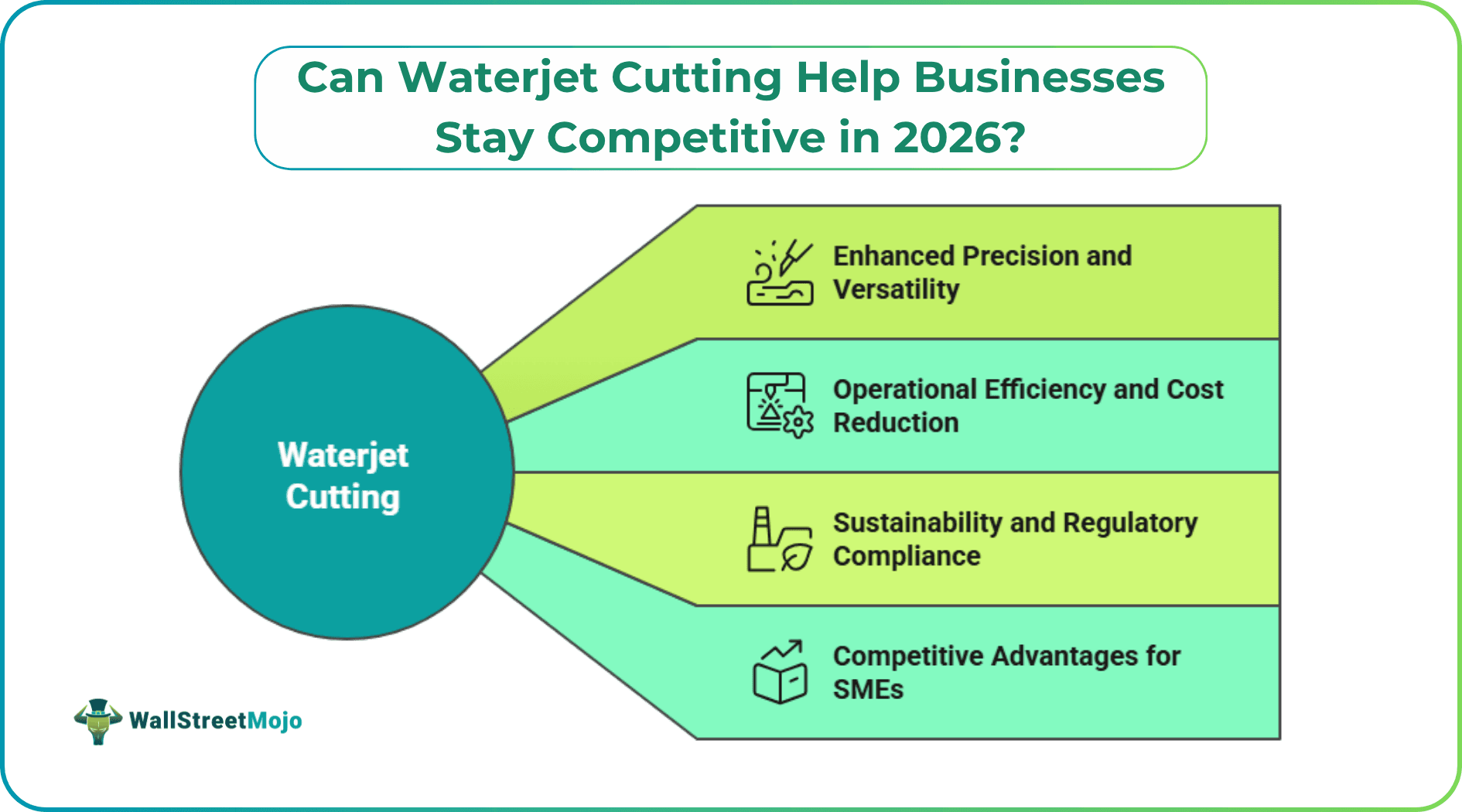
Here is how waterjet cutting helps businesses stay competitive in 2026:
#1 - Enhanced Precision and Versatility
Waterjet cutting stands out because it doesn’t force manufacturers to choose between accuracy and adaptability. It handles both, quietly and consistently.
- Works Across Materials Without Compromise: Metals, composites, ceramics, even glass, switching between them doesn’t require a complete reset. That alone simplifies operations in shops handling mixed workloads.
- Handles Complex Designs Naturally: Multi-axis cutting systems allow for angled edges, detailed contours, and intricate geometries without stacking multiple processes. It feels less like forcing a design into a machine and more like the machine adapting to the design.
- No Heat, No Hidden Damage: Because it’s a cold-cutting process, there’s no warping or internal stress. Parts come out clean, structurally intact, and closer to final form.
Many manufacturers relying on a modern water jet machine have noticed how this reduces the need for corrections later in the workflow. In some production environments, including those using OMAX systems, this kind of consistency tends to show up more clearly over longer runs.
#2 - Operational Efficiency and Cost Reduction
Efficiency doesn’t usually come from one big change. It builds quietly through fewer delays, better material use, and processes that don’t need constant fixing.
- Smarter Use of Materials: Modern waterjet systems often work alongside advanced nesting software, which helps arrange cuts in a way that gets more out of each sheet.
- Less Dependence on Secondary Processes: Because the cuts are clean and precise, there’s often less need for additional finishing. That means fewer extra steps, less manual work, and shorter production cycles overall.
- Automation That Supports Consistency: Many setups now integrate automated controls or robotic handling. Not in a drastic, factory-overhaul kind of way, but enough to keep output stable and reduce small human errors that tend to add up.
- More Predictable Turnaround Times: When processes are streamlined and require fewer corrections, timelines become easier to manage. Businesses can commit to delivery schedules with more confidence.
#3 - Sustainability and Regulatory Compliance
Sustainability in manufacturing often comes down to reducing impact without complicating operations.
- Cleaner Process: Waterjet cutting avoids heat, so there are no fumes or harmful emissions, making it easier to maintain a safer workspace.
- Easier Compliance: With stricter environmental regulations, processes that naturally produce less waste and pollution help businesses stay aligned without extra effort.
- Water Reuse Systems: Many setups recycle water through closed-loop systems, helping control usage and manage waste more efficiently.
- Less Scrap: No thermal damage means fewer rejected parts, which quietly reduces material waste over time.
#4 - Competitive Advantages for Small Businesses (SMEs)
For smaller businesses, staying competitive often comes down to doing more with limited resources, and doing it without overextending.
- Wider Range of Work: Waterjet cutting makes it easier to handle different materials and job types, so small shops aren’t restricted to a narrow set of projects.
- Flexibility in Production: From one-off prototypes to small production runs, the same setup can handle both without major changes.
- Lower Barrier Over Time: While the initial investment can feel high, improved efficiency and reduced waste tend to balance things out gradually.
- Ability to Compete with Larger Players: With consistent quality and adaptable processes, smaller businesses can take on work that would have previously gone to larger manufacturers.
2026 Market Outlook
Looking ahead, the waterjet cutting market in 2026 is being shaped as much by industry demand as by technological progress. North America is expected to remain a leading region, driven largely by consistent demand from aerospace and automotive sectors where precision cutting is non-negotiable.
At the same time, the automotive industry itself is seeing increased adoption, particularly for handling complex materials like composites and interior components that require cleaner, more controlled cuts.
There’s also a clear shift toward high-pressure systems, typically above 4200 bar, as manufacturers look for faster cutting speeds and improved efficiency without sacrificing accuracy. These shifts don’t feel sudden, but they do point toward a market that’s steadily optimizing rather than reinventing itself.
Conclusion
Staying competitive in 2026 doesn’t come down to one big decision, it’s usually the result of smaller, practical improvements that add up over time.
Waterjet cutting fits into that mindset. It brings precision without added complexity, supports a wide range of materials, and helps reduce waste in ways that aren’t always obvious at first but become clear in daily operations.
For many businesses, the advantage isn’t just in what the technology can do, but in how smoothly it fits into existing workflows. And in a landscape where efficiency and flexibility matter just as much as output, that kind of steady improvement is often what keeps businesses moving forward.