What Are Trading Alerts? Your Digital Eyes on the Market

Table of Contents

Introduction
In the fast-paced world of modern finance, the biggest challenge isn't just finding a good trade—it’s being there when it happens. Markets operate 24 hours a day, and even the most dedicated professional cannot stare at a screen indefinitely. This is where trading alerts come in. Essentially, they are your digital scouts, programmed to notify you the exact moment specific market conditions are met.
Whether you are a casual investor or a high-frequency day trader, understanding how to utilize these signals is the difference between catching a massive "pump" and arriving late to the party.
#1 - The Mechanics: How Alerts Work
At their core, trading alerts are "if-then" statements. You program a set of criteria into your trading platform or a third-party app, and when the market data matches those criteria, the system pushes a notification to your phone, email, or desktop.
This automation removes the emotional exhaustion of "chart watching." Instead of checking the price of Gold every ten minutes, you simply tell the system: "Notify me if Gold hits $2,500."
#2 - The Three Main Types of Alerts
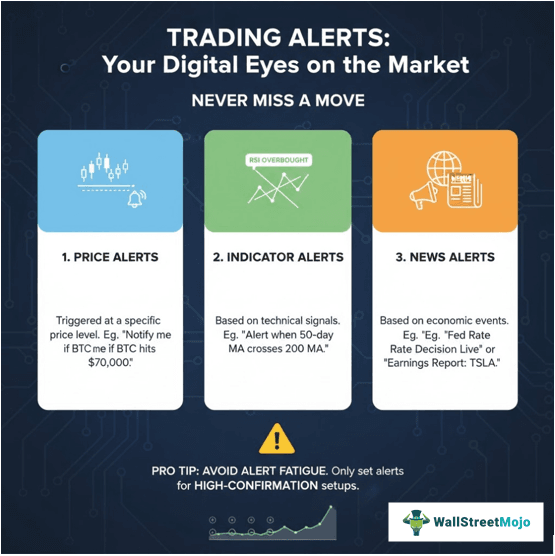
Not all alerts are created equal. Depending on your strategy, you will likely use a combination of these three:
- Price Alerts: The most basic form. You set a specific price level (Support or Resistance). When the asset hits that price, you get a ping. This is vital for "breakout" traders who want to buy as soon as a price ceiling is shattered.
- Technical Indicator Alerts: These are more sophisticated. You can set alerts for when two Moving Averages cross, when the Relative Strength Index (RSI) shows an "overbought" condition, or when a Bollinger Band is breached.
- Economic & News Alerts: These trigger based on external events—such as an unexpected interest rate hike from the Fed or a major corporate earnings leak.
#3 - Why Use Alerts? The Strategic Advantage
The primary benefit of trading alerts is efficiency. By using them, you can monitor dozens of assets across different markets (Japan, India, LATAM) simultaneously without having fifty tabs open.
- Emotional Discipline: Alerts help prevent "revenge trading" or "FOMO" (Fear Of Missing Out). If you only enter a trade when an alert triggers, you are following a pre-set plan rather than reacting to a random green candle.
- Freedom of Movement: For the modern trader, alerts mean you can go to the gym, have dinner, or sleep, knowing that if the "big move" happens, your pocket will buzz.
- Speed of Execution: In volatile markets, seconds matter. An alert allows you to jump directly into your broker app with the context already loaded.
#4 - The Danger of "Alert Fatigue"
While alerts are powerful, there is a common trap: over-alerting. If you set a notification for every minor price wiggle, you will eventually start ignoring them. This is known as "alert fatigue."
A professional trader only sets alerts for High-Confluence areas—spots on the chart where multiple indicators align. If you receive ten alerts a day, they are useful. If you receive two hundred, they are just noise.
#5 - Setting Up Your First Alert
Most modern platforms like the iforex trading platform have an "Alarm" icon. To start:
- Identify a key level where you would take action.
- Select the trigger (Price, % change, or Indicator).
- Choose your delivery method (Push notification is usually best for speed).
- Crucially: Define what you will do when the alert sounds before it happens.
Conclusion
Trading alerts are the bridge between a manual, stressful trading style and a systematic, professional approach. They allow you to stay connected to the global markets of 2026 without being enslaved to your monitor. By mastering the art of the alert, you ensure that you are always ready to strike when the iron—or the ticker—is hot.