What Drives Crypto Prices? A 2026 Guide to Market Trends and Key Influencers

Table Of Contents

Introduction
If you have been tracking crypto prices recently, you have probably felt that something has shifted. The market still moves quickly, but it does not feel as reactive as it once did. A single headline no longer sends everything soaring or crashing in the same way. So what changed?
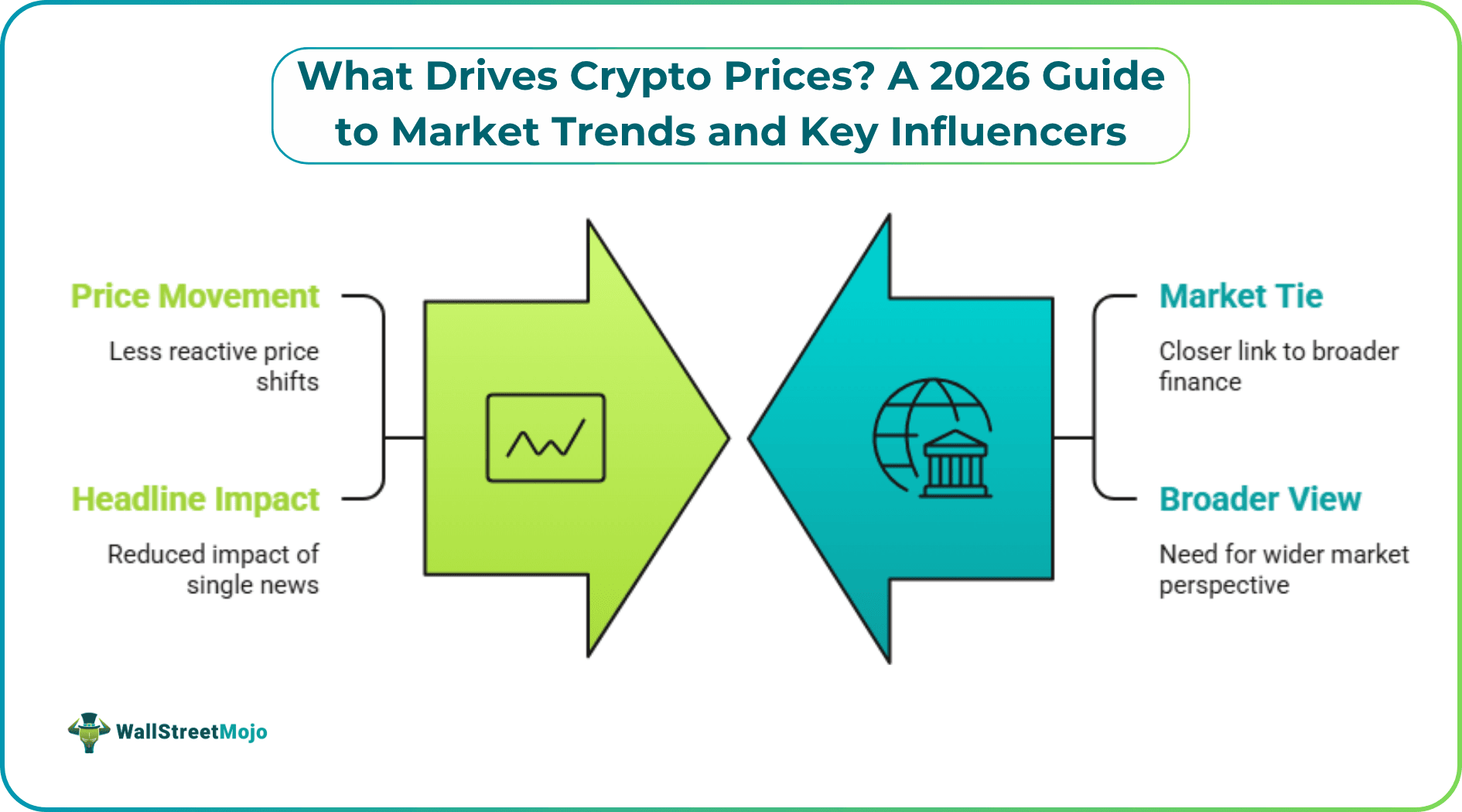
The short answer is that crypto is no longer moving on its own. It is now tied much more closely to the wider financial system. That means you cannot look at crypto prices in isolation anymore. You need to zoom out a little and look at the bigger picture.
The bigger picture now matters more
One of the clearest changes in 2026 is how strongly global conditions are influencing the market. Take oil, for example. Prices moved from around $119 to $81 and then climbed back towards $87 in a very short time. That kind of volatility doesn't stay contained. It affects inflation expectations, central bank decisions, and overall market sentiment.
When financial conditions tighten, liquidity becomes harder to access. And when that happens, investors usually step back from risk. Crypto, like equities, sits firmly in that category.
This is part of the reason why the total crypto market cap slipped by about 1.0 percent in January. It was not a dramatic fall, but it continued a four-month stretch of declines. That tells you something important. The pressure is steady, not sudden.
Why money is clustering around fewer assets
If you look a bit closer at the market, another pattern stands out. Capital is not spreading evenly anymore. Bitcoin holds roughly 59 percent of the total market. Ethereum sits near 11.8 percent. Everything else, especially altcoins outside the top ten, is squeezed into a much smaller share of around 7.1 percent.
That is quite a shift from earlier cycles. In simple terms investors are being more careful. Instead of chasing smaller tokens, they are sticking with assets that feel more established. It does not mean opportunity has disappeared, but it does mean confidence is not as broad as it used to be. You can think of it as a market that is still active, just a bit more selective.
Liquidity is telling its own story
Now, this is where things get more interesting. In January, spot Bitcoin ETFs saw outflows of more than $1.5 billion in the latter half of the month. That is a sizeable movement, and it added clear pressure on prices. What makes this important is not just the number, but what it represents.
At the same time, ETF volumes still account for about 9 percent of total Bitcoin spot trading. That is not huge yet, especially compared to equities, but it is growing.
So you have two things happening together. Institutional participation is increasing, but it is also more sensitive to macro conditions. When institutions pull back, the impact is noticeable.
Binance has pointed out that compliance, governance, and risk management are becoming central to the industry. That might sound technical, but the takeaway is simple. The market is becoming more structured, and large players are shaping how it moves.
Growth has not stopped, it has shifted
Even in a slower market, growth has not disappeared. It has just become more focused. Stablecoins are a good example. Their market cap is sitting close to $308 billion, which is near all-time highs. They quietly support a large part of the ecosystem by providing liquidity and stability.
There is also the rise of real-world assets. This segment has grown by about 14.4 percent to reach $19.5 billion. It reflects a steady push to connect blockchain with traditional finance in a practical way.
Ethereum is also seeing strong usage. Daily transactions are nearing 3 million and active addresses have crossed the 1 million mark. So even without prices moving too much, activity on the network remains high.
And then there are payments. Crypto card volumes have crossed $100 million, reaching roughly $115 million in January 2026. It is still small compared to traditional systems, but the direction is clear. Usage is slowly becoming more real.
So, how should you read the market now?
At this point, it is less about reacting and more about observing. Instead of focusing only on price, it helps to ask a few simple questions. Is liquidity improving or tightening? Is money flowing into major assets or spreading out again? Are certain sectors growing regardless of the broader trend?
You don't need to track everything. Just a few signals can give you a clearer picture. Crypto isn't just a speculative space anymore. It is becoming part of a larger financial system and that naturally changes how it behaves. Prices still move, sometimes sharply, but those movements are no longer random.
Taking a step back and looking at the full context can make the market start to feel less confusing. And once that happens, you are in a much better position to navigate it with confidence.