Why Discounted Cash Flow Models Often Give a False Sense of Confidence

Table of Contents

Introduction
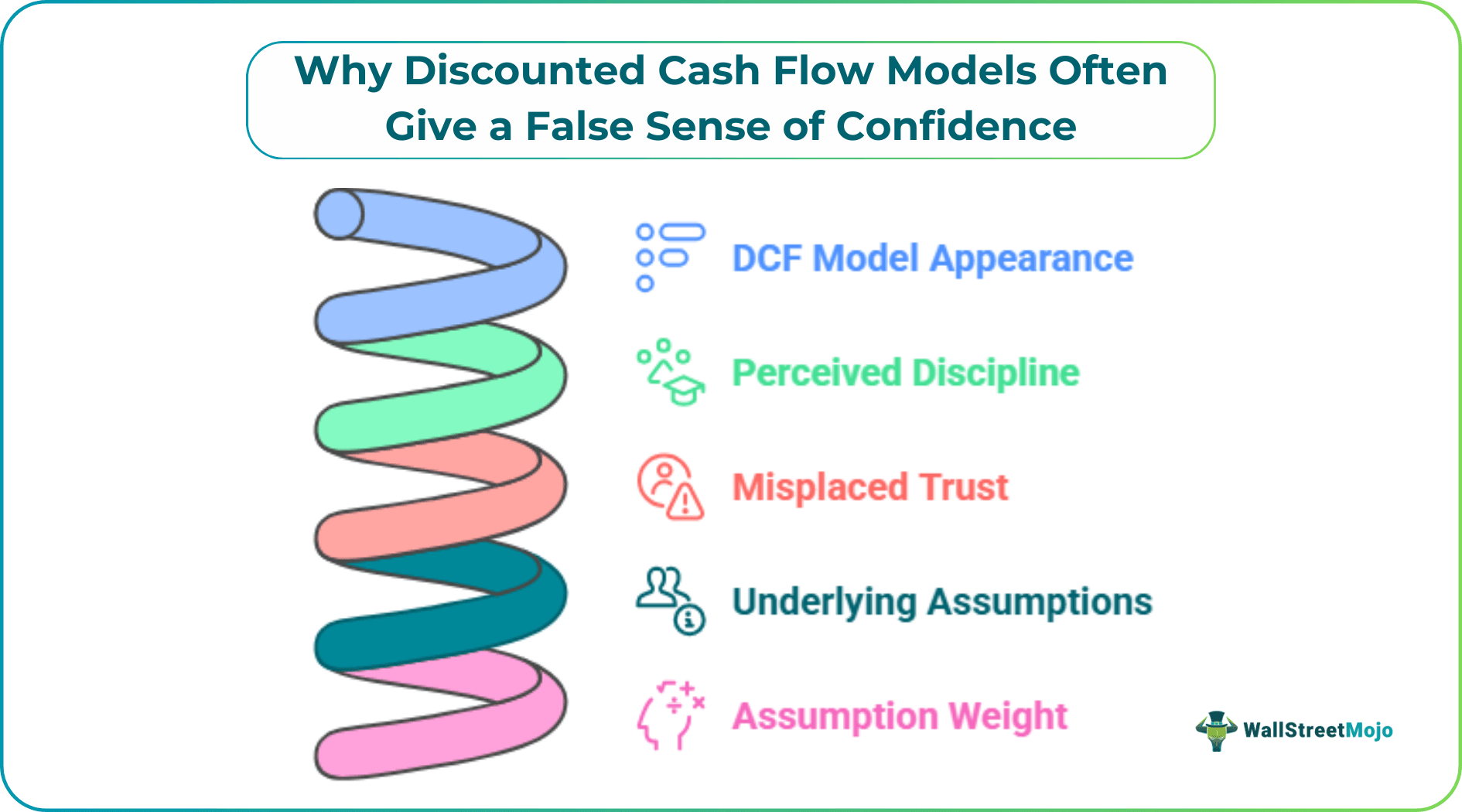
Most people trust DCF models because they feel disciplined. That trust is often misplaced. The discounted cash flow model appears scientific, wrapped in formulas and structured spreadsheets. But beneath the surface, DCF valuation relies on assumptions that carry far more weight than the math suggests. Understanding where DCF analysis breaks down matters more than knowing how to build one.
Why Finance Education Teaches DCF as the Gold Standard
Business schools present the discounted cash flow model as the foundation of valuation. The logic is clean: a company is worth the present value of its future cash flows. The method feels rigorous. It requires forecasting revenue, estimating margins, calculating working capital needs, and applying a discount rate. Each step appears methodical.
The appeal of DCF valuation lies in its structure. It forces analysts to think through operations, competition, and capital needs. The process creates the illusion of precision. Students learn that good financial modeling means detailed forecasts and careful documentation. They graduate believing that thorough DCF analysis produces reliable valuations.
But precision in method does not create precision in outcome. The discounted cash flow model is taught as a gold standard because it provides a framework, not because it delivers accuracy. The framework is valuable. The confidence it generates is not.
How Small Assumptions Quietly Dominate DCF Models
#1 - Revenue Growth Rate Assumptions
A 2% difference in annual revenue growth changes valuation by 30% or more in most DCF models. Analysts treat this input as a reasoned estimate. It is a guess dressed in research. Historical growth provides context, but past performance does not predict future results with the precision DCF valuation implies.
Market conditions shift. Competitors emerge. Regulation changes. A growth rate that seemed conservative last year becomes aggressive this year. The discounted cash flow model does not signal when assumptions have aged poorly. It simply recalculates based on whatever inputs the analyst provides.
#2 - Operating Margin Assumptions in Financial Modeling
Operating margins in DCF analysis follow a similar pattern. Analysts forecast steady improvement or stable margins based on industry benchmarks and management guidance. Small changes accumulate. A company projected to reach 25% operating margins instead of 23% generates vastly different cash flows over ten years.
Generating financial model documents through AI Docs can be a great way to get things moving, powered by AI, but with strict documentation and oversight.
Assumptions that dominate DCF model outcomes:
- Revenue growth rates compound small errors into large valuation gaps
- Operating margin assumptions change DCF valuation by 20-40%
- Working capital forecasts in financial modeling affect near-term cash flow
- Capital expenditure estimates alter free cash flow calculations
These inputs feel granular. Analysts spend hours refining them. But the refinement does not reduce uncertainty in DCF models. It hides it behind detail
Why Terminal Value Does More Work Than People Admit
Terminal value represents 60-80% of total value in most DCF valuation models. Analysts project cash flows for five or ten years, then calculate a terminal value to capture everything beyond the forecast period. This final number carries the bulk of the valuation.
The calculation looks straightforward. Take the final year's cash flow, assume a perpetual growth rate, and divide by the discount rate minus the growth rate. In a discounted cash flow model, changing the perpetual growth rate from 2.5% to 3% can shift valuation by 25%.
The perpetual growth rate is supposed to reflect long-term economic growth. In practice, analysts choose a number that feels reasonable. The difference between 2% and 3% growth forever is enormous. The DCF analysis does not communicate this sensitivity clearly. The final valuation appears as a single number, obscuring the fact that terminal value assumptions do most of the work.
Why terminal value creates DCF model risk:
- Terminal value represents 60-80% of total DCF valuation
- Perpetual growth rate assumptions are guesses, not forecasts
- Small changes in terminal value inputs create massive valuation swings
- Exit multiples in financial modeling produce similar sensitivity issues
How Discount Rates Are Treated as Inputs Instead of Judgments
The discount rate in DCF models is supposed to reflect risk. Analysts calculate WACC (weighted average cost of capital) using beta, market risk premium, cost of debt, and capital structure. The process feels objective. Each component has a formula.
But the discount rate is a judgment disguised as a calculation. Beta measures historical volatility. It does not predict future risk. The market risk premium depends on assumptions about long-term equity returns. Capital structure can change. The discounted cash flow model treats the discount rate as an input. It is actually a series of judgments about uncertainty.
A 1% change in discount rate changes DCF valuation by 15-20%. Analysts spend significant time refining cash flow projections while treating the discount rate as settled. The discount rate deserves more skepticism than it receives in financial modeling.
What Excel Hides by Making DCF Models Look Clean
Excel spreadsheets present DCF analysis in neat rows and columns. Formulas link cells. Colors highlight key outputs. The format signals professionalism. The structure implies rigor.
But spreadsheet clarity does not equal analytical clarity. A clean discounted cash flow model can obscure bad assumptions as easily as it can organize good ones. Excel makes it easy to update inputs and recalculate valuations. This ease creates a false sense that adjusting inputs refines accuracy.
The real problem is not the tool. The problem is that Excel allows analysts to build increasingly complex DCF models without forcing them to confront the uncertainty in their assumptions. More rows of calculations do not reduce uncertainty. They bury it.
What Excel formatting hides in financial modeling:
- Clean spreadsheets make DCF valuation assumptions appear more certain
- Linked formulas create the illusion of mathematical precision
- Complexity in DCF models often obscures rather than clarifies
- Easy recalculation suggests adjustments improve accuracy
Where AI Actually Helps Analysts Think More Clearly About DCF
AI does not fix the fundamental problem with DCF models. It cannot predict the future. But AI chat tools can surface patterns that human analysts miss and force clearer thinking about assumptions.
AI tools can compare a company's forecasted metrics against thousands of historical examples in financial modeling. They can identify when growth assumptions fall outside typical ranges for similar companies. They can flag when operating margin improvements exceed what comparable firms achieved.
This is not automation. It is pattern recognition. AI helps analysts see when their DCF valuation assumptions are optimistic or conservative relative to historical data. The analyst still makes the judgment. AI provides context.
How AI supports better DCF analysis:
- Compares DCF model assumptions against historical benchmarks
- Flags outlier assumptions in discounted cash flow models
- Runs sensitivity analysis faster than manual financial modeling
- Surfaces scenario distributions to show DCF valuation ranges
AI is useful when it makes uncertainty visible. It becomes dangerous when analysts use it to justify confidence.
Why DCF Models Are Still Useful If You Stop Asking the Wrong Questions
The discounted cash flow model fails when analysts ask it to produce a precise valuation. It succeeds when used as a framework for thinking through a business. The process of building a DCF model forces consideration of operations, competition, capital needs, and risk.
The value is in the questions, not the final number. What would need to be true for this company to justify its current valuation? How sensitive is value to margin assumptions? What happens if growth slows two years earlier than expected? These questions make DCF analysis useful.
The mistake is treating the output as truth. A DCF valuation is a range, not a point. It is a way to organize thinking, not a way to eliminate uncertainty. Used correctly, financial modeling through DCF helps analysts understand what drives value. Used incorrectly, it creates false confidence.
The discipline matters. The precision does not. When analysts stop asking DCF models to produce certainty, the models become more useful. They clarify assumptions. They expose sensitivity. They structure debate. That is enough.