

Part of our Risk Management guide
Introduction
Best Risk Management Software – Your customers no longer wait for audit week. They send security questionnaires year-round and expect evidence that is current, not “last quarter.” That shift turns SOC 2 from an annual fire drill into a continuous program.
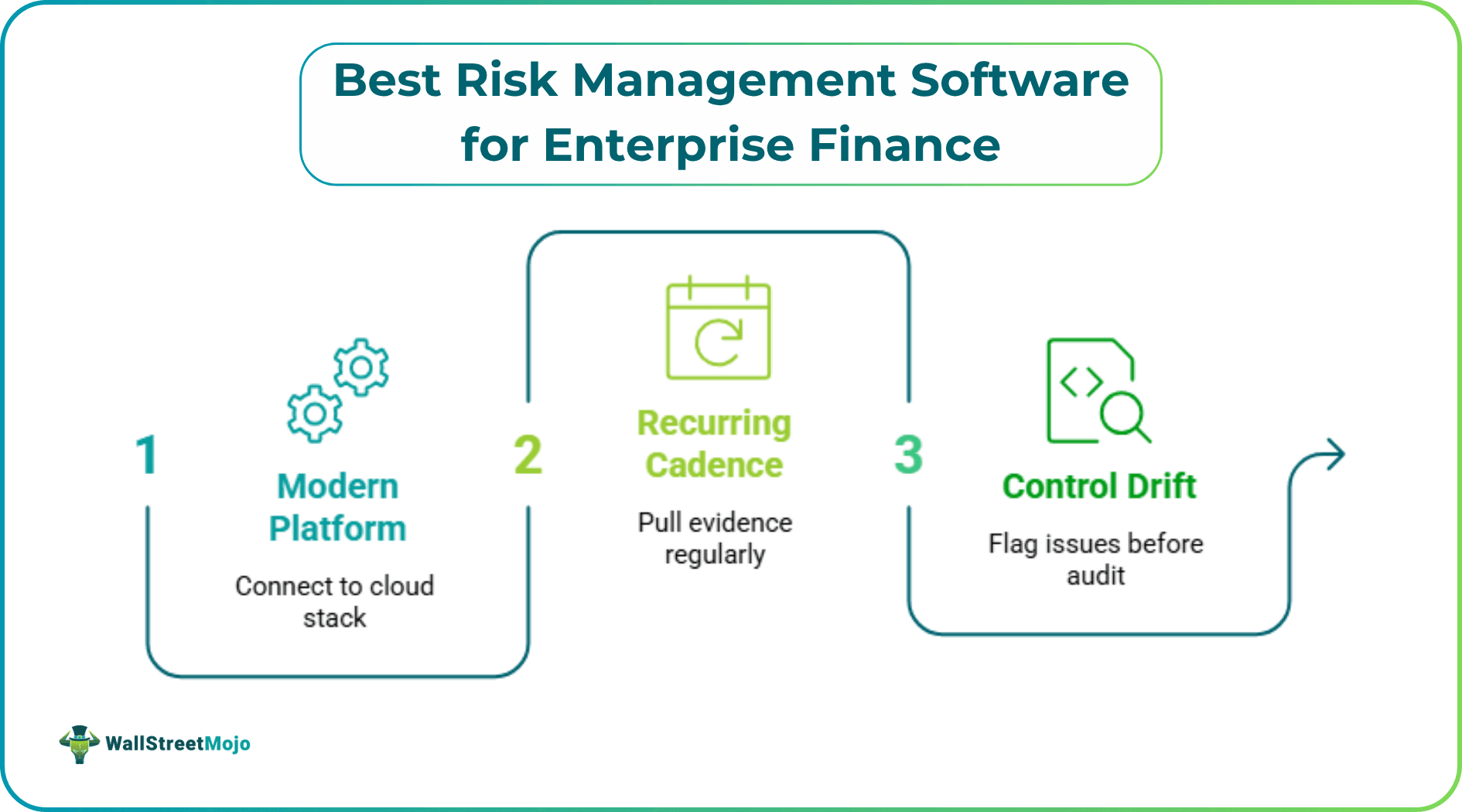
Modern compliance platforms are built for that reality. They connect to your cloud stack, pull evidence on a recurring cadence, and flag control drift before an auditor schedules a kickoff. In this guide, we compare the leading SOC 2 documentation and evidence-collection tools, highlight where each one is strongest, and call out where newer options and open-source projects fit.
How We Evaluated Each Platform
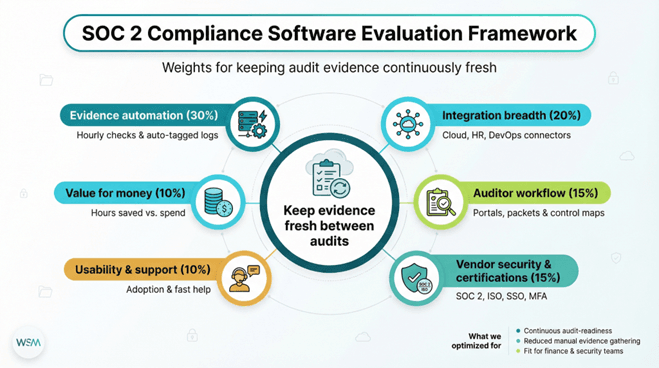
Before ranking anything, we asked one question: Will this tool keep audit evidence continuously fresh without turning SOC 2 into a second job?
We spoke with security engineers, reviewed user feedback, and ran hands-on trials in demo environments. We scored each platform on six factors that tend to predict day-to-day success, not just a clean audit week.
- Evidence automation (30 percent weight): Automatic evidence pulls and recurring control checks separate real time-savers from systems that still depend on screenshots. We prioritized tools that timestamp evidence, preserve history, and surface control drift quickly.
- Integration breadth (20 percent): Missing connectors create manual work fast. Front-runners now list 300-plus native integrations, and any serious contender should cover at least 100 across cloud, HR, and DevOps systems. Vanta, for example, advertises 375+ integrations.
- Auditor workflow (15 percent): Read-only auditor access, clean control mapping, and exportable evidence packets reduce back-and-forth during fieldwork. We favored platforms that support a clear auditor experience, including firms from both Big 4 affiliates and boutique CPA practices.
- Vendor security and certifications (15 percent): These tools ingest sensitive data, so we looked for vendors with their own SOC 2 or ISO 27001, plus enterprise basics such as SSO, MFA, and granular role permissions.
- Usability and support (10 percent); Automation only helps if control owners actually use the product. We tested task assignment, reminders, bulk edits, and in-app guidance, then evaluated support responsiveness for speed and substance.
- Value for money (10 percent): Finally, we weighed the cost against time saved. Higher-priced tools only scored well when their automation depth or framework coverage clearly reduced ongoing labor.
With that scoring model, we ranked the pure-play SOC 2 automation leaders head-to-head, then grouped the rest into categories where direct comparisons are less apples-to-apples. The goal is a shortlist your buying committee can defend.
Vanta
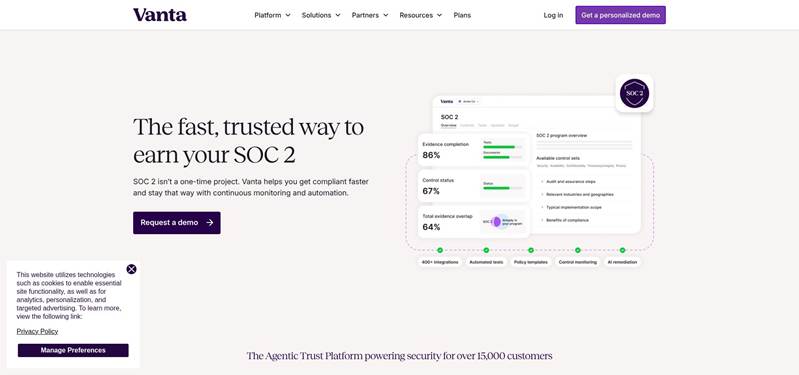
Vanta is the market leader in continuous compliance automation. It is built for teams that want evidence to stay current between audits, not just organized during audit week. The platform combines hourly monitoring, a large integration ecosystem, and auditor-friendly workflows, then extends into adjacent programs like Trust Centers, vendor risk management (VRM), access reviews, and questionnaire automation.
Vanta is ideal for:
- Mid-market and enterprise teams that need continuous, audit-ready evidence across a cloud-first stack
- Security and compliance leaders who plan to add frameworks beyond SOC 2 over time
- Revenue teams that want a customer-facing Trust Center to reduce repetitive security reviews.
#1 – How Vanta keeps evidence fresh
Vanta runs hourly automated tests across connected systems. When a check fails, such as a misconfigured cloud setting or an endpoint that falls behind on patching, Vanta ties the failure back to the underlying control and routes remediation to the right owner. The result is less “prove it after the fact” work, and more real-time control hygiene.
#2 – Integrations and automation depth
Integration coverage is where Vanta separates from most of the market. Vanta lists 375+ native integrations across core cloud, identity, HR, developer tooling, device management, and security tooling, plus options for custom and on-prem use cases through private integrations and an agent. For most organizations, that breadth is the difference between continuous evidence and a folder full of screenshots.
#3 – Auditor workflow
Vanta supports a clean auditor experience with a read-only portal and evidence that is already mapped to controls with timestamps and history. It also offers an auditor ecosystem to help teams find AICPA-accredited firms, which can reduce onboarding friction when you are choosing an auditor for the first time or switching firms.
#4 – Beyond SOC 2: frameworks, mapping, and scale
If SOC 2 is just your starting point, Vanta is designed to expand with you. It supports 35+ frameworks, and its cross-mapping approach lets you reuse controls and testing across multiple standards, so you do not rebuild your program every time the business adds a new requirement.
#5 – AI, Trust Center, and questionnaire work
Vanta’s AI capabilities are geared toward reducing manual compliance work. That includes an AI agent, a Smart Policy Builder, AI-generated artifacts such as SOC 2 system descriptions and ISO statements of applicability, and AI remediation guidance that can produce code-level fixes (for example, Terraform, AWS CLI, or CloudFormation suggestions). On the customer side, Vanta’s Trust Center can be paired with an AI chatbot for buyer Q&A, and its questionnaire automation helps teams respond faster to security reviews with less copy-paste.
#6 – Vendor risk management (VRM)
For teams trying to consolidate tools, Vanta also offers a dedicated VRM product through Vanta’s third-party risk management solution. It brings vendor questionnaires and supporting evidence into the same platform as your compliance program, which helps when procurement asks for third-party risk status in parallel with audit readiness.
#7 – Pricing and known limitations
Pricing is in the premium tier and is package-based, with entry points starting roughly $4K to $16K+ per year depending on scope and segment. For a 100-person SaaS pursuing SOC 2 with meaningful automation, quotes often land in the low five figures, scaling with headcount and the frameworks you add.
The main trade-off is cost, and the fact that deeper automation still requires upfront setup and ownership. If you invest that effort, Vanta is built to keep evidence continuously current, not just neatly stored.
Proof points: Vanta is trusted by 10,000+ customers and has been recognized as a Leader in the 2025 IDC MarketScape for Worldwide GRC software.
OneTrust GRC (formerly Tugboat Logic)
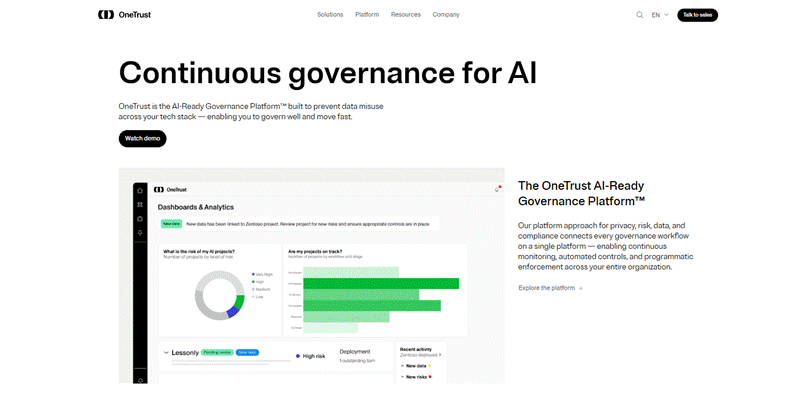
OneTrust GRC is part of a broader enterprise suite that spans privacy, third-party risk, and other governance programs. After acquiring Tugboat Logic, OneTrust folded SOC 2-focused compliance workflows into a larger platform aimed at organizations that want fewer vendors and a single system of record for governance. Its broader capabilities also support Enterprise change management by helping organizations align compliance, risk, and policy updates across multiple teams and business functions.
OneTrust GRC is ideal for:
- Enterprises where privacy and security programs are tightly linked, and teams want one platform for both
- Organizations that need broad coverage across compliance, privacy, and third-party risk, not just SOC 2
- Buyers comfortable with modular enterprise procurement and multi-team implementation
#1 – How evidence stays current
OneTrust includes compliance automation capabilities inherited from Tugboat Logic and supported by OneTrust’s broader ecosystem. Compared to pure-play SOC 2 automation tools, OneTrust does not publish the same level of detail around evidence freshness cadence, so it is worth validating how your highest-impact controls are monitored in practice.
#2 – Trade-offs to expect
- Breadth over depth: Reviewers tend to value OneTrust for platform breadth more than SOC 2-specific depth.
- Post-acquisition friction: The Tugboat-to-OneTrust transition has been bumpy for some teams, with reports of feature degradation after acquisition.
- Pricing complexity: Contracts are typically modular and enterprise-grade, often reaching six figures annually for full-suite adoption.
Hyperproof
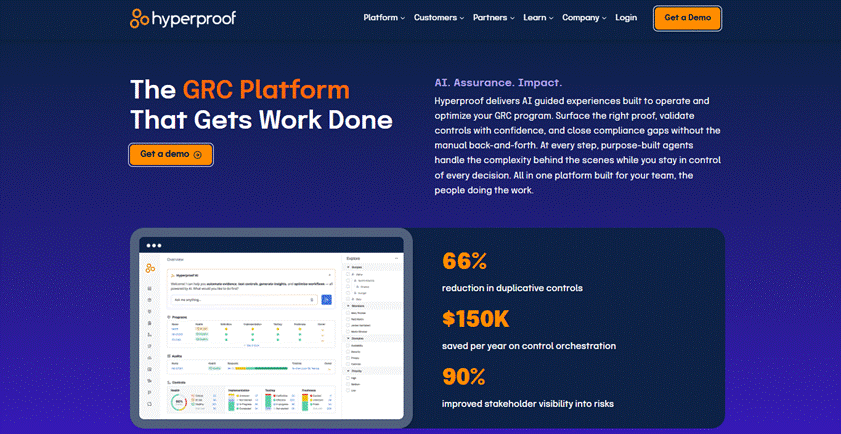
Hyperproof is best understood as a collaboration-first compliance workspace with risk built in. Controls behave like tickets. They have owners, due dates, and reminders, which helps when you are trying to run compliance as an operating cadence, not an audit scramble.
Best for
- Mid-market and enterprise teams that want a configurable system of record for controls, tasks, and risk
- Programs where ownership and accountability matter as much as automation
#1 – How evidence stays current
Hyperproof pulls evidence from native integrations on schedules you configure. It is not positioned around hourly, always-on infrastructure testing. In practice, evidence freshness depends on how aggressively you set those pull frequencies and how much of your stack is connected.
#2 – Where it stands out
- Risk linkage: When evidence shifts from pass to fail, linked risk scores can update automatically.
- Operational control management: Strong ownership workflows and a bulk-edit grid that makes it easier to update control frequencies at scale.
#3 – Limitations to plan for
- Onboarding effort: You typically need to model your control hierarchy up front, and that work benefits from a dedicated internal champion.
- Automation depth: More “compliance project management plus integrations” than deep, continuous control testing.
Thoropass
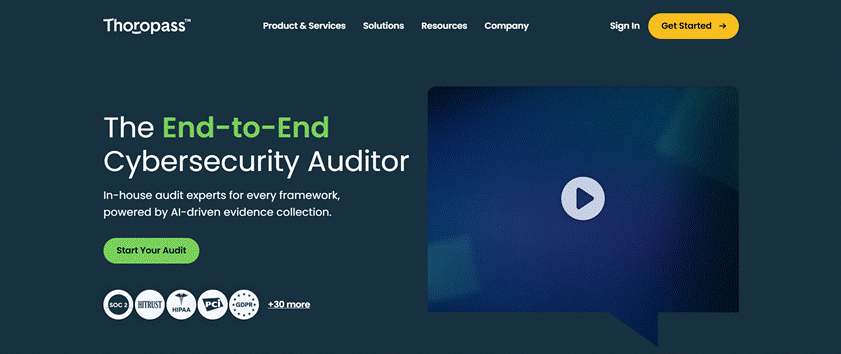
Thoropass (formerly Laika) bundles a compliance platform with an in-house, AICPA-registered CPA audit firm. The headline benefit is continuity. The same team that helps you prep can move into fieldwork without a big handoff.
Thoropass is ideal for:
- Small to mid-market companies that want one contract for prep plus audit
- Teams that value speed and convenience over auditor choice
- Organizations with mainstream cloud stacks, not complex on-prem environments
#1 – How evidence stays current
Thoropass can monitor cloud integrations and collect evidence automatically, but it does not publicly commit to a specific scan cadence. It also launches AI features like First Pass AI to pre-screen evidence quality before the audit, plus AI-driven sorting and questionnaire support. A key constraint is environment. On-prem evidence collection is fully manual, so the platform becomes more of a repository than an always-on evidence engine.
#2 – Audit workflow, with the trade-offs up front
Bundling the auditor reduces coordination overhead, but it also creates auditor lock-in and can raise independence concerns for some buyers. Reviews also flag operational risk, including auditor swaps and slower response times in some cases. If your procurement team requires auditor independence or you already have a preferred CPA firm, validate fit early.
#3 – Pricing (as reported)
- Platform subscription starts around $8,700 per year
- SOC 2 audit subscription starts around $5,800 per year
Scytale
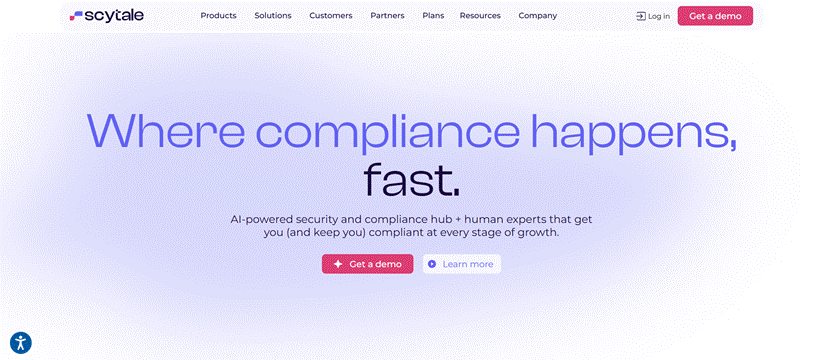
Scytale is a compliance automation platform with a strong “white-glove guidance” posture. It is often chosen by teams that want a dedicated expert involved from day one, not just software and templates.
Scytale is ideal for:
- First-time compliance teams that want hands-on guidance through SOC 2 and ISO 27001
- Startups that can live with daily monitoring and a smaller integration catalog
- Organizations that want a lighter-weight tool and high-touch support
#1 – How evidence stays current
Scytale runs automated tests daily, with roughly 500+ automated tests available. That supports continuous monitoring, but it also creates a 24-hour blind spot between scans if evidence freshness is your top priority.
#2 – Integrations, AI, and adjacent programs
Scytale offers about 90 integrations, which is meaningfully fewer than the largest platforms. It also includes an AI capability branded as a GRC agent, plus early access AI questionnaire support. Its AI does not include code-level remediation, and its vendor risk management is manual-only, with no vendor portal or continuous monitoring.
#3 – Framework coverage, with notable gaps
Scytale supports core frameworks such as SOC 2, ISO 27001, HIPAA, GDPR, PCI DSS, and SOX ITGC (via an acquisition). It does not support HITRUST, FedRAMP, or CMMC, which matters if you expect your roadmap to move in that direction.
#4 – Pricing (as reported)
- Startup SOC 2 around $7,500 per year
- Growth around $12,000 per year
- Built-in audit add-on around $4,200
How to Choose the Right SOC 2 Tool
Start with a reality check. SOC 2 software does not create a compliance program for you. It makes an existing program easier to run, easier to prove, and harder to ignore. If your policies live in an outdated folder and control owners never review them, the best platform will surface those gaps quickly.
Before you evaluate vendors, map three things: scope, stack, and staffing.
#1 – Define your scope
Be clear about what you are trying to accomplish in the next 90 days.
- Do you need a narrow SOC 2 Type I to unblock one customer?
- Or do you need SOC 2 Type II, with ISO 27001, HIPAA, or other frameworks queued up?
Tools optimized for fast SOC 2 readiness are different from platforms designed to run a multi-framework assurance program.
#2 – Match the tool to your tech stack
List the systems that store, process, or control access to customer data, then compare that list to each vendor’s integration catalog.
A useful rule of thumb is to target at least 70 percent automated coverage. If you cannot automate the majority of in-scope systems, you will fall back to screenshots, one-off exports, and last-minute evidence hunts.
If a critical system is missing, ask two questions:
- Is there an API or supported custom connector path today?
- If it is “on the roadmap,” what is the date, and what is the workaround until then?
Do not assume it will be painless.
#3 – Be honest about your people constraints
The right tool depends on who will run it.
- A small startup may benefit from hands-on implementation support and a guided workflow.
- A larger organization with an internal audit function may prioritize approvals, reporting, and role-based governance across many teams.
Choose a platform that fits the team you have now, not the org chart you hope to have next year.
#4 – Run a proof of concept that mirrors real work
Do not rely on demos alone. Set up a small test that includes:
- One non-production cloud account
- One code repository
- One identity provider or HR system if those are in scope
- At least one control owner outside the security team
Then evaluate what matters for continuous evidence:
- How quickly does evidence populate, and is it clearly timestamped?
- How clear are remediation steps when a control fails?
- How much manual work remains for the tools you actually use?
#5 – Involve your auditor early
Bring your auditor into the evaluation before you commit. Share screenshots or provide a guest login, and ask how they prefer to review evidence and request samples. A platform your auditor already knows and trusts can reduce fieldwork friction and cut down on back-and-forth.
Conclusion
Treat this selection like any other security decision. Define requirements, test in a contained environment, document what you found, then choose. When you pick a tool that fits your scope, stack, and staffing, evidence stays fresh, and audit season becomes a routine checkpoint instead of a scramble.
Recommended Articles
For more on Risk Management, explore these related articles from our Risk Management guide.