

Part of our Business Structures and Roles guide
Introduction
Skills-based employee development is transforming how organizations prepare their workforce for changing business demands. As industries are disrupted by automation and shifting global markets, the gap between what employees can do and what businesses need them to do is widening. This disconnect creates a strategic bottleneck that hampers growth and stifles innovation.
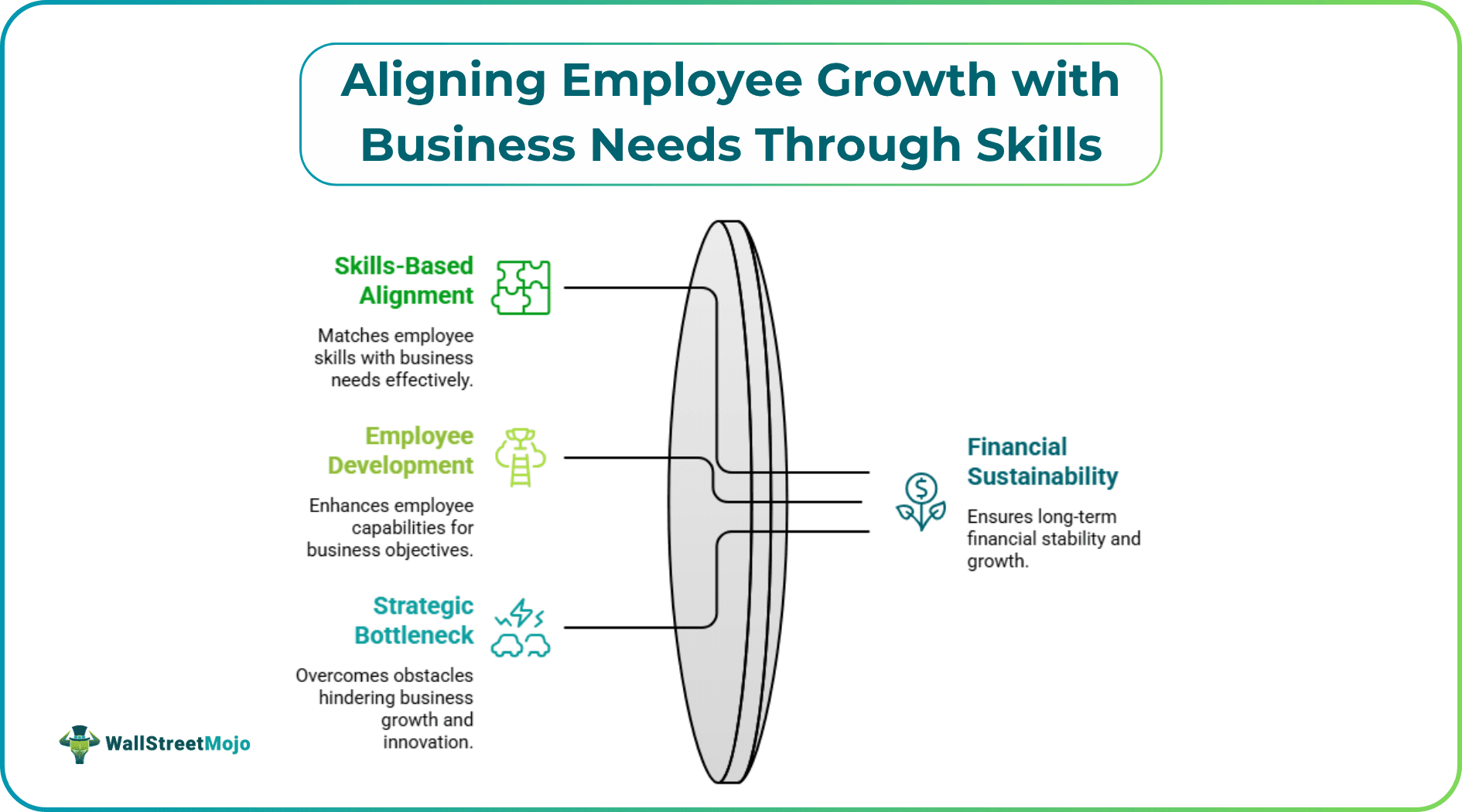
Aligning employee development with business objectives is no longer a luxury of human resources. It is a fundamental requirement for financial sustainability. A skills-based alignment ensures that every dollar spent on training and every hour invested in professional growth directly feeds back into the company’s bottom line.
This article explores how organizations can implement skills-based employee development to transition from rigid role-based structures to a dynamic skills ecosystem that fosters individual growth and organizational agility.
Key Takeaways
- Skills over Jobs: Focus on what people can do, not just their job titles.
- Strategic Mapping: Identify skills that directly support the company’s long-term goals.
- Gap Analysis is Critical: You cannot fix what you haven’t measured; regular audits are essential.
- Culture Matters: Technology facilitates learning, but a growth mindset sustains it.
- ROI Focused: Measure the impact of training on business KPIs like productivity and internal mobility.
- Agility: A skills-based approach allows companies to pivot faster in response to market disruption.
What Is Skills-Based Employee Development?
For years, the job was the most important part of the work. You just have to hire a “Financial Analyst” or a “Marketing Manager” based on a static list of responsibilities. A skills-based approach deconstructs these roles into their constituent competencies. Instead of viewing an employee as a fixed title, the organization now views them as a portfolio of skills.
Role-Based vs. Skills-Based Models
In a role-based model, career progression is both linear and vertical. In a skills-based model, work is fluid. If a project requires data visualization and risk assessment, then the organization pulls the best individuals with those specific skills, regardless of their department.
“The shift from jobs to skills is the most significant change in the workforce in our lifetime. Companies that don’t make this transition will find themselves unable to compete for talent or innovate at speed.” — Jack Ziegler, Founder of Athens Marketing.
By focusing on skills, businesses can deploy talent more precisely. It allows for internal gig economies where employees apply their strengths to high-priority projects, maximizing the return on human capital.
Importance of Aligning Employee Growth with Business Needs
Skills-based employee development bridges employee satisfaction and shareholder value by ensuring that workforce capabilities directly support business objectives. When development is haphazard, employees gain skills they may never use, resulting in the company remaining starved for critical expertise.
- Organizational Agility: A skills-aligned workforce can pivot quickly. When market conditions change, a company with a clear map of its internal skills can reassign people to new strategic priorities without any requirement for massive external hiring.
- Employee Engagement: Professionals are more motivated when they see a clear path between their growth and the company’s success. It provides not only a sense of purpose but also job security.
- Productivity and Performance: Targeted skill development eliminates competency waste. Employees spend their time mastering the specific tools and methodologies that drive the best quality output.
- Talent Retention: High-performers stay where they see growth. If an organization invests in an employee’s future in a way that benefits the business, it creates a mutually beneficial loyalty loop.
Types of Skills Organizations Must Focus On
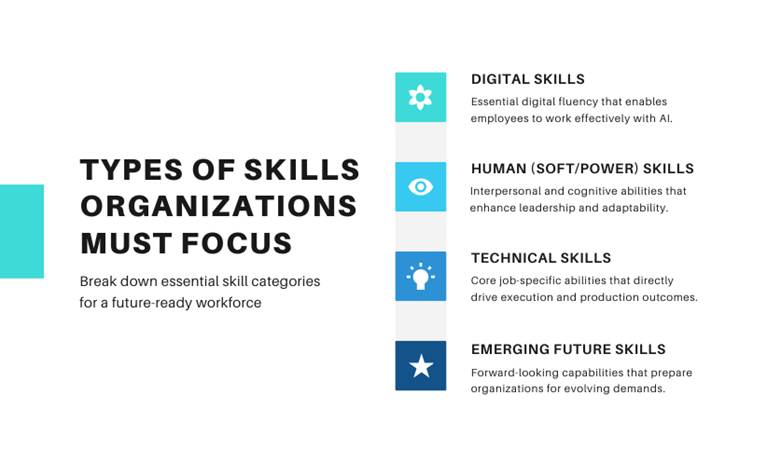
To achieve alignment, leadership must categorize skills into distinct buckets to ensure a balanced development strategy. By organizing competencies into these four pillars, businesses can create a roadmap that addresses immediate operational needs while preparing for long-term industry shifts.
#1 – Technical Skills
There are some of the hard skills required for specific tasks, such as coding, financial modeling, legal compliance, or operating machinery. While these have the shortest half-life, they are the immediate drivers of production.
#2 – Digital Skills
Beyond “tech” roles, every employee now needs digital fluency. This includes data literacy, the ability to work with AI tools, and cybersecurity awareness.
#3 – Human (Soft/Power) Skills
As AI takes over routine technical tasks, human-centric skills become much more valuable. Empathy and leadership are some of the skills that sustain an organization through many transitions.
#4 – Emerging Future Skills
These are speculative but necessary competencies, such as prompt engineering or sustainability reporting, which are expected to be critical in the next 3–5 years.
“We are moving into an era where the most important skill is the ability to learn and adapt. The ‘how’ of work is changing faster than the ‘what’.” — Jeffrey Zhou, CEO and Founder of Fig Loans.
Identifying Business-Critical Skills
Identifying which skills matter most requires a top-down approach to the company’s five-year strategy. If a bank plans to move 80% of its services to a mobile app, customer empathy and mobile UI/UX become business-critical skills.
- Linking Skills to Strategic Goals: Leadership must ask: What are our three primary growth drivers? And what specific competencies are required to execute them? This turns HR from a cost center into a strategic partner.
- Role of Leadership and HR: Leadership defines the where, and HR maps the how. For instance, in the pharmaceutical industry, if the goal is to shorten R&D cycles, machine learning for drug discovery and agile project management might be most critical for the organization.
Conducting a Skills Gap Analysis
A skills gap analysis is the diagnostic tool used to measure the distance between current capabilities and future needs. Here are some of the steps required in this process:
#1 – Assessing Current Skills
Organizations must go beyond basic resumes to catalog the actual proficiency levels of their staff. This inventory utilizes employee self-assessments and objective performance data. By quantifying existing strengths, leadership gains a transparent view of available human capital. This process often uncovers hidden talents that remain underutilized in traditional structures.
#2 – Defining Required Skills
The focus should shift to defining competencies required for future success based on strategic goals. If a company aims for automated manufacturing, the list must include robotics and data science. Leadership should look ahead three to five years to find the most dominant industry technologies. This forward-looking list serves as the primary blueprint for all subsequent hiring and training initiatives.
#3 – Identifying the Gaps
The final step is the gap analysis, where current inventory is compared against future requirements. The resulting deficit represents the “skills gap” that the organization must bridge. Identifying these specific voids allows HR to move with surgical precision. Instead of generic training, the firm invests in niche programs that address exact missing links to impact competitive advantage.
#4 – Tools and Methods
Organizations use Skills Matrices and 360-degree feedback to quantify these gaps. In finance, this might reveal a surplus of traditional accounting knowledge but a deficit in automated audit technologies.
Designing Skill Development Strategies
Once the gap is identified, skills-based employee development helps organizations close it through structured learning and targeted training initiatives.
- Personalized Learning Paths: A training that can help everyone in the organization is dead. Using AI, companies can curate specific courses for individuals based on their current skill level and career aspirations. AI can make your job easy, but it will be you who can do critical thinking.
- Blended Learning: This combines online theory with practical, on the basis of job application for each role.
- Mentorship and Coaching: Technical skills can be taught by watching video lectures, but wisdom and nuance require human interaction.
- Continuous Feedback: Skill development shouldn’t be an annual review topic. It should be a monthly conversation.
“The best way to develop people is to give them a difficult task and the support to fail safely while they learn the ropes.” — Andrew Bates, COO of Bates Electric.
Integrating Skills into Workforce Planning
Skills-based employee development strengthens workforce planning by shifting the focus from headcount to the skills employees need to support business growth. Organizations can strengthen workforce planning by focusing on the following key strategies:
#1 – Forecasting Future Skills
By analyzing industry trends, companies can predict when a skill will become obsolete. For example, manual data entry is a declining skill, whereas data storytelling is ascending.
#2 – Hiring vs. Upskilling
The Buy vs. Build debate is central here. Often, it is more cost-effective to upskill an existing employee who understands the company culture than to hire a new, expensive specialist from the outside.
#3 – Internal Mobility
A skills-based organization allows employees to move laterally. If a salesperson has a hidden talent for data analysis, they should be able to transition into a business intelligence role easily.
“Management is about more than just moving people around; it’s about matching the right talent to the right problem at the right time.” — Tim Cassidy, Co-Founder of Online CE Credits.
Establishing Governance for Skills Alignment
To ensure skills-based employee development remains sustainable, organizations must move beyond ad-hoc training and establish formal governance. Governance provides the framework to synchronize individual growth with financial objectives. This oversight transforms skill management from a passive HR function into a rigorous business discipline that prevents fragmented or redundant development.
#1 – The Skills Steering Committee
A successful model begins with a cross-functional steering committee involving Finance, Operations, and HR. This group validates critical skills and authorizes capital allocation toward different areas. Involving the CFO ensures every learning initiative ties back to a measurable return on investment. This oversight prevents the training trap that often drains corporate budgets.
#2 – Standardizing the Skills Taxonomy
Effective governance requires a standardized skills taxonomy to serve as a common language. For instance, data fluency must mean the same thing in marketing as it does in accounting. Governance ensures this taxonomy is updated regularly to reflect rapid industry shifts. Without a unified language, data from intelligence platforms becomes unreliable, making an accurate gap analysis impossible.
#3 – Policy and Ethical Oversight
Governance provides the ethical guardrails for using skill data, particularly as companies implement AI tracking. Clear policies must dictate how data is collected and used in performance evaluations to protect privacy. Transparent guidelines build workforce trust, ensuring employees see skill alignment as a career benefit rather than surveillance. This fosters a culture of mutual accountability and long-term commitment.
Role of Technology in Skill Alignment
Technology is the engine that enables skills-based employee development at scale through AI-driven learning and real-time skills intelligence.
#1 – Modern Learning Management Systems (LMS)
Modern learning management systems (LMS) like ProProfs LMS have evolved far beyond simple digital repositories. Today, these platforms track individual progress in real-time and use algorithms to suggest highly relevant content. This ensures that training remains engaging and aligned with specific career trajectories. By automating the delivery of education, an LMS allows the organization to scale its growth initiatives with minimal administrative overhead.
#2 – AI-Driven Personalized Learning
AI-driven learning has revolutionized how employees interact with professional development. Artificial intelligence analyzes an individual’s daily work patterns to identify specific inefficiencies that need improvement. It then proactively suggests skills that would make that specific employee more productive. This personalized approach turns learning into a continuous and data-driven cycle. Live formats are increasingly part of this mix too — platforms offering Electives AI training for employees pair AI-curated content with instructor-led practice, which tends to drive faster real-world adoption than static, self-paced modules alone.
#3 – Real-Time Skills Intelligence Platforms
Skills Intelligence Platforms provide a comprehensive, real-time inventory of every competency within the organization. These tools allow leaders to visualize their talent bench at a single glance. By mapping these internal capabilities, businesses can respond to market shifts with speed and precision.
“We are seeing the rise of the ‘Second Machine Age,’ where technology doesn’t just replace physical labor but augments human cognition. Our skill sets must evolve to complement these machines.” — Adrian Iorga, Founder & President of Stairhopper Movers.
Building a Culture of Continuous Learning
No amount of technology can fix a culture that doesn’t value growth.
- Leadership Support: If executives don’t make time for their own learning, employees won’t either. Leadership must signal that learning time should be given to every employee.
- Encouraging a Learning Mindset: Psychological safety is key. Employees must feel safe admitting they don’t know something so they can be trained to master it.
- Rewarding Skill Development: Link promotions and bonuses to skill acquisition, not just tenure. When an employee masters a business-critical skill, it should be reflected in their compensation.
Measuring Effectiveness
The success of skills-based employee development should be measured using workforce, productivity, and financial performance metrics.
To satisfy the CFO, the ROI of skill alignment must be measurable through data. A business cannot manage what it does not quantify with specific metrics. Leadership teams must track how skill acquisition translates into actual financial performance. Every learning initiative must prove its worth on the corporate balance sheet.
#1 – Tracking Skill Acquisition and Velocity
One critical metric is the Skill Growth Rate within the organization. This tracks how quickly employees move from novice levels to expert status. Faster growth indicates that your internal training programs are highly efficient. It also shows that the workforce is adapting to new technologies quickly. High velocity in skill acquisition prevents the company from falling behind competitors.
#2 – Enhancing Internal Talent Mobility
Another vital indicator is the Internal Fill Rate for open positions. This measures the percentage of roles filled by existing staff members. A high rate suggests that upskilling efforts are successfully preparing people for promotion. This drastically reduces the high costs associated with external executive searches. It also keeps valuable institutional knowledge within the company walls for longer.
#3 – Reducing Time to Productivity
Time to Productivity is another essential metric for modern business leaders. It measures how long it takes a person to master a new skill. This is crucial when the company pivots to a new strategy. If employees learn faster, the business can realize new revenue streams sooner. Reducing this time frame minimizes the period of low output during transitions.
#4 – Analyzing Financial Impact and Retention
We must also analyze the Revenue per Employee as a macro-metric. This figure helps determine if a more skilled workforce is more efficient. Higher often indicates that skills are being used effectively. It serves as a high-level proof of the value of human capital. CFOs often look at this to justify larger budgets for learning.
Organizations should monitor employee retention rates among those in training. Data often shows that skilled employees stay longer at their companies. This reduces the significant financial burden of high staff turnover rates. Continuous learning creates a loyal workforce that feels valued by the firm. When growth aligns with needs, every training hour adds tangible value.
“If you don’t measure it, you can’t improve it. In the world of talent, the metrics must move from ‘completion rates’ to ‘impact on business outcomes’.” — Gavin Yi, Founder and CEO at Yijin Solution.
Challenges and Solutions
Transitioning to this model isn’t without friction.
1. Rapid Skill Changes: The half-life of a technical skill is now about five years.
- Solution: Focus on foundational learning skills.
2. Budget Constraints: Training is often the first thing cut in a recession.
- Solution: Use peer-to-peer coaching and free internal resources to lower costs.
3. Resistance to Change: Older employees may feel threatened by new requirements.
- Solution: Clear communication on how upskilling ensures their continued relevance and job security.
Best Practices for Success
- Align L&D with Strategy: Every training module should be traceable back to a corporate objective.
- Use Data, Not Guesswork: Use analytics to identify where the real bottlenecks are.
- Promote Internal Growth: Give employees the first shot at new roles before looking outside.
- Cross-Functional Collaboration: Break down silos so skills can flow between departments.
“The most effective organizations are those that function as ‘learning communities’ where knowledge is shared as much as it is acquired.” — Kellon Ambrose, Managing Director at Electric Wheelchairs USA.
Real-World Example: The Digital Pivot
Consider a global retail bank facing competition from FinTech startups. Their business need was “Digital First Banking.” However, their workforce was skilled in “Branch-Based Relationship Management.”
The Strategy:
- They identified 12 future-fit skills, including Cloud Computing and Agile Coaching.
- They launched an internal “University” where branch managers could learn digital product management.
- Outcome: Within just 24 months, 30% of their digital roles were filled by the most skilled internal staff, reducing hiring costs by $15 million and significantly increasing speed for their new mobile app.
Future Trends
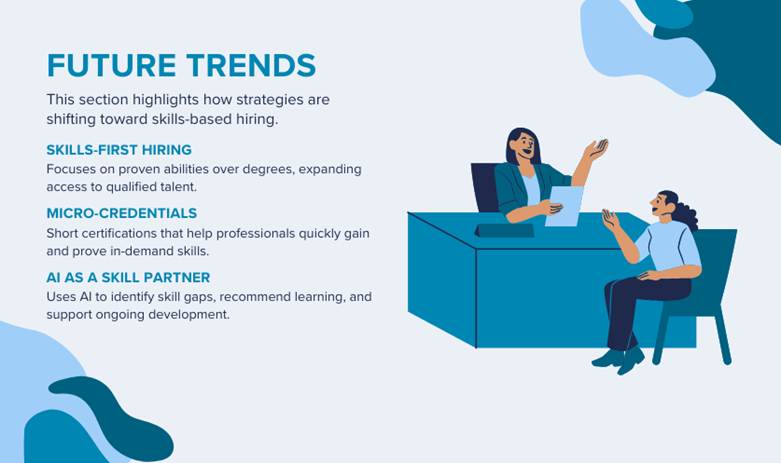
The future of work is not just approaching; it is already being built through a fundamental shift in how we value talent. As organizations move away from traditional credentials, several key trends are defining the new landscape.
- Skills-First Hiring: Removing degree requirements and hiring based on proven competencies.
- Micro-credentials: Moving away from four-year degrees toward specific, verified certifications.
- AI as a Skill Partner: Using AI to identify emerging trends before they hit the mainstream.
“The workplace of the future isn’t about where you sit; it’s about what you can contribute. The skill is the new currency.” — Tal Holtzer, CEO of VPSServer.
Conclusion
Skills-based employee development is the foundation for aligning employee growth with business needs. It helps organizations build an agile workforce while enabling employees to develop capabilities that drive long-term business success.
Precisely, for the business, it ensures a resilient, capable, and agile workforce ready to tackle the challenges of a volatile market. It also provides a clear sense of value and a trajectory for lifelong employability. By treating skills as a strategic asset, much like capital or equipment, organizations can unlock unprecedented levels of performance and innovation.
Frequently Asked Questions (FAQs)
What is a skills-based organization?
A skills-based organization de-emphasizes traditional job titles and hierarchies in favor of viewing work as a collection of tasks and employees as a collection of skills. This allows for more fluid deployment of talent across different projects based on competence rather than seniority.
Why is skill alignment important for the bottom line?
When employee growth is aligned with business needs, the company reduces wasteful spending on irrelevant training, lowers recruitment costs by filling roles internally, and increases revenue through higher productivity and faster innovation.
How can companies identify skill gaps?
Companies identify gaps through a Skills Gap Analysis. This involves auditing the current abilities of the workforce, defining the skills needed to achieve future business goals, and identifying the discrepancy between the two.
What tools help in skill development?
Common tools include Learning Management Systems (LMS), AI-powered learning platforms that offer personalized content, Skills Matrices for tracking progress, and internal talent marketplaces that match employees to projects based on their skills.
How often should a skills audit be conducted?
In fast-moving industries like tech or finance, a skills audit should be a continuous process or at least performed annually. This ensures the organization stays ahead of technological shifts and market changes.
Recommended Articles
For more on Business Structures and Roles, explore these related articles from our Business Structures and Roles guide.