7 Evidence‑Based Study Tactics for Finance Exams

Table of Contents

Introduction
Finance exams have a way of exposing study habits that feel productive but fall apart under pressure.
Rereading notes, watching solution videos, and memorizing formulas can create confidence right up until exam questions force you to recall, apply, and choose the correct method on the clock.
Many students do nt fail finance exams because they lack effort. Rather, it’s because their study approach does not match how exams actually work.
The good news is that certain study tactics consistently improve recall, accuracy, and decision making, especially in subjects like finance, where concepts overlap and timing matters.
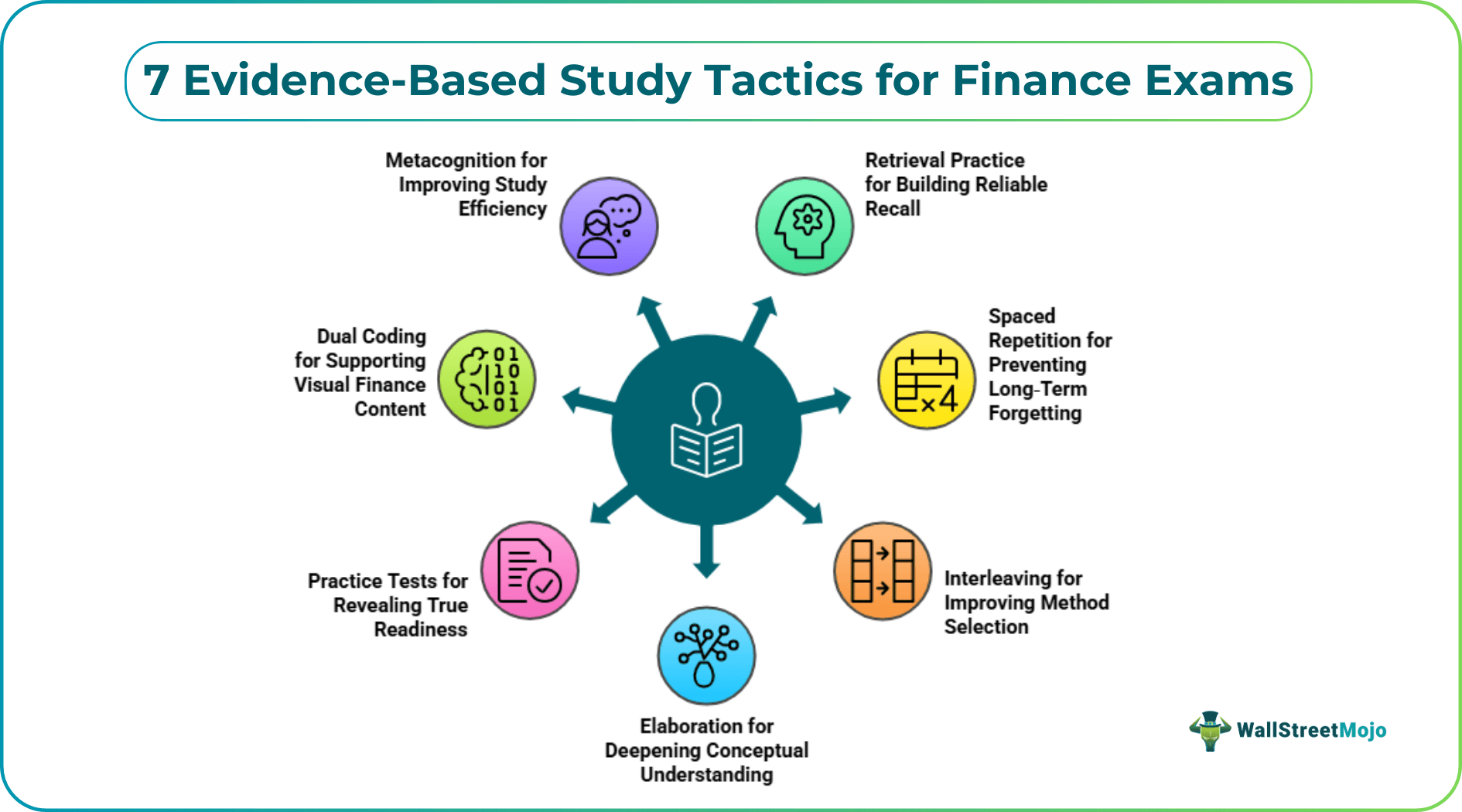
In this article, you will learn seven evidence‑based study tactics for finance exams that are backed by research and proven in real testing environments. Each tactic focuses on helping you study more efficiently, retain information longer, and perform with confidence when it matters most.

Image source: https://www.pexels.com/photo/close-up-shot-of-a-beautiful-woman-using-her-laptop-9158994/
Why Evidence‑Based Study Tactics for Finance Exams Matter
Evidence‑based study tactics for finance exams align with how the brain encodes and retrieves information. Finance exams rarely test isolated facts, so memorization alone collapses when questions combine concepts like risk, time value of money, and cash‑flow timing.
Strong strategies train recall and reasoning simultaneously.
Research in cognitive psychology consistently shows that active learning methods outperform passive review. Students using evidence‑based approaches often study fewer total hours while achieving higher scores.
#1 - Retrieval Practice for Building Reliable Recall
Retrieval practice involves pulling information from memory before checking notes or solutions. Retrieval practice leads to stronger long‑term retention than rereading or highlighting. Each recall attempt strengthens the memory pathways needed during exams.
Finance exams demand rapid recall of formulas and logic. Practicing how to calculate present value, bond yields, or accounting ratios without notes closely mirrors exam conditions. Mistakes during practice reveal gaps early, when correction still feels manageable.
High school students preparing for AP Economics exams often use AP exam practice tests to apply retrieval practice under realistic timing. Because AP Microeconomics and Macroeconomics require rapid concept application, timed testing strengthens recall while building endurance for multi-section exams.
#2 - Spaced Repetition for Preventing Long‑Term Forgetting
Spaced repetition spreads study sessions across days or weeks instead of cramming everything into one sitting.
Research reviewed by the Centre for Educational Neuroscience shows spaced learning improves retention and knowledge transfer. Small gaps between reviews strengthen memory consolidation.
Finance material builds sequentially. Revisiting time value of money, opportunity cost, and risk concepts weekly prevents relearning before finals. Spaced repetition also reduces stress by turning studying into a predictable routine.
#3 - Interleaving for Improving Method Selection
Interleaving mixes different types of problems within the same study session instead of blocking topics. Interleaving improves the ability to choose the correct strategy. Exams reward selecting the right approach, not repeating one formula.
Finance questions rarely announce which method applies. Mixing depreciation, cash‑flow timing, and ratio analysis forces careful reading. Interleaving feels harder during practice, but leads to stronger exam performance.
#4 - Elaboration for Deepening Conceptual Understanding
Elaboration involves explaining how and why a concept works in your own words. It improves comprehension and recall. Explanation builds connections between formulas and meaning.
Finance concepts benefit heavily from elaboration. Writing brief explanations for why higher risk demands higher return or why discount rates affect valuation strengthens reasoning. Strong reasoning reduces formula misuse during unfamiliar scenarios.
#5 - Practice Tests for Revealing True Readiness
Practice exams simulate pressure, pacing, and fatigue better than drills. A 2024 study indexed on PubMed found that spaced retrieval combined with testing significantly improved learning transfer. Transfer matters because finance exams often include unfamiliar twists.
Full‑length practice tests reveal pacing issues early. Awareness allows adjustments to timing strategies before exam day. Repeated exposure also reduces anxiety through familiarity.
#6 - Dual Coding for Supporting Visual Finance Content
Dual coding combines words with visuals like graphs, tables, and timelines. Cognitive‑science research shows that pairing verbal and visual information improves recall. Finance relies heavily on visual interpretation.
Drawing cash‑flow timelines or supply‑and‑demand curves reinforces understanding. Visual anchors speed recall under time pressure. Diagrams reduce cognitive load during multi‑step calculations.
#7 - Metacognition for Improving Study Efficiency
Metacognition involves evaluating what you actually know versus what feels familiar. Students often overestimate their understanding when relying on passive review. Accurate self‑assessment improves study efficiency.
Finance students benefit from checking confidence against performance. Incorrect answers signal where effort should go next. Honest evaluation prevents wasted study time.
Study Habits That Support These Tactics
Evidence‑based tactics work best when paired with consistent habits. Small behaviors compound over time and reinforce learning without adding extra hours.
Effective habits create structure and reduce procrastination. So:
- Study in short, focused sessions with one clear objective
- Attempt problems before checking notes or solutions
- Review errors and write brief corrections
Consistency matters more than perfection. Daily effort produces better results than irregular cramming.
Turning Evidence‑Based Study Tactics for Finance Exams Into Results
Evidence‑based study tactics for finance exams succeed because they match how learning actually works.
Retrieval practice, spaced repetition, interleaving, elaboration, and practice testing build durable skills rather than short‑term familiarity. Strong preparation reduces panic and increases confidence.
Be sure to check out other blog posts on our site about study tactics so that you can ace your finance exam.