


What Is Position Sizing?
Position sizing in trading refers to the number of units or shares held by the investor in a particular security. It forms a core component of the financial markets. It helps to estimate the trader’s capacity to purchase shares and the associated risk tolerance level.
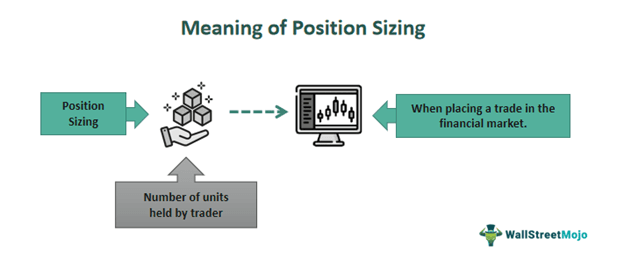
There are different methods and techniques to determine position size. Traders can also utilize it to control the risk level and returns generated from it. Besides, it is also possible to determine the capital invested in a particular trade. However, there are certain factors impacting the trader’s position size.
Key Takeaways
- Position sizing is the number of units owned by a trader in securities like stocks and currencies. The size may vary depending on the risk tolerance and capital invested.
- With the help of account risk and trade risk, it is possible to determine a trader’s position size. The formula for calculating position size is account risk divided by trade risk.
- Account risk is a percentage or fixed amount of the capital residing in the trading account. Trade risk is the amount allotted for each trade despite market conditions.
- The Kelly criterion uses probability to reduce losses and boost gains.
Position Sizing Explained
Position sizing is a financial term used in trading to describe the total units held by a trader in a particular trade. It refers to the shares owned in a trading position (buy or sell). Mostly, it is used in intra-day trading in the forex and equity markets. Traders use this concept to estimate their capacity to trade shares and own them at the same time. Also, it depicts their risk-bearing level to prevent losses further and optimize the profits.
Two major factors help estimate a position size for a particular trade: account risk and trade risk. Unless a trader acknowledges the risk associated with this account and trade, it is not possible to determine the position sizing in trading. Here, account risk refers to the risk associated with the equity capital or funds residing in the trading account. It suggests that traders spend only a part (or percentage) of it to avoid account risk. Conversely, trade risk aligns trades with available investment. They can set stop-loss orders to avoid any risk on trades placed.
Similarly, the prevalence of position sizing in the forex market is also visible. It helps traders to estimate the number of currency units owned by a forex trader in a particular trade. They can choose the account size and risk tolerance level to find their position size. Also, it is viable to earn higher returns at a reduced risk.
How To Calculate?
Position sizing is a crucial element of the trading system that helps to define the trades opted by traders. However, it is also essential to calculate the position size for the same. Following are the steps to determine the position sizing for the trades. Let us look at them:
Formula
To calculate the trader’s position size, it is necessary to consider both account and trade risk. The position sizing formula is described below:
Position size = Account risk/Trade risk
= (Equity held in the Account * risk per trade)/ (Security price – stop-loss)
Here, the position size is the number of units held by a trader in a trade position. In contrast, account risk is the percentage of the investor’s capital. For instance, if a person has $10,000 in the trading account and chooses to trade 3% ($300) on a trade, the position size can be calculated accordingly.
Position sizing strategies
Position sizing strategies are crucial for effective trading and portfolio management. Let us look at them:
Kelly Criterion
It is a mathematical formula used to find the position size while minimizing losses and maximizing gains. John Kelly first proposed it in the 1950s to determine the optimal position size for a trade.
k (%) = bp – q / b
Here, p and q are the probability of winning and losing (reward and losses) for a trade. Likewise, b is the ratio of net profit and net loss.
Fixed-dollar amount
It is the most popular method adopted by traders, and it involves a fixed amount for trades. For instance, a trader may tend to risk $300 despite volatility in the markets.
Percentage of account
It is similar to the fixed-dollar amount strategy. However, here, the approach considers a fixed percentage of the account for trade.
Volatility-based sizing
This method is flexible as it adjusts the risk depending on the volatility circulating in the market. For instance, a trader may reduce the position size in a highly volatile market to reduce losses.
Examples
Let us look at some examples to comprehend the concept in a simplified manner:
Example #1
Suppose Samuel is a trader who buys and sells different financial securities in the market. It has been around seven years since he started trading in shares and currencies. Each time, he uses a secret formula to minimize the losses and boost the returns in a sensitive market. With the help of position sizing, it was possible to avoid negative returns and decide the risk associated with each trade.
For instance, if Samuel has $30,000 in his trading account, he uses only a 4% percentage of it to trade stocks. In addition, he also kept a stop-loss of $300 to adjust the strategies to the volatility. Let us look at the formula used by Samuel:
Position size = Account risk / Trade risk
= ($30,000 * 4%) / $300
= $1200 / $300
= $4
Here, Samuel takes a position size equivalent to 4 lots to mitigate the risk associated with it.
Example #2
Published on March 27, 2024, an article delves into the notable presence of Alphabet and Chipotle Mexican Grill in billionaire hedge fund manager Bill Ackman’s investment portfolio, constituting 37% of his $10.4 billion holdings. This substantial investment demonstrates Ackman’s strong belief in the potential for large returns from these companies. The analysis further evaluates Alphabet and Chipotle’s financial standing and future growth potential, emphasizing the significance of position sizing in portfolio management. Additionally, it sheds light on how Ackman’s investment choices demonstrate his confidence in these businesses.
Importance
This approach holds significant importance for traders in both the forex and equity markets due to several key reasons:
- It prevents excess losses by determining the risk tolerance level for each trade or position.
- Traders receive an opportunity to tackle the extreme volatility and book profits. It helps in carefully selecting trading positions and benefits from the price efficiencies in stocks and currencies.
- This approach helps create consistency in the investment levels rather than allocating varying amounts of capital to trades. It allows traders to consider an optimal level of risk that does not drive the portfolio negatively.
- This strategy shields the trading account from uncertain market movements and reduces the risk of falling below margin levels.
Frequently Asked Questions (FAQs)
Frequently Asked Questions
What is the position sizing rule in trading?
Position sizing has certain rules that allow traders to trade effectively in the market. Typically, traders allocate 5% to 10% of their invested capital for each trade. As a result, a trader does not need to follow a formula or strategy to trade securities. For instance, if a trader has a capital of $1,00,000 in the trading account, the position ranges between $5,000 and $10,000. This approach helps traders manage risk by limiting the amount they are willing to risk on each trade.
How to calculate position sizing for options trading?
The formula for calculating position size for options traded in the stock market remains the same, but the account risk’s calculation varies. To determine the account risk, the premium per contract is multiplied by the quantity of underlying assets held in the contract. For example, a premium of $3 with 200 shares will result in an account risk of $600.
What is the difference between full porting and position sizing?
While both terms are widely used in trading sessions, they differ in their approach. Full porting occurs when a trader invests 100% of the capital in a single trade. In contrast, position sizing enables a shield where a trader refrains from investing entire capital.