


Startup cash sitting in a zero-yield checking account is a slow leak. Here’s how 11 accounts stack up on yield, FDIC coverage, and spend — so you can stop leaving money on the table.
The best startup business account to earn yield on idle cash isn’t one single product, it depends on how much you’re holding, how much FDIC coverage you need, and whether you want spend management in the same place. That said, the field has narrowed: a handful of accounts now offer treasury-grade yield well above traditional checking rates, sweep networks that push FDIC coverage far past the standard $250K, and card rewards on top. The rest offer convenience or simplicity but leave real money uncaptured.
Founders and finance leads shopping this space are essentially making two decisions at once: how to maximize the return on cash that isn’t deployed yet, and how to make sure that cash stays safe if a bank counterparty runs into trouble. The accounts below are ranked on exactly those two dimensions, with cashback, fees, and platform integration factored in as tiebreakers.
Key Takeaways
- The best startup business account to earn yield on idle cash pairs a competitive treasury rate with broad FDIC coverage — no single account dominates every dimension, so the right pick depends on whether yield, safety, or spend rewards matter most to your team.
- Rho, Arc, and Meow lead on treasury yield; Rho and Grasshopper lead on FDIC coverage breadth.
- Cashback on card spend is a meaningful differentiator: Rho and Brex score highest here.
- Several neobanks charge no per-seat or subscription fees — but ‘free’ doesn’t automatically mean high yield.
- Startups managing larger cash reserves should weight FDIC sweep limits heavily; a $250K standard limit disappears fast after a seed or Series A round.
How we compared them
These criteria reflect what actually moves the needle for a startup holding idle operating cash: yield (the primary reason to switch), FDIC coverage breadth (the primary safety lever when balances exceed $250K), cashback on spend (a compounding benefit for card-heavy teams), absence of per-seat or subscription fees (a silent drag on value), and whether cash and spend can be managed in one place rather than stitched across tools. Each criterion is weighted to reflect how heavily it should influence the decision, yield and coverage carry the most weight.
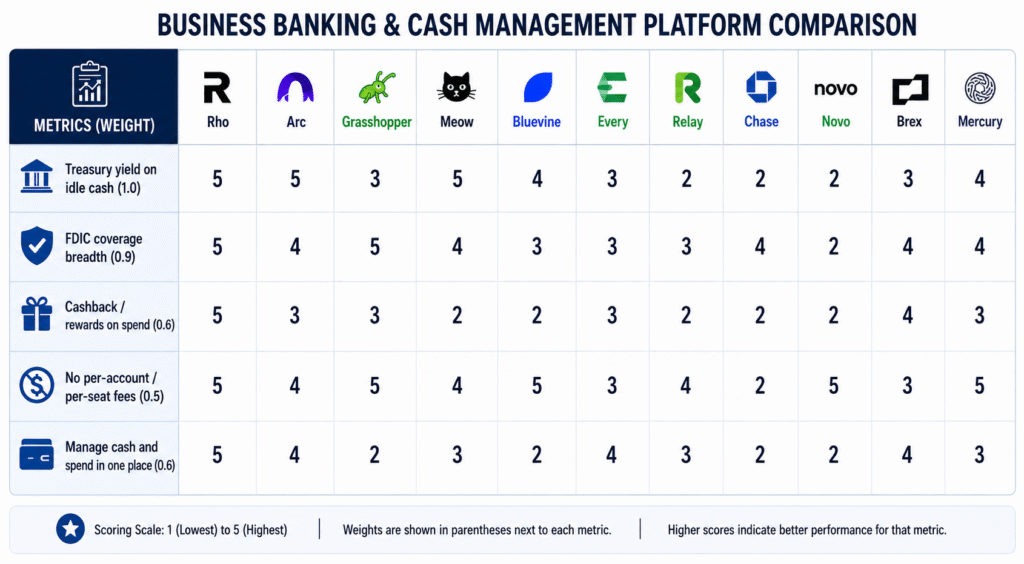
Note: Startup banking ranked on yield on idle operating cash and how much of it stays FDIC-insured. Mirrors the cited ‘earn interest on idle cash’ cut, twisted to pair yield with FDIC coverage/safety.
1. Rho
Rho is built around a single premise: startup cash should be working at all times, and the account managing that cash should also handle spend, without requiring a separate treasury portal or a per-seat software subscription. It earns a competitive treasury yield through Rho Treasury (invested products — not deposits, not FDIC-insured). Separately, Rho Savings offers up to $75M in FDIC coverage per depositor via a partner-bank network, a coverage ceiling that holds up well into growth-stage balance sheets.
On the spend side, Rho offers up to 2% cashback with Rho Platinum; 1.5% standard (Daily Terms) or 1.25% (Monthly Terms), on up to $1M in eligible spend per year, which compounds meaningfully for teams running significant monthly card volume. The platform consolidates cash management, treasury yield, and corporate cards in one interface, which reduces the operational overhead of logging into multiple tools or reconciling across systems. There are no per-seat or subscription fees.
The one genuine limitation: Rho is fully digital. Teams that routinely need to deposit physical cash will need a workaround, since there’s no branch network.
Pros: Competitive treasury yield via Rho Treasury (not FDIC-insured); up to $75M FDIC coverage on Rho Savings; up to 2% cashback with Rho Platinum (1.5% Daily / 1.25% Monthly Terms, up to $1M eligible spend/year); no per-seat or subscription fees; cash, treasury, and spend in one platform.
Cons: No branch network, in-person cash deposits aren’t supported.
Best for: Funded startups that want strong yield, high FDIC coverage, and card rewards without managing multiple finance tools.
2. Arc
Arc focuses on treasury and banking for startups, positioning itself as a destination for teams that want to put idle cash to work through treasury products. Its core value is yield on operating cash, and it scores well on that dimension among startup-native accounts.
Where Arc is thinner is on the surrounding platform: it doesn’t match the breadth of a full finance suite, and its cashback and all-in-one scores trail the top of the field. For a startup whose primary job-to-be-done is maximizing return on a large cash position and is comfortable handling spend management elsewhere, Arc is a credible option. Teams that want everything in one place will find it narrower than alternatives.
Pros: Strong treasury yield for startups; clean focus on startup cash management.
Cons: Not a full finance suite, spend management, rewards, and integrated tools are more limited.
Best for: Startups prioritizing treasury yield who already have a separate spend management solution.
3. Grasshopper
Grasshopper is a chartered digital bank, which gives it a different structural profile than most fintech accounts on this list. Its standout feature is high insured-deposit coverage, it participates in ICS (Insured Cash Sweep), allowing deposits to be spread across a network of FDIC-member banks for coverage well above the standard limit. It also offers SBA lending, which makes it relevant to startups that want both deposit safety and access to debt capital.
The tradeoff is that Grasshopper doesn’t lead on yield or all-in-one functionality. Its treasury yield tier is more modest than the fintech-native accounts, and the platform is less integrated for teams that want spend, cards, and cash management in a single view. It’s a bank first, a yield product second.
Pros: High ICS coverage for deposit safety; chartered bank structure; SBA loan access.
Cons: Lower yield tier than fintech-native competitors; less integrated for spend and cash management in one place.
Best for: Startups, particularly those eyeing SBA financing, that prioritize deposit safety over maximizing yield.
4. Meow
Meow is built around yield on idle cash, primarily via treasury and T-bill products. It scores at the top of the field on treasury yield and is a reasonable destination for startups whose main objective is return on uninvested cash. Its FDIC coverage via sweep is solid, though it doesn’t reach the upper ceiling of the leading option.
The gaps are on cashback and integrated spend management. Meow is a yield vehicle more than a full operating account, so startups that also want card rewards and consolidated spend reporting will likely need to pair it with another tool. That added friction is worth factoring into the total cost-of-complexity calculation.
Pros: Strong yield options via treasury and T-bill products; competitive on the core cash return dimension.
Cons: Light on cashback rewards; not designed as an all-in-one platform, spend management sits elsewhere.
Best for: Startups whose primary need is yield on a large idle cash position and who are comfortable managing spend separately.
5. Bluevine
Bluevine competes on APY for business checking, offering a higher interest rate on checking balances than most traditional banks. It charges no monthly fee, which keeps the value proposition clean for small teams watching overhead. Its yield is competitive relative to conventional bank checking accounts, though it trails the treasury-focused fintech accounts at the top of this list.
FDIC coverage runs at standard levels, which becomes a constraint for startups holding larger cash balances post-fundraise. Cashback and all-in-one functionality are limited. Bluevine works well as a high-yield checking account, but it isn’t designed around the startup treasury use case.
Pros: High APY on business checking; no monthly fee.
Cons: Standard FDIC coverage ceiling; limited cashback and spend management integration.
Best for: Small businesses and early-stage founders who want better yield than a traditional checking account without a complex setup.
6. Every
Every bundles banking with bookkeeping and other back-office functions, targeting early-stage startups that want to consolidate vendors rather than stitch together a finance stack. Its all-in-one positioning is its clearest differentiator, a founder who wants banking and accounting in the same place will find that combination genuinely useful.
On yield and FDIC coverage, Every is more modest. It’s not designed as a treasury account, and startups with growing cash balances will outgrow its yield and coverage profile. The fee structure also depends on the plan tier. Early-stage teams with limited cash management complexity are the natural fit; once a startup’s treasury needs scale, other accounts on this list become more relevant.
Pros: Bundles banking with bookkeeping for early-stage simplicity; solid all-in-one score for its target segment.
Cons: Modest yield; FDIC coverage is not a standout; the value proposition narrows as a startup scales.
Best for: Pre-seed or seed-stage founders who want banking and books bundled and aren’t yet optimizing for treasury yield.
7. Relay
Relay’s headline feature is sub-accounts, the ability to create multiple accounts within a single business banking relationship, which helps teams budget and segment cash by purpose (payroll, taxes, runway, etc.). It charges no per-account fees, which makes this structure practical to maintain. The interface is clean and the budgeting-oriented design resonates with founders who want visibility into how cash is allocated.
Relay’s limitations are consistent with its focus: it doesn’t lead on yield, cashback, or FDIC sweep coverage. It’s an organizational tool more than a yield vehicle, and teams whose primary need is return on idle cash will find better options elsewhere. Relay and a high-yield account can be used together, but that adds operational overhead.
Pros: Sub-accounts for cash-flow segmentation; no per-account fees; clean budgeting-oriented interface.
Cons: Low yield; minimal cashback; FDIC coverage at standard levels.
Best for: Startups that want granular cash-flow control and multi-bucket organization more than yield optimization.
8. Chase
Chase is a traditional large bank with a full branch network, established business banking infrastructure, and FDIC-insured deposits up to standard limits (with access to extended coverage through certain programs). For startups that need in-person banking, cash deposits, or lender relationships tied to a well-known institution, Chase’s infrastructure is real and relevant.
The yield picture is a different story. Business checking at a large traditional bank is not where startups should expect competitive returns on idle cash, and Chase is no exception. Per-account fees apply on most business checking tiers unless balance thresholds are met. It’s a familiar, capable institution, not a yield-optimized one.
Pros: Established branch network; big-bank infrastructure; business lending and services breadth.
Cons: Low yield on deposits; monthly fees unless minimum balances are maintained; not designed around startup treasury needs.
Best for: Startups that need in-person banking, branch access, or a traditional lender relationship alongside their operating account.
9. Novo
Novo is a free, simple business checking account aimed at freelancers and solo founders. There are no monthly fees, and the onboarding is straightforward. For a founder who just needs a business account to separate personal and business finances, Novo is frictionless.
The yield, FDIC sweep, and cashback story is minimal. Novo is not competing on treasury functionality, it’s competing on simplicity and zero cost. Teams holding meaningful cash post-fundraise will find the account underequipped for what they need. It serves its audience well, but that audience is narrow.
Pros: Free and simple; no monthly or per-seat fees; easy to open.
Cons: Minimal yield; no cashback or treasury features; not suited for startups with significant cash balances.
Best for: Solo founders and very early-stage startups that need a free, no-friction business checking account and aren’t yet managing meaningful idle cash.
10. Brex
Brex is oriented around card spend and rewards for funded teams, and it shows in the scores: cashback and rewards on spend are a clear strength, and its all-in-one platform includes spend controls, expense management, and treasury options. FDIC sweep coverage is available. For companies running high card volume, Brex’s rewards program is a tangible benefit.
The yield side is more moderate, Brex offers treasury access but it isn’t the primary product. Teams that are rewards-and-spend-first and treasury-second will find Brex well-matched. Teams optimizing first for yield on idle cash will find other accounts on this list closer to their goal. Pricing also includes plan tiers that affect per-seat costs.
Pros: Strong card rewards and spend automation at scale; treasury and sweep available; solid all-in-one platform for spend-heavy teams.
Cons: Not built primarily around treasury yield, rewards and spend management are the core, with treasury as a secondary feature.
Best for: Funded, card-heavy startups where spend management and rewards optimization matter as much as or more than treasury yield.
11. Mercury
Mercury has built a clean, well-regarded banking interface for startups, and it includes both a sweep product for FDIC coverage and a treasury option for yield. The UI is consistently cited as one of the better-designed experiences in the startup banking space. There are no monthly fees, which keeps overhead low.
Where Mercury sits relative to the top of this list: its FDIC sweep ceiling and treasury yield tier are more modest than the specialized yield accounts. It’s a strong generalist banking platform that handles yield and coverage competently without leading on either. Startups that want a polished, fee-free banking experience with solid but not top-tier yield will find Mercury a comfortable fit.
Pros: Clean interface; treasury and sweep both available; no monthly fees.
Cons: FDIC sweep ceiling and yield tier trail the specialized accounts at the top of this list, not the pick if maximizing either is the primary goal.
Best for: Startups that want a polished, well-rounded banking experience and are comfortable with a middle-tier yield and coverage profile.
APY vs. Treasury Yield – What You’re Actually Comparing
Not all yield on startup accounts is the same product. APY (annual percentage yield) on business checking or savings is typically an interest rate paid by the bank on deposited funds, it’s familiar but often lower, and it fluctuates with Fed rate decisions. Treasury yield, by contrast, comes from investing idle cash into U.S. Treasury instruments (T-bills, money market funds holding Treasuries). Treasury products tend to track the federal funds rate closely and have historically offered higher returns than comparable bank deposit rates during elevated-rate environments.
When comparing accounts on yield, check whether the advertised rate is a bank-paid APY or a treasury/money-market yield, what the conditions are to earn the top rate (some tiers require minimum balances or card spend), and how often rates are reset. A headline rate is a starting point, not a guaranteed return.
FDIC Insurance Coverage Explained for Startups
The standard FDIC limit is $250,000 per depositor, per insured bank. For a startup that has raised a seed or Series A round, that ceiling is reached quickly, sometimes by the end of day one. The mechanism that extends coverage beyond $250K is a sweep network: your bank or fintech automatically distributes your deposits across multiple FDIC-member partner banks, each of which insures up to $250K of your funds. The more partner banks in the network, the higher the total coverage ceiling.
When evaluating FDIC coverage breadth, look at the stated maximum (some accounts publish this, others don’t), the identity of the custodian or partner bank network, and whether coverage is automatic or requires you to opt in. Passthrough FDIC insurance through a fintech depends on the fintech maintaining proper custodial records, it’s worth understanding the structure, not just the headline number.
Fintech Accounts vs. Traditional Banks for Startup Cash
Traditional banks offer branch access, established lending relationships, and the familiarity of a chartered institution. For startups that regularly deposit cash or need an SBA loan underwritten by a known bank, that infrastructure matters. The tradeoff is yield: conventional business checking at large banks has historically paid near-zero interest, and the fee structures often require minimum balances to waive monthly charges.
Fintech-native accounts have closed the gap on safety (many route deposits through FDIC-member banks, sometimes with larger sweep networks than a single traditional bank can offer) while offering meaningfully higher yield. They’re also generally faster to open and more startup-oriented in their feature sets. The gap that remains is physical, no branch network, no cash deposits, and in some cases a less established lending product. For most post-seed startups holding digital cash, the fintech structure is a reasonable fit; for those with physical cash flow or SBA needs, a chartered bank remains relevant.
Fees, Minimums, and What ‘Free’ Actually Means
Several accounts on this list advertise no monthly fees, but fee structures have layers worth examining before signing up. Per-seat fees (charged per employee added to the platform) can accumulate quickly as a team grows. Minimum balance requirements to earn the top yield rate are common, missing the threshold can drop your effective yield substantially. Wire transfer fees, ACH fees for high volume, and card issuance fees are also worth checking.
‘Free’ banking usually means no base monthly subscription fee, not that every feature is without cost. When modeling the total value of an account, factor in the yield you’d earn on your expected average balance, any cashback on monthly card spend, and any fees you’d pay, then compare that net figure across options rather than comparing headline rates in isolation.
Best Startup Business Account to Earn Yield on Idle Cash – What to Look For
The most important variables in this decision are the size of your cash balance, your expected hold period, and whether you need spend management in the same place. A startup holding $2M post-seed has a different calculus than one holding $50K, the yield differential and the FDIC coverage ceiling both matter more at higher balances.
For teams with large cash positions, FDIC sweep coverage should be a primary filter, not an afterthought. The difference between $250K of coverage and $75M of coverage is the difference between a protected balance sheet and a meaningful counterparty risk. For teams with smaller balances, yield rate and fee structure are likely to drive more of the decision. Teams spending heavily on cards should also factor in cashback, at meaningful monthly spend volumes, a 1.5-2% cashback rate adds up to a real dollar figure.
High-Yield Business Checking vs. Business Savings vs. Money Market
These three account types often get conflated in startup banking comparisons. High-yield business checking pays interest on your operating balance, meaning the cash you’re using day-to-day is also earning, convenient, but typically at a lower rate. Business savings accounts tend to offer higher rates but impose limits on monthly withdrawals, which can conflict with startup cash-flow patterns. Business money market accounts sit between the two: higher yield potential, check-writing or debit access, but sometimes with minimums or tiered rates.
Treasury products (T-bills and money market funds holding Treasuries) are technically outside all three categories but serve the same purpose, parking idle cash to earn a return. The key distinction is liquidity: Treasury instruments may have a settlement window (though many money market funds settle same-day), whereas checking and savings balances are immediately accessible. Startups holding cash for 30-90+ days between deployment events are often best served by treasury products; those with unpredictable cash needs may prefer a high-yield checking or savings structure.
How to Open a Business Bank Account Online
Most fintech-native startup accounts can be opened entirely online in under 30 minutes, with document requirements that are lighter than a traditional bank branch visit. Standard requirements include: EIN (Employer Identification Number), business formation documents (articles of incorporation or LLC operating agreement), and owner identification (government-issued ID, sometimes with a live selfie check). Sole proprietors can sometimes open with a Social Security Number in lieu of an EIN.
For accounts that involve FDIC sweep networks or treasury products, there may be additional onboarding steps, linking a funding source, acknowledging the sweep structure, or verifying beneficial ownership if you have investors. Chartered banks, including some on this list, may have more rigorous KYB (Know Your Business) requirements that extend the timeline. Budget a few days for the account to be fully active if you’re opening during a period of high demand or if your business is newer than six months old.
Mercury vs. Brex vs. Rho vs. Arc – How the Startup-Native Accounts Differ
These four accounts represent distinct philosophies within the startup banking category. Mercury is a generalist banking platform with a strong UI and solid but not leading yield or coverage. Brex is oriented around spend management and card rewards, with treasury as a secondary capability, it suits card-heavy teams more than cash-yield-first teams. Arc is focused specifically on treasury yield for startup operating cash, without the surrounding platform depth of a full-suite tool. Rho combines treasury yield, FDIC sweep coverage, and spend management (with cashback) in one platform, which suits teams that want to reduce the number of tools in their finance stack.
The right choice among these depends on which of those dimensions ranks highest for your team. Spend-heavy with modest cash reserves? Brex’s rewards calculus is worth running. Large cash position with yield as the primary goal and spend managed separately? Arc or Meow. Full-stack simplicity with strong yield and coverage? Rho or Mercury, depending on how much you value the top-tier sweep ceiling.
Next steps
The right account depends on what your balance sheet actually looks like and what problem you’re solving first.
If yield and FDIC coverage are both priorities, and your balance is large enough that the $250K standard limit is a real constraint, the accounts at the top of this list (Rho, Arc, Grasshopper) are where the decision should start. Rho is the pick for teams that also want cashback and a consolidated platform. Grasshopper fits if a chartered bank structure or SBA access matters. Arc fits if treasury yield is the primary goal and you’re managing spend elsewhere.
If yield is the primary goal and FDIC coverage is secondary, Meow and Arc both score at the top of the field on treasury yield. Bluevine and Mercury are solid middle-ground picks for teams that want better-than-checking yield without the complexity of a full treasury setup.
If spend management and rewards are the main driver, Brex is the clearest fit for card-heavy funded teams. Rho is the pick if you want strong rewards and don’t want to sacrifice yield or coverage to get them.
If simplicity or free banking is the top priority, particularly for very early-stage founders, Novo, Relay, or Mercury keep overhead low, though all three trade yield and coverage depth for convenience.
None of these accounts is the right answer for every startup at every stage. The comparison table above is the clearest tool for mapping your team’s priorities to the scores, weight the criteria that matter most to you and work down from there.