


The development of AI is gradually moving beyond the usual race for graphics accelerators and is beginning to encompass a much broader technological market. Payment platforms are preparing for a marked debut — with a potential Stripe IPO as one example — amid the spread of AI agents capable of making purchases and carrying out financial transactions autonomously on behalf of users, while chip manufacturers gain a new source of demand for computing power. One of the main beneficiaries of this transition is unexpectedly Intel, whose central processing units play a significantly larger role in running AI agent systems.
In the early stages of the AI boom, CPUs were perceived more as a supporting component of data centers, since the bulk of investments were directed toward GPUs for model training and inference. However, AI agents need to not only generate responses but also perform multiple tasks in real time. Now they have to work with websites, applications, databases, and other services, and that load is increasingly shifting toward central processors.
The scale of the potential market is already becoming noticeable at the consumer level. Muse, the AI agent released by Meta, has been downloaded 2.5 million times since its launch on September 8. If such products truly become widespread, the computational load will increase not only during the training of new models but also with every interaction of millions of agents with external services.
For Intel, this creates an opportunity to capitalize on the AI boom after several years in which most investor attention was focused on Nvidia and AMD. Against the backdrop of high demand, the company is planning to raise prices for processors by approximately 10%. Meanwhile, Intel is trying to regain its position in advanced chip manufacturing and is developing Intel Foundry as an alternative to TSMC.
The first signs of progress are also emerging here. According to media reports, Google has chosen Intel for contract manufacturing of specialized TPUs, and Nvidia is considering the company as a backup manufacturer. Intel plans to start trial production using 14A technology as early as the first quarter of 2027.
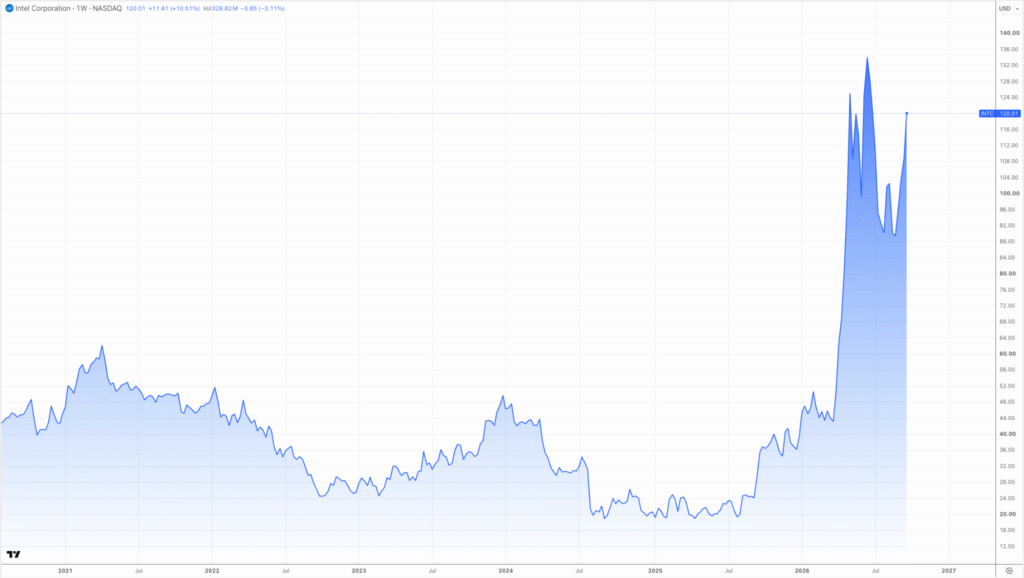
Unsurprisingly, the market has reacted aggressively. Over the past five months, Intel shares have risen by more than 170%, and by 270% over the past 12 months. For comparison, the Nvidia stock chart shows a gain of slightly more than 30% over the year, while AMD shares rose by 290%. However, Intel’s absolute market capitalization remains significantly lower at about $644 billion.
The comparison with AMD is particularly telling: this week, AMD crossed the $1 trillion market capitalization mark for the first time. Just ten years ago, Intel was valued at approximately 30 times more than its competitor, but now the situation has effectively reversed. In the second quarter, AMD’s revenue grew by 50% to $11.54 billion, and sales from its data center division increased by 107% to $6.7 billion. The company expects to double its sales of data center solutions by 2027.
However, Intel’s success in contract manufacturing is far from guaranteed. TSMC is accelerating the development of its own A14 process technology and intends to begin its trial use in the first quarter of 2027 as well. Mass production is scheduled for 2028. Compared to N2, the new technology should increase transistor density by 20%, boost performance by 10-15% while maintaining the same power consumption, or reduce power consumption by 25-30% while preserving performance.
TSMC is also significantly expanding its existing facilities. 2‑nm production is expected to reach 100,000 wafers per month by the end of this year and 140,000 in 2027, while 3‑nm production volumes will exceed 200,000 wafers per month.
Thus, Intel’s growth currently reflects two investor bets at once. The first is that the spread of AI agents will restore CPUs to a more prominent role in data center architecture. The second is that Intel will finally be able to turn its long‑term investments in manufacturing into a competitive contract business.
After such rapid growth over the past year, the market is already pricing a significant portion of the expected recovery into Intel’s valuation. Now Intel will have to prove that the new demand for CPUs and potential early customers for Intel Foundry can turn not only into a compelling comeback story but also into steady growth in revenue and profits.