

Part of our Business Finance guide
Introduction
For many professionals across Indian industries, AI has now become an integral component in their daily workflows and processes. This transition to AI readiness in the workplace hasn’t been dramatic or disruptive across domestic industries – and that’s mainly due to India’s tech-oriented professional culture. In the finance sector alone, we’ve seen a willingness to adopt tech like generative AI across various use cases, from financial modelling to analytics and data presentation.
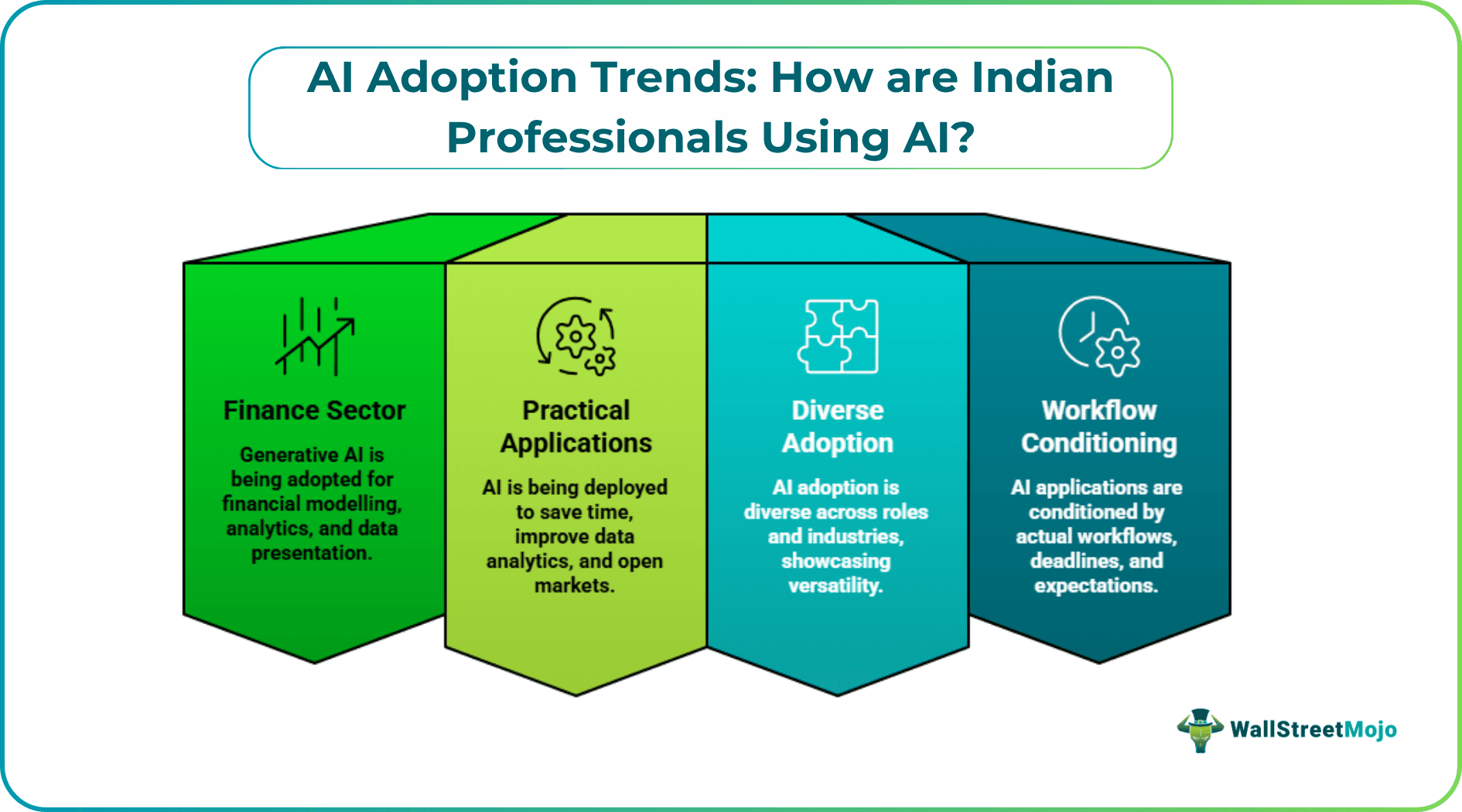
The same rings true for other major industries across the country. In real time through both public and private sector innovation, we’re seeing AI being deployed in practical, grounded ways: helping Indian professionals save time on mundane tasks, bolstering our data analytics and presentation capabilities, and effectively opening our professional outputs and markets up to globalising audiences.
What’s most interesting about current AI adoption trends is the way AI is being used differently in different roles and industries. The diversity of AI adoption measured by MeitY and initiatives like the IndiaAI Mission showcases the sheer versatility of the tools, but also the resourcefulness of our domestic industries. Across the board, however, AI applications and adoptions are being conditioned by actual workflows, deadlines, and expectations.
Here’s what the latest AI adoption trends and investments look like in different fields and sectors.

Creative Work Is Getting Faster, Not Less Personal
One of the most visible AI adoption trends is the growing use of AI in design, content, and marketing roles across India. Tools like Adobe Firefly’s generative AI tools are allowing creatives to scale by generating visuals, mockups, or variations – in minutes instead of hours. The goal isn’t to replace or substitute human creativity, but rather to speed up the early stages so that there is more room for refining and enhancing the finished product.
Meanwhile, writers, copywriters, and marketers are using AI to assist with outlining, generating ideas, and rewriting content in different tones or formats. Rather than starting with a blank page, they get an initial framework to mold and refine, which boosts their output in turn and greatly improves efficiency across these creative and strategic departments.
The final result, of course, is still entirely in the hands of whoever is using the tool. What’s changing is how fast they can iterate and refine to ensure their work is market-ready.
Routine Tasks Are Being Quietly Automated
One of the most significant AI adoption trends is the increasing use of AI for behind-the-scenes process automation – the backbone of efficiency in any digital-ready workplace. Here, the use of AI assistants is skyrocketing in popularity, with industries implementing these tools to perform administrative tasks such as scheduling, sorting emails, generating reports, or organising data, and even to undertake customer service tasks.
Adopting AI tech to facilitate these administrative tasks is naturally freeing up human resources for more dynamic action items, supporting Indian industries in maximising the value of their staff, and providing more compelling roles for industry talent.
Automation has other dynamic benefits alongside human resource management, including supporting Indian enterprises in maintaining more orderly, systematic processes. Indian professionals across various sectors are employing AI to perform management tasks like tidying up spreadsheets and summarising lengthy documents, as well as drawing key insights from business and client meetings.
The emphasis isn’t on doing things entirely differently, but instead on completing tasks faster and with less effort. Over time, that leaves more room for action items that merit the full attention and judgment of your staff.
Customer-Facing Roles Are Becoming More Responsive
In roles related to sales, customer support, and services, AI is helping professionals respond more quickly without compromising on quality. Chatbots and AI-assisted systems are often employed to address initial queries, sort requests, and draft responses that can be edited before sending.
This means much faster response times, a competitive advantage in fast-paced industries. It also enables teams to manage a larger volume of inquiries without needing to grow their team in parallel.
Customer service does, of course, still require a layer of human interaction to get the most out of it, particularly where tricky cases (i.e. complaints) are concerned. But now, it’s AI making the first pass, moving things along and streamlining customer service staff tasklists to ensure people can actually speak to a human agent faster if needed.
Learning and Upskilling Are More Self-Directed
Current AI adoption trends show that AI has become a reliable learning partner for many Indian professionals. Rather than being limited to formal courses, professionals looking to upskill efficiently can rely on AI to help explain concepts and dissect dense topics step by step. In this aspect, generative AI learning resources function almost like an always-available support system.
This is especially useful in disciplines and industries that are constantly evolving, such as tech and marketing. Professionals in these sectors operate with an expectation to keep their finger on the pulse, with top level leaders often even allocating time outside of business hours purely for industry research and skills building. With AI, these expectations for self-driven industry learning become easier to manage.
But the efficacies of AI for boosting the accessibility of industry learning isn’t just limited to senior leaders and business owners – it’s a potent resource for students at all levels as well, as the tools can adjust to your level of comprehension and existing industry knowledge. Even laymen can begin exploring new skills without having to commit to structured programs immediately. For this reason, AI mastery programs focusing on technical skills like coding, financial modelling, and trading are proving to be elegant alternatives to traditional tertiary courses and course providers.
Decision-Making Is Becoming More Informed
AI adoption trends also highlight how AI is supporting decision-making, especially in information-heavy roles. Professionals use AI tools to analyse data, identify trends, or model alternative scenarios. They’re getting a much clearer view of things at a speed they never would have been able to keep up with by manually going through spreadsheets or reports. AI doesn’t render human judgment obsolete, however. It just enhances that judgment with clearer, more accessible information.
This is particularly impactful in areas like finance, operations, and strategy, where decisions benefit from data-backed insights.
Freelancers and Small Businesses Are Scaling Smarter
One noticeable change has been how freelancers and small business owners are using AI to scale their output. Once-outsourced tasks – like basic design, content creation, or organising data – can now be done in-house with the assistance of AI tools. That doesn’t mean everything is a solo act. It just means that people can be more autonomous in the early days of growth.
For some, it’s a way of staying competitive without necessarily needing to drive up costs immediately. This opens up more flexibility in how work is managed and delivered.
There’s Still a Learning Curve, But It’s Getting Easier
Obviously, AI adoption hasn’t been without its hiccups. Some professionals are still figuring out where AI fits into their workflow, or how to make effective use of it without becoming overly reliant on it. There are also valid concerns around accuracy and data privacy.
But the tools themselves are also growing easier to use, which helps here. Interfaces are simpler, outputs are better, and there’s more guidance overall. As that continues, the barrier to entry keeps dropping and we see more professionals turning to AI as a result.
Final Thoughts
Current AI adoption trends show that Indian professionals aren’t suddenly taking a great leap into AI. It’s just happening in small practical ways across various types of work. People are using it where it fits naturally, rather than shoehorning it into their processes. Whether it’s saving time, improving quality, or staying responsive to customers, the focus remains on usefulness.
It’s not replacing professional skills, nor skills building strategies, but rather providing alternative pathways to make the end goal of self-improvement more accessible to a wider pool of professionals that may have different learning styles or weekly capacities for learning and knowledge absorption. Those who are getting maximum value from AI are people who already understand their own work well enough to guide it. And that’s probably how this trend will play out, with AI being a helpful addition to a process, rather than the entire solution.
Recommended Articles
For more on Business Finance, explore these related articles from our Business Finance guide.