The 7 Sectors Every Investor Should Watch in a Bull Market

Table Of Contents

Introduction
There is a moment in every bull market when investors start feeling invincible. Stocks are going up, portfolios look healthy, and it seems like everything you touch turns to gold. That feeling is exactly when most people stop paying attention to the details and just ride the wave without a plan.
The investors who actually build wealth in a bull market are not the ones who buy randomly and hope for the best. They are the ones who understand which sectors lead a rally, which ones follow, and which ones quietly become the biggest winners before the mainstream media even notices.
Sector investing is not complicated. But most people never learn it properly, which is why they end up buying at the top of the wrong sectors and wondering why their portfolio underperforms an index that just keeps marching higher.
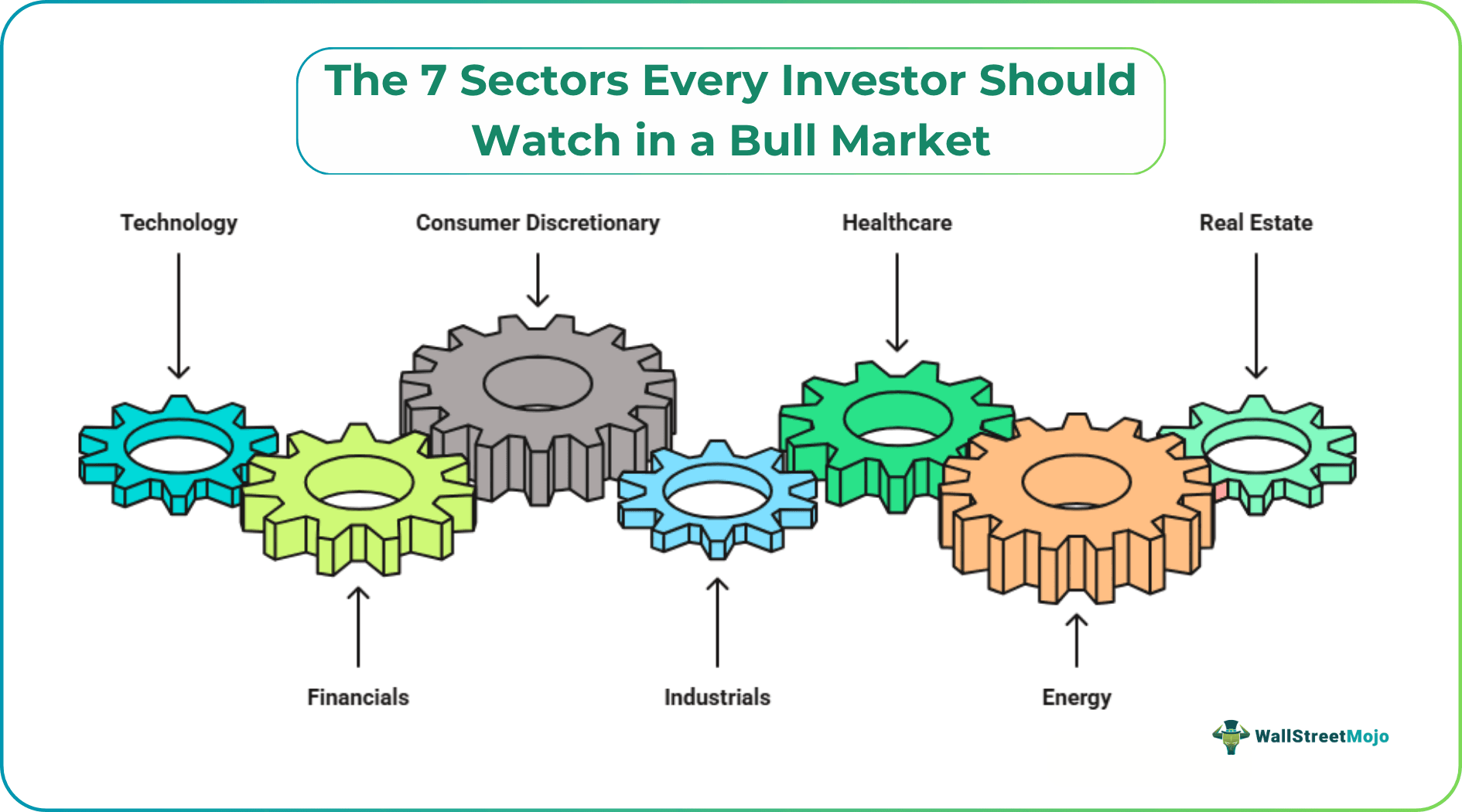
Here are the seven sectors you absolutely need to be watching when the market is running hot.
#1 - Technology: The Engine That Drives Everything
No bull market in the modern era has ever run without technology leading the charge. It is the sector that attracts the most capital, generates the most headlines, and produces the most extreme gains and losses.
During a bull market, technology stocks benefit from multiple expansion. Investors are willing to pay premium valuations for future growth because optimism is high and interest rates are often in a favorable zone. Software companies, semiconductor manufacturers, cloud platforms, and AI-driven businesses all tend to see their multiples stretch in ways that seem irrational until you understand the psychology driving them.
But here is the thing people miss. Not all tech is the same. Large-cap tech like the major indices components tends to be more stable and acts almost like a market proxy. Mid and small-cap tech is where the real explosions happen. A company that grows revenue 40% in a bull market environment can see its stock double or triple not because the business suddenly became twice as good, but because investor sentiment pushed valuations to a completely different level.
Watch the semiconductor index as your leading signal within tech. When chip stocks are running, it usually means broader tech is about to follow. Semiconductors feed into every part of the economy, from consumer electronics to data centers to automotive. They are the heartbeat of the sector.
#2 - Financials: The Quiet Compounder Nobody Talks About Enough
Banks and financial institutions are not glamorous. Nobody goes to a party and talks about their financial sector ETF. But bull markets are almost always good for financials, and the reasons are straightforward.
When the economy is growing, loan demand increases. Businesses borrow to expand, consumers borrow to spend, and banks collect the spread. Net interest margins improve, credit quality is strong, and provisions for bad loans shrink. All of this flows directly to the bottom line.
Insurance companies and asset managers also do extremely well. When markets are rising, assets under management grow, fee income increases, and the investment portfolios of insurance companies appreciate. It is a sector that compounds quietly in the background while everyone is watching tech stocks.
The key metric to watch here is credit spreads. When high-yield spreads are tight and investment-grade spreads are narrow, it signals that the market believes credit quality is healthy. That is almost always good for financials.
#3 - Consumer Discretionary: Where Confidence Becomes Cash
Bull markets create a wealth effect. When people see their investment accounts going up and feel secure about their jobs, they spend more. They upgrade their cars, renovate their homes, book vacations, and buy things they have been putting off. This behavior directly benefits consumer discretionary stocks.
Retailers, restaurants, travel companies, luxury goods makers, and entertainment businesses all see demand rise during bull markets. But the most interesting plays within this sector are often the companies that straddle the line between necessity and luxury, the brands that people aspire to but can actually afford when times are good.
E-commerce and direct-to-consumer businesses deserve special attention here. Their fixed cost structures mean that incremental revenue flows through to profit at a much higher rate than traditional brick-and-mortar businesses. During a bull run, that operating leverage creates massive earnings upside.
#4 - Industrials: The Backbone of a Growing Economy
When corporate confidence is high, companies invest in expansion. They build new facilities, upgrade equipment, order machinery, and increase capital expenditures. All of that activity flows through the industrial sector.
Defense companies, construction businesses, logistics providers, aerospace manufacturers, and industrial conglomerates tend to post strong earnings growth during bull markets. Government infrastructure spending adds another layer, and when global trade is healthy, the companies that move goods around the world see volumes and revenues rise together.
One thing smart investors watch in this sector is order backlogs. A company with a growing backlog during a bull market is essentially locking in future revenue, which gives visibility and supports valuations even when the cycle eventually turns.
#5 - Healthcare: The Defensive Growth Sector
Healthcare is unique because it sits at the intersection of growth and defense. People do not stop getting sick because the market is up, which gives the sector a baseline demand that does not depend entirely on economic cycles. But during bull markets, healthcare also benefits from increased elective procedures, higher healthcare spending, and a risk-on environment that sends biotech stocks on parabolic runs.
Biotech deserves its own conversation. Small and mid-cap biotech companies are essentially binary bets on clinical trial outcomes, but during bull markets when risk appetite is high, investors pile into the space. A single successful trial can send a stock up 200% in a day. The failures are brutal, but the winners are extraordinary.
Large-cap pharma offers something different: steady earnings, strong dividends, and pricing power. They are not the exciting part of the bull market story, but they provide ballast to a portfolio that has significant exposure to more volatile sectors.
#6 - Energy: The Inflation Hedge That Everybody Forgets Until They Need It
Energy is a complicated sector because it is driven by commodity prices as much as by market sentiment. But in a bull market that is accompanied by economic expansion, energy demand rises. More manufacturing activity, more transportation, more construction, all of it consumes energy.
Oil and gas companies generate enormous free cash flow when energy prices are elevated, and many of them have shifted toward returning that cash to shareholders through dividends and buybacks rather than reinvesting in new production. That makes them surprisingly attractive income plays alongside their growth characteristics.
Renewable energy has added a new dimension to this sector. Solar, wind, and battery storage companies trade more like growth stocks, sensitive to interest rates and policy, but during bull markets with supportive policy environments they can generate returns that make traditional energy look sleepy.
#7 - Real Estate: The Leverage Play That Rewards the Patient
Real estate investment trusts, known as REITs, offer something that most equity investments do not: a combination of income and appreciation that tends to perform well when the economy is growing and inflation is moderate.
Commercial real estate benefits from higher occupancy rates and rising rents during economic expansions. Industrial REITs in particular have been standout performers as e-commerce has driven demand for warehouse and logistics space to levels nobody predicted a decade ago. Data center REITs have become one of the most interesting growth stories in the sector, driven entirely by the explosion in cloud computing and AI infrastructure needs.
Residential real estate is more sensitive to interest rates, which can complicate the picture. But in a bull market driven by strong employment and wage growth, the underlying demand for housing tends to support valuations even when rates are not particularly favorable.
A Note for Indian Investors Watching These Same Dynamics Play Out
The sector rotation framework described above is not exclusive to US markets. Indian equity markets follow remarkably similar patterns during domestic bull runs, with a few important nuances worth understanding.
Nifty IT mirrors global technology sector behavior closely because India's largest IT companies derive the bulk of their revenue from US and European clients. When global tech spending is healthy, Nifty IT tends to run. Nifty Bank behaves similarly to US financials during domestic economic expansions, driven by credit growth, improving asset quality, and expanding margins. Nifty Auto has historically been one of the most reliable bull market performers in India, driven by the same consumer confidence and wealth effect dynamics that power consumer discretionary in the US.
What makes Indian markets particularly interesting right now is the sheer volume of new capital entering through the IPO pipeline. Sector trends often show up in the IPO market before they fully play out in secondary markets, because companies tend to list when their sector is hot and valuations support strong pricing. Watching which sectors are generating the most IPO activity, and how those listings are being received by the market, gives you a real-time read on where institutional and retail conviction is running highest.
For Indian investors who want to track sector rotation alongside live IPO market signals, BullRun's sector analysis tool gives you an organized breakdown of how different sectors are performing in the Indian market right now. And if you want to gauge real-time investor sentiment through the grey market, the IPO GMP tracker shows you exactly which upcoming listings are attracting the strongest premiums, which is often the clearest real-time signal of where market enthusiasm is genuinely concentrated.
How to Actually Use This Information
Reading about sectors is one thing. Knowing how to put it into action is another.
The most important concept is sector rotation. Bull markets rarely see all seven sectors rising at the same time with the same intensity. Capital moves from one area to another as valuations stretch, earnings expectations get revised, and macro conditions evolve. The investors who understand rotation are always one step ahead of those who just hold a static portfolio and hope.
One practical approach is to track relative strength across sectors regularly. When a sector that has been lagging starts showing relative strength against the broader market, it often signals that institutional money is beginning to rotate in. Getting there early, before the momentum traders pile in, is where the real returns are generated.
The Bottom Line
Bull markets are not the time to be passive. Yes, index investing works, and yes, rising tides lift most boats. But the investors who genuinely outperform over a full market cycle are the ones who pay attention to where capital is flowing, which sectors are leading, and when to shift their exposure before the music stops.
The seven sectors above are not a guaranteed formula. Markets are unpredictable, and any individual sector can disappoint for reasons that have nothing to do with fundamentals. But understanding these sectors, how they interact, what drives them, and where they sit in the economic cycle gives you a framework that most retail investors simply never develop.
That framework is the difference between riding a bull market and truly profiting from it.