

Part of our Corporate Structures guide
Introduction
A growing share of US founders are setting up European operating entities, often in Estonia or Ireland, instead of defaulting to a US LLC. The tax consequences are not minor, and the most common mistake on the US side is treating the EU entity like a foreign branch rather than a foreign corporation.
The IRS does not. As soon as you own more than half of an Estonian OÜ or Irish Limited, that entity is a Controlled Foreign Corporation. The reporting obligation is Form 5471. The income inclusion mechanism is GILTI under section 951A. Founders who skip either one are exposed to penalties that start at $10,000 per missed Form 5471, per year, and rise from there.
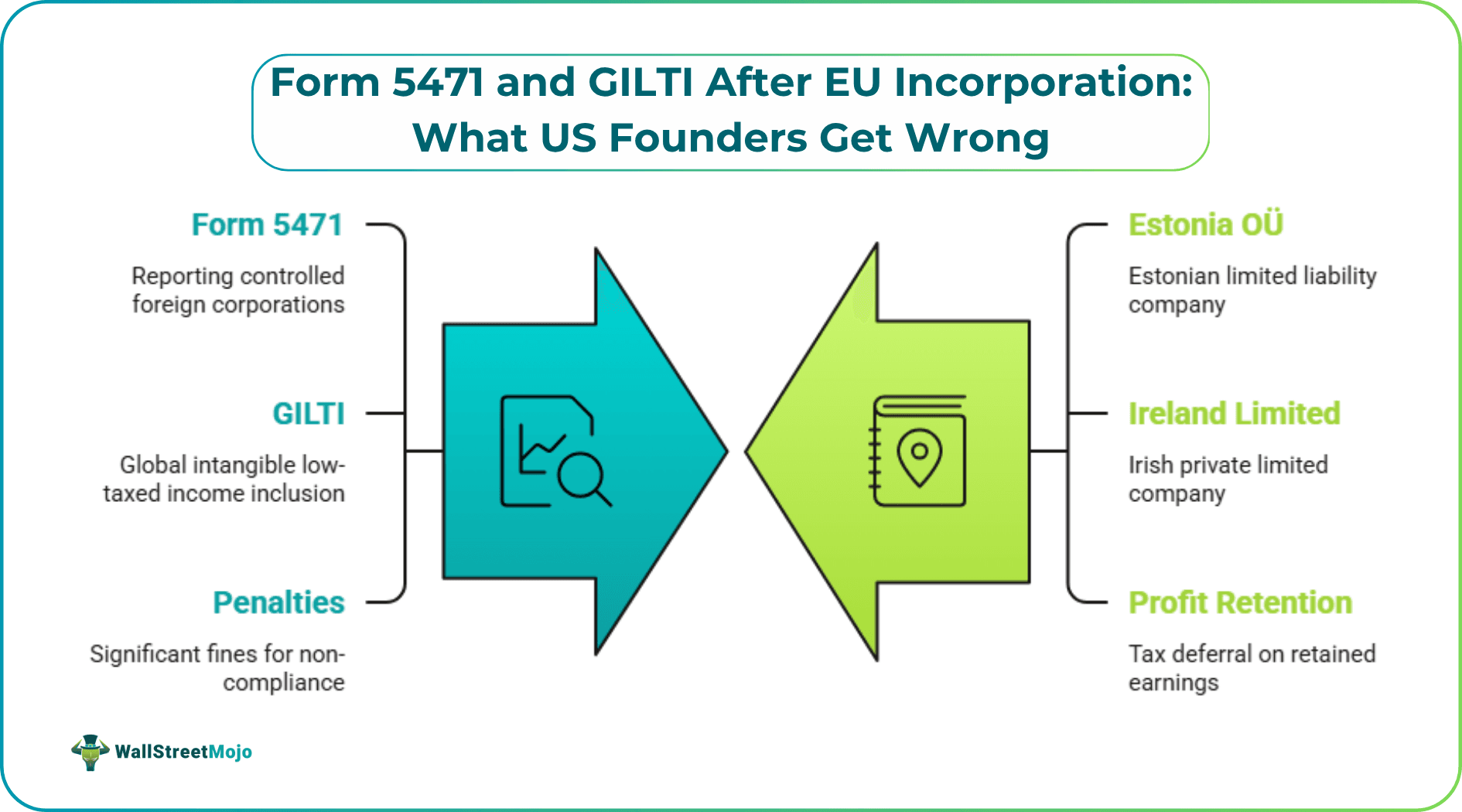
A worked example makes this concrete. Assume a US founder owns 100% of an Estonian OÜ that nets $300,000 in operating profit. Estonia’s distributed-profit tax model means the company pays 0% corporate tax as long as profit is retained. On paper, the founder still pays nothing in Estonia. On the US side, GILTI pulls $300,000 in tested income up to the founder’s personal return, less a 50% deduction where applicable, and applies the founder’s marginal rate. For a founder in the 32% bracket, the federal tax bill from this single entity is roughly $48,000 per year, before state tax. There is no foreign tax credit to offset, because Estonia collected nothing.
The same operating profit through a US LLC, taxed as a pass-through, would land on the founder’s personal return at the same 32%, and the GILTI calculation never enters the picture. Same dollars, different reporting burden.
This is where the strategic question for US founders actually sits. EU incorporation is not a tax avoidance play for someone US-resident. It is a market access and structural play: a European registered entity that can hold European operations, sign European contracts, hire European employees, and run European billing flows that a US LLC cannot reach without expensive nominee structures. The tax savings, if any, come from later moves like physical relocation and holdco structuring, not from the EU entity itself.
For a US founder weighing the two structures, the more useful framework is to first answer the operational question (do you need European market presence?) and second the tax question (are you comfortable with the Form 5471 and GILTI overhead?). The honest comparison includes the compliance cost of a CFC reporting layer, which is typically $1,500 to $3,000 per year for a competent US accountant.
A growing reference for this kind of decision is the comparison of EU Inc and US LLC at EuIncGuide, which walks through the structural cases where each wins and where the GILTI exposure is offset by genuine operating benefits. The site also maintains a broader resource for founders evaluating EU incorporation, which covers the 27-jurisdiction comparison most accountants get asked about by clients.
The takeaway for tax professionals serving founder-clients: when a client mentions setting up an Estonian, Irish, or Dutch entity, your first conversation should not be about whether to do it. It should be about the Form 5471 timeline, the GILTI estimate for year one, and whether the operational benefits are real enough to justify the recurring compliance cost. Most founders walk into the decision having only seen the optimistic side of the pitch.
Recommended Articles
For more on Corporate Structures, explore these related articles from our Corporate Structures guide.