



A phone can open a financial service in a second and still require several deliberate steps before money moves. The shortcut changes how the app is accessed, but it does not determine how funds are displayed, how a transfer is approved, or whether the change in balance is easy to read after money has been moved. Payment salience is how clear and understandable the financial information is to the reader. A transaction remains salient when its amount, unit, status, and effect on the balance are clear. It becomes less salient when those cues are hidden, delayed, or split across multiple screens. Counting the taps needed to make a transaction isn’t enough to determine how user-friendly an app is.
Among 238 active digital-wallet users aged 18 to 41 in Jakarta, a 2025 Frontiers study found that perceived usefulness and enjoyment were significantly associated with positive attitudes toward wallets, while perceived ease of use was not. The sample came from one metropolitan area and a limited age range, so the figures should not be generalized to all wallet users. Still, it does suggest that, within that group, ease was not a significant predictor of attitude.
Access, Authorization, and Balance Are Separate Aspects
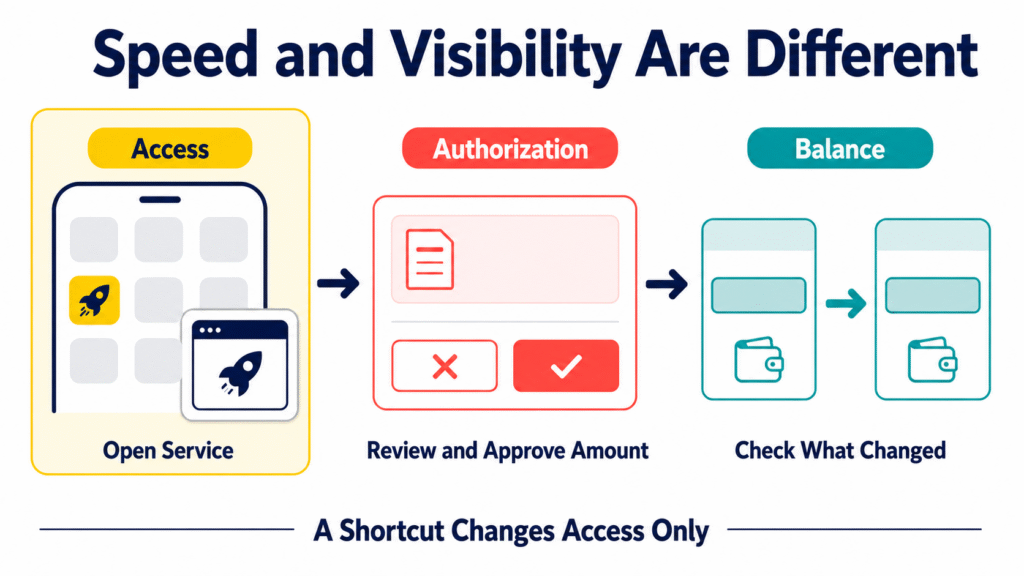
Ease becomes more specific once a digital payment is divided into the actions a person actually performs. Opening a service, authorizing a transfer, and reading the resulting balance occur at different points, and each can demand a different amount of attention. A shortcut may remove the login and navigation steps without changing the approval screen. The financial change remains clear when the amount and unit appear before authorization, and the updated balance can be checked afterward.
Online casino deposits follow that sequence before any game begins. A player may open an account, choose an amount, move to an external wallet, approve the transfer, and return to wait for the casino balance to update. The route into a crypto casino may be brief, while the payment still requires separate approval. The wallet can show the amount and currency before transmission, while the casino account later records the credited balance.
Network confirmation and account credit are also different events, so a transfer can be accepted before the playable balance appears. If the amount sent, the unit received, and the new balance remain clear, low access friction does not reduce payment salience. Confusion can arise when values appear in different units, the transfer status is unclear, or the casino balance changes without an obvious reference to the original amount. The payment remains traceable when the player can identify the amount, approve it, and confirm the resulting balance with ease.
A November 2025 post about direct home-screen entry shortens the first part of that sequence: reaching the service. Its one-click message describes how fast players can access the content. A home-screen icon can remove the hassle of browser navigation, while every financial checkpoint remains unchanged.

Three Questions Separate Convenience From Visibility
Start by separating three questions. How many actions are needed before the service is ready? Is the transfer amount visible at the point of approval, with its unit made unmistakable? Can the user compare the balance before and after payment? A fast entry route affects only the first question. Saved credentials may also reduce access effort, while a separate wallet confirmation keeps authorization deliberate.
Consider two payment flows. In the first, the service opens from a shortcut, the wallet displays a transfer of 0.01 units of a clearly labeled currency, and the account later records the credited amount. Access is quick, and the payment cues remain visible. In the second, several screens precede approval, with one screen showing the amount of crypto to be transferred, another showing that value converted into a fiat currency, and then the confirmation button on yet another page. Not only does it take the user longer to click through all of this, but the financial salience has been decreased. Adding steps did not automatically increase readability.
Fast Front Ends Can Hide Several Payment States
A 2025 CX Dive report on frictionless payments notes that front-end speed can coexist with privacy, security, data-management, and integration demands behind the screen. In a crypto payment, a fast screen response does not collapse network confirmation and casino account credit into one event. “Submitted,” “confirmed,” and “credited” describe different events: the request was sent, the transfer was accepted by the network, and the recipient updated the account balance. Clear status labels preserve visibility, even when the steps complete quickly. One vague “done” message can make a fast process harder to understand than several accurately labeled updates.