


Part of our Economic Concepts guide
Production Meaning
Production refers to an organized activity of turning natural resources into finished goods & services to fulfill the consumer demand for such goods & services. It primarily aims to create goods and services that humans want to buy with money, boosting the economy and production activities.
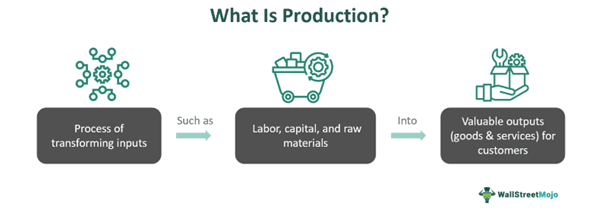
It has various means, such as land, capital, labor, and entrepreneurship. It has a broad scope that includes manufacturing goods using machinery. The company owns resources to make goods for customer needs. It involves the production of either tangible or intangible goods.
Key Takeaways
- Production is understood as taking resources as inputs and performing specific actions to produce a product that has value for the customer.
- Its primary purpose has been to produce goods and services demanded by human needs that can be traded with money, boosting the economy.
- It also means the total number of goods produced, whereas the rate of producing goods per input is referred to as productivity.
- It contains manufacturing as an essential aspect that may or may not be required, but manufacturing can never encompass production.
Production In Economics Explained
Production is defined as the process whereby resources are transformed into finished goods or services demanded by customers. Economists often view it as synonymous with value creation, as it involves the addition of resources through the process. It serves as the foundation of every industry, playing a pivotal role in economic activity and growth. Every firm facing rivalry must produce goods and services at affordable cost and high quality rather than only their mining costs to survive the competition.
In actual practice, it helps a firm gradually transform one form of resource into another while conserving the quality standards that satisfy human wants. The input includes- tangible inputs, raw materials, and intangible inputs like ideas or data that convert these into demanded finished goods.
It consists of many factors:
- Land- It includes the usage of land and its resources, which are available freely to everyone.
- Labor – It comprises the workforce that accomplishes the task of creating goods and services.
- Capital- It involves the amount of money invested.
- Entrepreneur- It refers to a person owning, investing capital, and creating goods for sale to consumers.
Means Of Production
Marx and Engels described the means of products as comprising every tangible and intangible resource besides labor used to produce products and services. These resources, including natural resources, machinery, and technology, collectively constitute how goods and services are produced. Moreover, it can be understood as societal use and ownership of factors to produce goods and services.
Beyond the process, this also involves the logistical distribution and exchange of goods, thereby influencing societal distribution between the bourgeoisie and the proletariat. In essence, the bourgeoisie controls the entirety of these production means. At the same time, the proletariat labor within them is often referred to as a means of physical production due to their focus on economic resources and primary production.
Types
Production is classified into many types, such as :
- Job-Shop Production: Here, the products get created in a few numbers to cater to the demand of the customers who need them at a particular time and cost. Therefore, the product has a high variety and lower volume in this process.
- Batch Production: Under this process, several batches are produced, and every product undergoes various stages comprising multiple functional departments during the whole production process.
- Mass Production: facilitates the manufacturing of individual components of goods through specialized manufacturing methodologies.
- Continuous Production: Here, the chronological arrangement of production operation is utilized, so the facilities automatically become essential.
Examples
Let us read into some good examples to understand the topic better.
Example #1
Let us assume that many people need mobile for everyday use. However, smartphones have become costly and not suitable for longer calls as they are bulky and get heated up. Therefore, customers create the demand to make a mobile phone that can use 5G technology, offers essential internet functions, has hard numeric keys, and is lightweight. Hence, a company called Orange Corporation decided to tap into it and create a mobile with all such qualities. Thus, it starts, and the product is created as per the wants of the people.
Example #2
Upstream merger and acquisition (M&A) activities have surged in the oil and gas industry, reflecting a trend of rapid expansion. Notable mergers include Chord Energy’s merging with Enerplus, Chesapeake Energy’s merging with Southwestern Energy, and EQT Corp’s intention to acquire Equitrans. These developments underscore the dynamic nature of the market, with companies seeking strategic alliances to optimize operations and capitalize on emerging opportunities.
Furthermore, projections suggest that U.S. oil production may reach a plateau later this decade, prompting industry leaders to evaluate long-term strategies. Despite technological advancements driving production growth, concerns about diminishing returns and declining output per rig are surfacing. Analysts anticipate a potential inflection point in shale production, leading to increased scrutiny of the sustainability of current drilling practices and the future trajectory of the industry.
Production Vs. Manufacturing
Understanding the disparities between both concepts is essential for grasping their respective roles within industrial processes. While both terms are often used interchangeably, they represent distinct aspects of manufacturing, focusing specifically on the physical transformation of materials into finished products.
| Production | Manufacturing |
|---|---|
| It converts input into final services or goods. | It transforms natural materials into finished products. |
| The firm owns the raw material to give output. | The firm obtains raw materials from third parties to convert into finished goods. |
| It may lead to finished goods or services. | It only leads to finished goods. |
| The product can be either tangible or intangible. | It always produces tangible goods. |
| Machinery may or may not get used. | It requires manpower, materials, and machines to make products. |
| The utility gets produced that can be used now or at later times. | The products so created get sold immediately or after. |
| It has a greater scope that includes manufacturing as one of its aspects. | It has a limited scope. |
| All activity does not get termed as manufacturing. | All manufacturing activity gets termed ad production. |
Difference Between Production And Productivity
Analyzing the table below provides insights into the fundamental disparities between both concepts. Understanding these variances is crucial for optimizing operational processes and maximizing output within various industries.
| Production | Productivity |
|---|---|
| It means creating goods & services from tangible and intangible input to give an output that people can buy for use. | It is understood as the efficiency with which a firm can produce goods & services. |
| It simply gets earmarked as the process of goods creation. | It gets measured as the number of goods& services produced per unit input of materials. |
| It represents the total number of goods produced by a unit of the firm. | It could be found by using the formula as units produced divided by user input. |
| Its expression has always been in absolute terms. | It has always been expressed in relative terms. |
| It helps to determine the output value. | It helps to determine efficiency related to factors of production. |
Frequently Asked Questions (FAQs)
Why production is important?
It remains important to all in an economy because it spurs demand for new goods, creates more demand, requires more workforce, and creates employment. In addition, customers spend their money on buying goods, adding money to the economy.
Who owns the factors of production?
It includes land, labor, capital, and entrepreneurship, which are typically owned by individuals, businesses, or governments, depending on the specific context. Ownership rights vary based on legal, economic, and political systems in different societies. In capitalist economies, individuals or private entities often own these factors, while in socialist or communist systems, ownership may be centralized within the state or collective ownership structures.
What are stages of production?
The five stages of production encompass development, pre & post-production, production, and distribution. These stages represent a comprehensive framework for the creation and delivery of goods or services to consumers, covering everything from initial planning and preparation to final distribution and customer interaction.
Recommended Articles
For more on Economic Concepts, explore these related articles from our Economic Concepts guide.