


What Is SEC Form D?
SEC Form D is a filing procedure required for private companies with the Securities and Exchange Commission to sell securities exempting the Regulation D or Section (a)(5) provisions. The filing procedure is observed as a short notice that some companies give to the SEC with the basic company information for investors regarding new issuance.
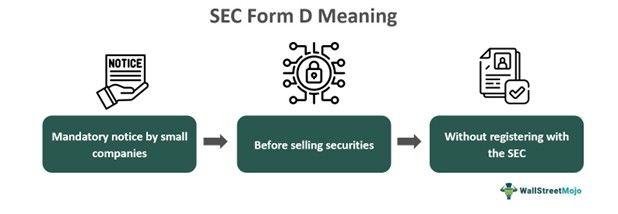
Instead of offering lengthy reports and following the traditional methods, any firm exempting Regulation D can file Form D as concise information about the company, including the size and date of the offering. It may contain information about the names and addresses of the company’s executive officers. The form is also referred to as Notice of Sale of Securities.
Key Takeaways
- SEC Form D is used by private companies or small startups looking to raise capital through the sale of securities by exempting Regulation D or Section (a)(5).
- SEC Form D is used by private companies or small startups looking to raise capital through the sale of securities by exempting Regulation D or Section (a)(5).
- It must be filed within 15 days after the date of the first sale of securities and annually if the company continues to sell securities on the original Form D date anniversary.
- It serves as a brief notice to investors about the company. An investor willing to buy its securities must check on the EDGAR database to verify the company’s Form D filing.
SEC Form D Explained
SEC Form D is a brief notice filed by small companies and startup firms when they intend to offer and sell securities without registering with the US Securities and Exchange Commission. This exemption is under Regulation D, but Form D must be filed within 15 days after the first sale of securities to take advantage of it. The companies need to file the same form annually if the offering reported in the original Form D is continued even after the anniversary date of the previous filing. Though no fees are imposed on filing Form D, late filing penalties and fines can be imposed, and these will vary from one state to another.
The filing process is simple and digital as it must be approached through the SEC’s online portal called EDGAR. Any investor willing to buy such a company’s securities must check and verify if the firm has filed Form D in the EDGAR database. Since the data is publicly available, the companies filing the form must ensure they do not file any crucial information. The SEC mandates that corporations offering securities use Form D as a notice of sale of securities to provide fundamental information or key facts about the company and the whole selling structure.
Filing Requirements
The filing requirements for SEC Form D are as follows –
- The company must have its unique SEC identification number, also known as the central index key (CIK number), along with a set of passwords called access codes.
- In case the company does not have a CIK, they have to complete the Form ID application online by uploading and submitting the notarized document between 6 am to 10 pm ET, Monday through Friday.
- The SEC will take at least two business days to process.
- Once accepted, the SEC will email the company its CIK number, credentials, and instructions for generating access codes in EDGAR.
- The company shall consider filing Form D as soon as possible, determining that it will raise funds under Regulation D.
- The company should understand that a lot of information will be publicly visible and hence take precautions with entering crucial details.
How To File?
Following are the steps to file SEC Form D –
- The notice through Form D must be filed within 15 days from the date of the first sale of securities.
- The Form D amendments and notices are to be filed online using the SEC’s EDGAR, which is an electronic filing system and stands for (Electronic Data Gathering, Analysis and Retrieval) system.
- The date of the first sale is the date on which the first investor is contractually and irrevocably committed to invest.
- If the due date is on a Weekend such as Saturday, Sunday or holiday, it is relegated to the next business day.
- There are no charges imposed by the SEC or filing fee for Form D notice or amendment.
- Once the company has the CIK number and access codes, they have to log in to the EDGAR portal, choose Form D and “make a filing” option.
- After the completion and submission of Form D, the SEc will notify about the submission status through an email.
Examples
Below are two examples of SEC Form D are –
Example #1
Suppose Jennifer has started a startup company and just finished her series A funding after the seed stage. She is willing to raise funds and file for SEC Form D, making an exemption for Regulation D on his sale of securities. She visits the EDGAR portal, which is the SEC’s online filing system.
Jennifer has her company’s unique SEC identification number and access codes. She follows the process and submits the notice. The SEC will email her about the submission status. This notice offering will allow Jennifer to sell securities without registering with the SEC. It is a simple SEC Form D example. In case Jennifer does not have the CIK number and access codes, there is a separate process to obtain them.
Example #2
For the second example, in December 2020, New York’s then-Attorney General Letitia James issued guidance regarding the mandatory filing of SEC Form D. The guidance came after years of uncertainty about whether and how firms are supposed to operate, issuing securities in a private placement to the New York residents. The issuers were to comply with the Martin Act.
The issuers selling covered securities must, under the guidance of the attorney general, file a completed Form D through the electronic filing depository of the North American Association of Securities Administrators. The new guidance issued made everything clear. Hence, every private placement offering securities to New York residents must oblige the Form D submission.
Frequently Asked Questions (FAQs)
Can a startup choose not to file an SEC Form D?
A notice offering the requirements of Regulation D but does not include the Form D filing should still be exempt under section 4(a)(2). Hence, the securities exemption depends on either case. Hence, in some scenarios, the startups feel comfortable not filing Form D to remain in stealth mode. The downside is that the issuer would have to satisfy the state-level laws separately.
What disclosure is required in an SEC Form D?
The disclosure in the Form D includes –
- The issuer’s identity and contact information
- Types of securities offered
- The name and address of individual directors, promoters and executive officers
- Total amount offered, the sold amount and the amount left to be sold, including the total number of investors.
- The minimum investment accepted by any outside investors.
Is SEC Form D always required?
The SEC Form D may not suit a company in all circumstances. Still, yes, it is a legal requirement under Rule 506 of Regulation D. It offers businesses the ability to raise unlimited capital from an unlimited number of investors with minimum obligations and guidelines. Form D works for both the federal and state levels. Hence, it is highly advised.