

Part of our Financial Markets Basics guide
Introduction – Strongest US financial markets
American financial markets continue to show remarkable strength, mainly thanks to the United States’ ability to concentrate capital, innovation, and liquidity. Wall Street remains the leading global benchmark because it brings together major stock exchanges, leading companies, and institutional investors with a depth that few other markets can match. In 2026, the S&P 500 clearly benefited from the boost in corporate earnings, with particular attention on companies linked to artificial intelligence and major technology groups. Some investment banks have even raised their targets for the index, citing earnings growth and AI investment as the main drivers.
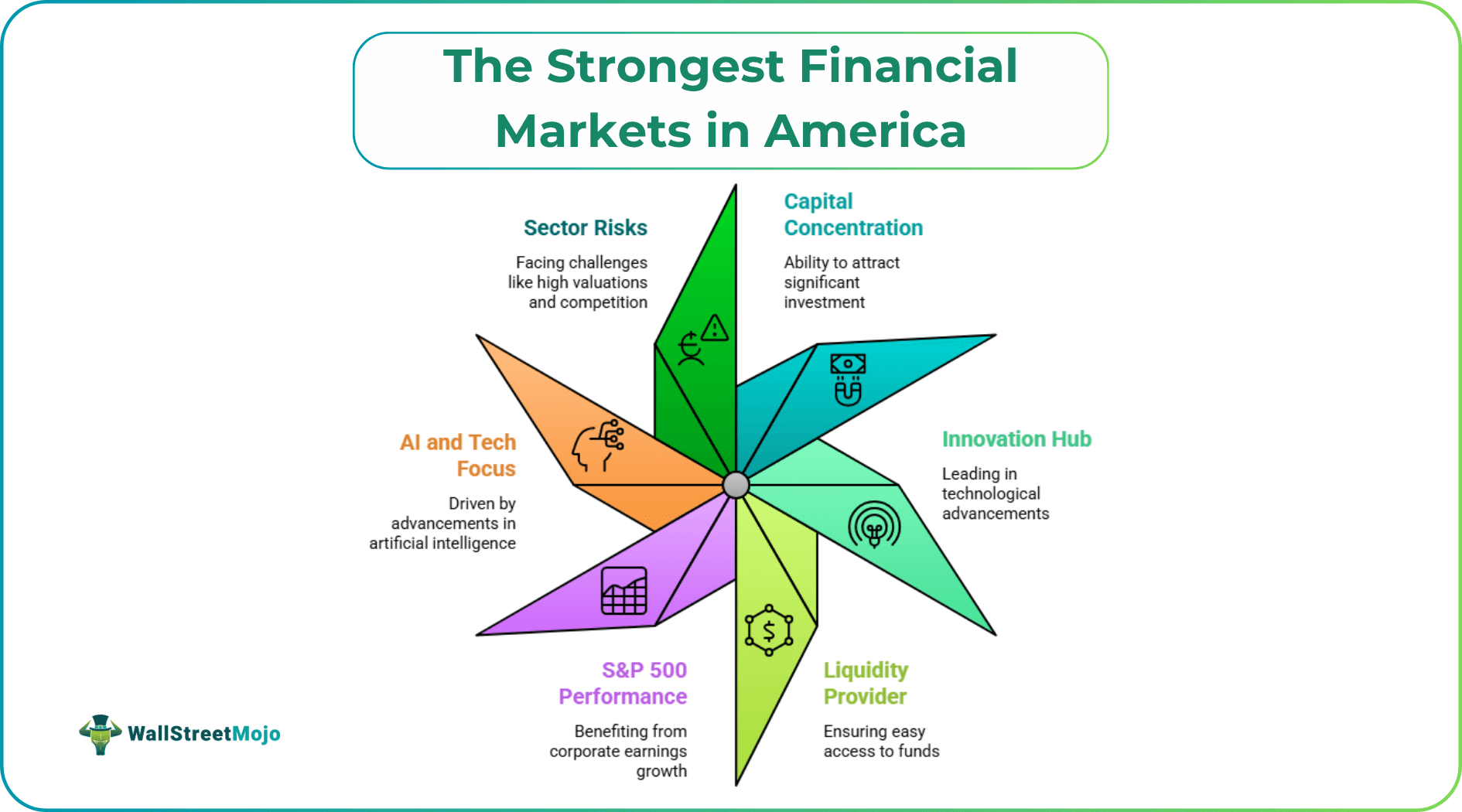
The technology sector is therefore the first one to watch. It is not just about software or semiconductors, but an ecosystem that includes cloud computing, cybersecurity, data infrastructure, automation, and digital services. American companies dominate many of these areas and attract capital because they promise high margins and scalable growth. However, the sector’s strength does not eliminate its risks: overly high valuations, global competition, and geopolitical tensions over chips can make the sector volatile.
Finance, Healthcare, and Energy: The Defensive Pillars
Alongside technology, the financial sector remains one of the most solid markets in the United States. Banks, insurance companies, asset managers, and payment companies benefit from a large and sophisticated economy. When interest rates remain relatively high, some banks can improve their interest margins, although they must manage credit risk and regulatory pressure. America’s advantage lies in variety: there are not only traditional banks, but also fintech companies, payment networks, and investment platforms that connect consumers with global markets.
Healthcare is another strong sector, often less spectacular than technology but more stable. Pharmaceuticals, biotechnology, medical devices, and health insurance represent an essential part of the American economy. An aging population, demand for innovative treatments, and medical research support the sector over the long term. Here too, however, political risk must be considered: drug prices, public reimbursements, and healthcare regulations can affect revenues.
Energy holds a particular position. The United States is among the world’s leading producers of oil and gas, but it is also investing in renewables, power grids, and efficiency technologies. In the short term, the sector can strengthen when oil prices rise; in the long term, the energy transition creates new opportunities but also uncertainty. International tensions can push cr hi ude oil prices higher and influence inflation, with indirect effects on stocks, bonds, and consumer spending.
Consumers, Media, and Online Entertainment
Another American strength is the consumer market. Retail, discretionary goods, travel, sports, streaming, and digital advertising all depend on households’ ability to spend. When employment and incomes remain strong, these sectors can grow quickly. Online entertainment is also part of this universe, a segment that combines technology, digital payments, marketing, and regulation.
U.S. commercial gaming showed growth in 2026: according to the American Gaming Association, gross commercial revenue reached $6.22 billion in February, with iGaming up 25% year over year. This explains why operators, platforms, and investors pay close attention to benefits such as free spins no deposit, often used in online casino marketing to attract new users. It is a profitable sector, but not without limits: licenses, consumer protection, and state regulations can change quickly.
The strongest financial markets in America are those that combine innovation, scale, and stable demand. Technology and AI drive growth, finance and healthcare provide depth, energy offers protection during inflationary cycles, while consumer markets and online entertainment show America’s ability to monetize new digital habits. The strength is there, but it should not be confused with an absence of risk: the true competitive advantage of the United States is its ability to reinvent itself sector after sector.
Recommended Articles
For more on Financial Markets Basics, explore these related articles from our Financial Markets Basics guide.