


What Is Transferable Letter Of Credit (TLC)?
A transferable letter of credit is a legal document that allows the first beneficiary to shift complete or partial credit to another party. By doing so, the first beneficiary creates a second beneficiary. It allows seamless credit transfer between the beneficiaries. The letter is primarily used in trade transactions.
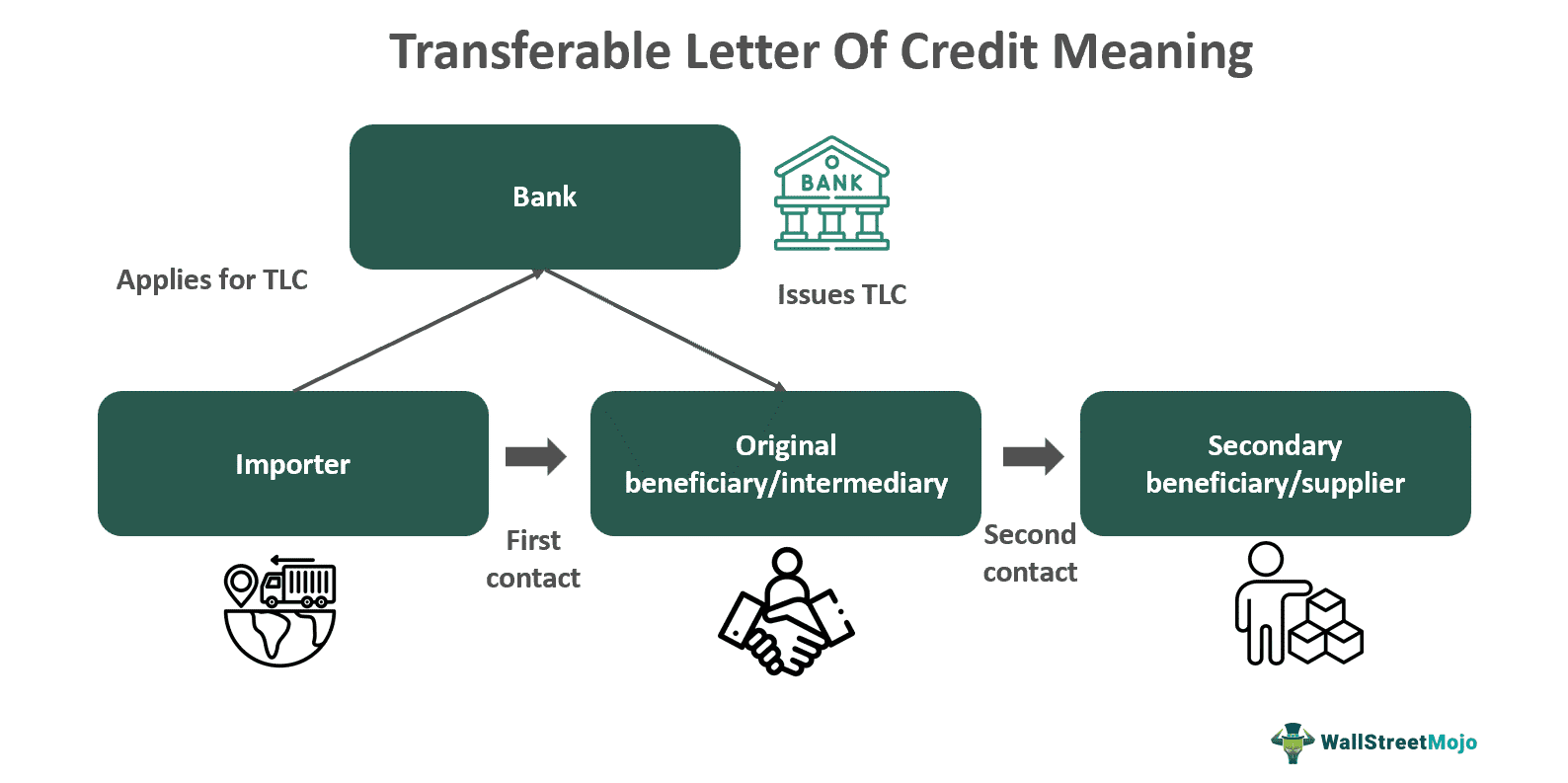
Although different types of letters of credit can be issued according to the need and nature of the trade transactions, with a transferable letter of credit, there can be two beneficiaries with the objective of timely payments from manufacturers and suppliers. A transferable letter of credit offers risk mitigation and flexibility options to the parties involved.
Key Takeaways
- A transferable letter of credit enables the first and original beneficiary to transfer the credit wholly or partly to another person, making them the second beneficiary.
- An importer to a bank is requested to issue a credit letter in the name of the broker, who has the power to transfer it to a secondary beneficiary, most probably the supplier or manufacturer.
- It ensures swift and assured payment to the supplier but, at the same time, comes with certain risks, such as default risk, non-compliance risk, and increased freight costs and fees.
- The main parties involved in such a transaction are the buyer, seller, the bank, and the supplier of the goods and services. Yet, the bank holds the right to refuse to issue a transferable LC.
How Does A Transferable Letter Of Credit Work?
A transferable letter of credit (TLC) is a legal document that serves as a financial instrument. It is a bank-issued letter used mainly for trade transactions. The main purpose of this letter is to allow the primary beneficiary to shift a portion or complete credit to a secondary beneficiary. In trade facilities, the importer’s bank issues the TLC, and the primary beneficiary is the party that accepts it. The whole concept is based on the assurance of timely payments to manufacturers and suppliers, especially in international trade agreements.
Using a transferable letter of credit format, the exporter can instruct the bank to pay or transfer the funds to a third party that is established as a secondary beneficiary. It is designed to shift the payment rights from the original beneficiary to another party to whom they owe. The key players in this arrangement are the buyer, the first beneficiary, which could be a broker or a retailer, the issuing bank, and the second beneficiary, which is a supplier or manufacturer.
However, the bank holds the right to refuse or acknowledge the transfer execution under specific circumstances, such as agreement failures or breach of law. A transferable LC is different from a traditional letter of credit that does not permit the transfer of credit to another party.
Process Steps
The steps to process a transferable letter of credit are:
- To receive a transferable letter of credit, the importer must submit an application to the bank for assessment and approval.
- Once approved, the importer’s bank issues the letter of credit, enabling the original or primary beneficiary to shift the credit to a secondary beneficiary.
- There are certain sets of rules that guide the transferable LC, and it may come with additional charges.
- Leveraging the credit of the buyer, it operates like a financial instrument offering payment assurance to the supplier or manufacturer.
- The TLC is issued in favor of the original beneficiary, who becomes a middleman and transfers some or all of the credit to a second beneficiary.
- The second beneficiary with the credit letter receives payment assurance for the goods and services provided.
- The letter serves as a confidence-building instrument in international trade transactions.
Examples
Here are two examples of TLC:
Example #1
Suppose Kevin is an importer from the US and places an order to Bethany in the UK. Bethany asks Kevin to issue transferable letters of credit. It will allow Bethany to avail of the credit facility from its supplier. Kevin, as requested, wrote an application to the bank requesting to issue a transferable letter of credit.
The bank, upon evaluation, issues the letter of credit, which Bethany gives to the original supplier or manufacturer. Now, doing so makes Bethany the first beneficiary, but she also becomes an intermediary, giving out the letter of credit to the supplier, who is now the secondary beneficiary. The letter now assures payment to the supplier from the importer’s bank.
Example #2
Suppose William wants to buy nine hundred ice cream boxes from Jacob. The order is big, and the supplier is new and wants assurance. William, upon knowing this, requests his bank draft a transferable LC in the name of Jacob, who then becomes a middleman and endorses the credit letter further to the leading ice cream supplier.
As the supplier receives it, he becomes the secondary beneficiary in the agreement. William, who is the buyer, has his bank’s approval and assurance to the supplier that the bank’s guarantee will make the payments back. Now, the supplier has confidence in the deal and makes the order ready. In this scenario, Jacob is the first beneficiary.
Advantages And Disadvantages
The advantages of a TLC are –
- The risk of non-payment or default gets minimized as the buyer’s bank guarantees the payment.
- The credit letter is not based on due diligence and time-consuming credit checks; hence, the process increases the trust and confidence among the parties involved.
- Since the payment is guaranteed from the buyer’s bank, timely payment is ensured.
- Credit transfer is one of the major benefits of a transferable LC, allowing a level of flexibility for intermediaries.
The disadvantages of a TLC are –
- Using a transferable LC means adding more people to the transaction. Therefore, the complexity increases.
- It demands consistency to ensure that all parties, such as banks, suppliers, buyers, and the essential documents, are intact and following the right procedure.
- Transferable LC also increases the cost of the trade transaction.
- Some of the TLCs have certain limitations, such as the explicit transfer authorization from the issuing bank.
- The issuer may refuse to recognize or carry out the transfer in some scenarios.
- Another risk lies with the possibility of the seller not being able to fulfill the terms of a transferable letter of credit. It may lead to non-compliance and amendments in the shipping schedule.
Transferable Letter Of Credit vs Back-to-Back Letter Of Credit
The main distinguishing factors between a transferable letter of credit and a back-to-back letter of credit are:
| Transferable Letter Of Credit | Back-to-Back Letter of Credit |
|---|---|
| It is utilized to shift a part or the whole credit to another party. | The back-to-back letter of credit is not transferable. |
| The TLC is a single credit letter used in international trade transactions. | A back-to-back letter of credit is the combination of two credit letters. |
| There are two beneficiaries but one letter. | Here, there are two credit letters with the parties remaining the same. |
| A transferable LC allows flexibility and risk mitigation options. | The primary risk resides with the original beneficiary in case it doesn’t meet the terms and conditions. |
Frequently Asked Questions (FAQs)
Frequently Asked Questions
How many times can a transferable letter of credit be transferred?
It can only be transferred once as per the details offered by the primary beneficiary about the secondary beneficiary. Hence, the latter cannot transfer the money to a third party. The bank does not permit or give this provision with a transferable LC.
What can be changed in a transferable letter of credit?
Although the terms and conditions drafted in the original letter of credit cannot be changed while transferring the credit letter, the amount on the credit letter, including the unit price of goods, time of shipment, expiry date, and the last date for the presentation of the document can be changed in a transferable letter of credit.
Is a transferable letter of credit safe?
Yes, they are secured and safe because the letter itself operates as a financial instrument, ensuring that the manufacturer will receive its payment. The importer using a transferable LC offers banks a guarantee in the transaction.