Financial Planning for Workforce Expansion: What Smart Companies Do Before They Hire

Table Of Contents

Introduction
The growth of the team is the fattest milestone a company can achieve. But without financial planning, it's the fastest way to burn your hard-earned cash. It is not positive on ambition; it will be the insurance liability.
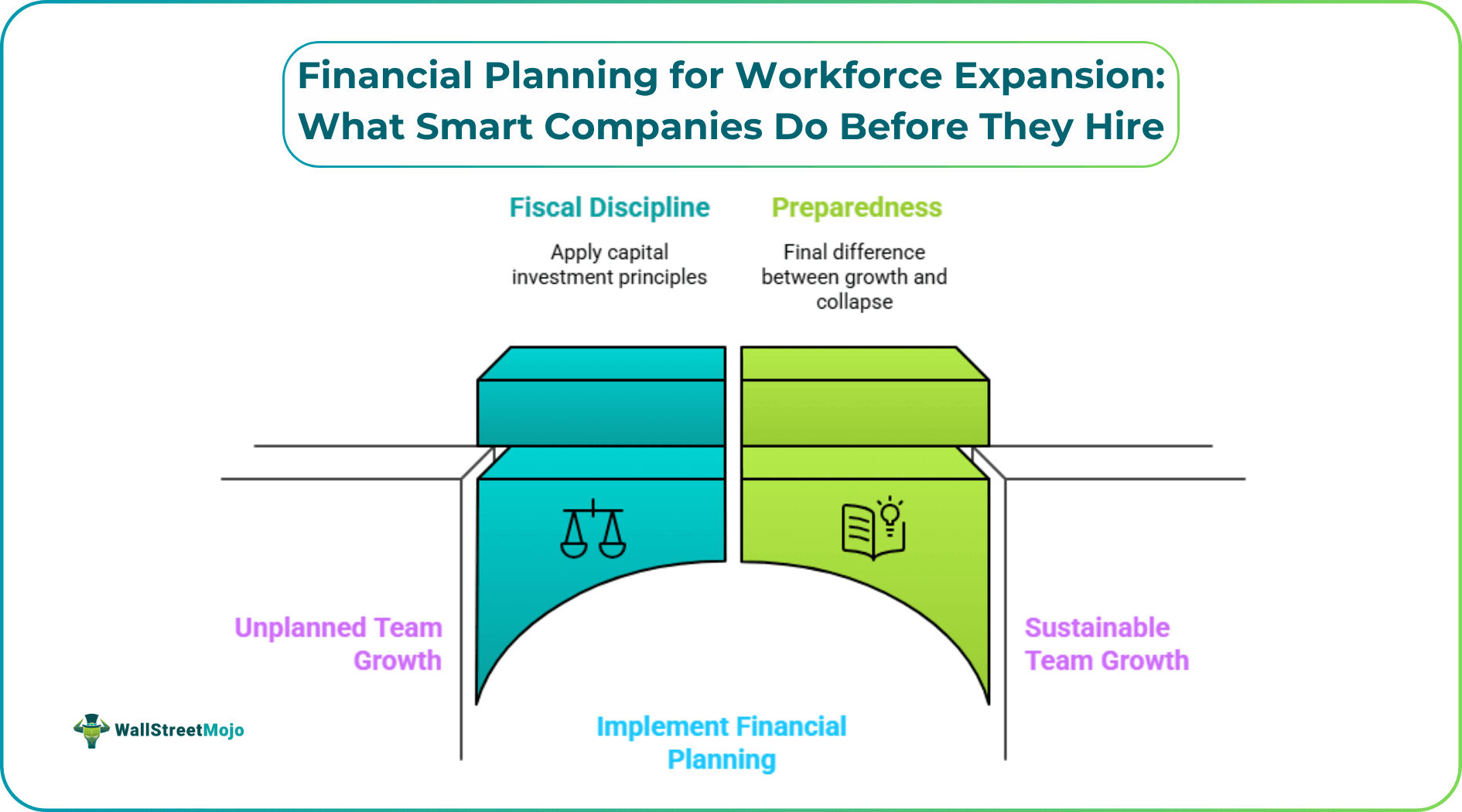
Of course, the same fiscal discipline necessary for any capital investment goes into play: whether particular to an established structure, as an SME peddling on one department, or a startup trying to move from 5 to 50. What usually puts the final difference in companies between growth and utter collapse after a team-building may just be preparedness.
The Real Cost of Hiring Goes Beyond Salary
Most business owners define the expansion of personnel in bundle-for base pay. This is not quite the right base point.
Simply paying your employee for their work reduces only one aspect of the total when you bring on a new employee. What you might also foresee in total is paying your taxes and the matching contributions probably required, employee benefit modules, onboarding time and materials, computer, telephone, software and software access, staff time spent in training the new hire, productivity dips in the time it takes to get the new hire 'up-to-speed.' The estimated cost for a 1.5 to 2 times an annual employee salary just in their first year is actually the true cost for a single position.
Mark McShane, Managing Director at SSSTS Course, has seen this firsthand with businesses that expand teams without accounting for compliance and training costs. "One of the most overlooked expenses during workforce expansion is regulatory training," he says. "Companies often budget for salaries but forget that certain roles come with mandatory certification requirements — and those costs add up quickly, especially when you're scaling fast."
This is particularly true in industries with health, safety, or professional compliance obligations. Budgeting for certifications, renewals, and ongoing training from day one prevents nasty surprises six months into a hiring push.
Build the Financial Model Before You Post the Job Ad
Before publishing a single job posting, your finance team — or you, if you are the finance team — need to come up with the response to three simple questions:
Can We afford this hire for 12 months even if revenue remains flat? What is the break-even point where this hire starts generating more value than they cost? What does our cash flow look like in months 3, 6, and 9 of this hire?
Cash flow is the silent killer of the expansion plan. Often, profitable companies collapse because they run out of cash, not for lack of customers. Payroll keeps vitiating your accountinflationary-index when you aggressively hire, not revenue-laboriously especially when the newly appointed may be in sales, business development, or any position that takes time to start producing output.
Sofia Torchio, Editor-in-Chief with over 11 years of content leadership experience and a journalism degree from the University of Valencia, has navigated multiple team expansions in the media space. "Content teams are often scaled reactively rather than strategically," she explains. "You take on more clients, you hire more writers — but if you have not modeled out the revenue per head versus the cost per head, you will find yourself in a situation where you are busier than ever but not more profitable."
Her advice: tie every new hire to a specific revenue outcome or cost reduction target, and review that metric quarterly.
Phased Hiring as a Cash Flow Strategy
The achievement of a phased hiring strategy has been examined on a more practical basis and found to be one of the most effective financial decisions applied to enable workforce extensions.
Once yon are in a position to bring people on board in January, think of it in a team of two for Q1, then again two for Q3, then pause and reconsider an addition or another hiring program before engaging further into this direction. This enables you to let your cash flow absorb the cost before the next charge, thereby buying time for real data to be furnished: do they from Q1 actors meet these expectations? If they do, you move on. If not, you can adjust before increasing the bet.
Ethan Ramírez, Founder of Mostarle, advocates strongly for this model. "Scaling a team is not a one-time decision — it is an ongoing financial experiment," he says. "The businesses that do it well treat each hire as a hypothesis. They define what success looks like at 90 days, and they are honest about whether the data supports the next phase of growth."
This kind of financial discipline does not slow growth. It makes growth stick.
Technology, Automation, and the Smarter Hiring Equation
One needs to keep on questioning whether additional people are needed or better systems, rather than just increasing the size.
It is not an efficient way to grow a business when a role costs a business $80,000 a year, the tasks of which could be trained into automation or be simplified through a clever, advanced tool. It is not an argument against hiring -it is an argument for thoughtful hires.
Sourov, founder of NativeSwap, operates at the intersection of technology and financial infrastructure, and he brings that lens to team building. "In the Web3 and fintech space, the instinct is always to hire engineers — but before we add headcount, we look hard at whether the right infrastructure is in place," he says. "Sometimes the smarter financial move is investing in tooling first, and letting that create leverage before you scale the team around it."
This principle applies well beyond tech. Whether you are in logistics, marketing, or professional services, mapping your processes before mapping your org chart is smart financial planning.
What Your Hiring Budget Needs to Include?
A solid workforce expansion budget should account for:
- Recruitment costs - job boards, agency fees, internal recruiter time
- Onboarding and equipment - laptops, software, access credentials
- Training and compliance - role-specific certifications, mandatory courses
- Benefits and employer contributions - healthcare, pension, taxes
- Management overhead - the time your existing team spends ramping up the new hire
- Contingency buffer - typically 10–15% of projected hiring costs
Skipping any of these line items does not make them disappear. It just makes them surprises.
The Bottom Line
Increasing your workforce is not a sure sign that your company is doing well — it is just a bet on this fact. Like any bet, the goal is to do it not too big.
The best path forward in today's scenario is not having the most money when up-scaling ones' team but knowing upfront what to do and what not to do. One that asks the more difficult questions on the key stuff before hiring, lays the real deal in cash flow, and brings budget planning into action and was measured on the value of growth-let alone the headcount of increase.
Ambition in hiring. Precision in planning.