


Part of our Cost Control and Management guide
What Is Financial Aggregation?
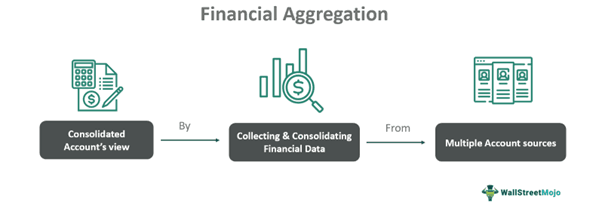
Financial aggregation refers to collecting and consolidating financial data from different sources like retirement accounts and bank accounts to get a single consolidated view. It aims to play a major role in financial planning and management by tracking the performance of investment portfolios, managing debt, and strategizing future financial goals.
Firms use it for asking funds or refinancing as per future cash flows generated by the assets from the investors. Lenders and banks use it to facilitate account viewing and summaries to their customers. Some of its services also involve collecting information on debts like credit cards.
Key Takeaways
- Financial aggregation is the collecting and gathering of financial data spread across sources like bank checking accounts and retirement accounts for having a unified view.
- It has a major role in financial strategy and management by tracking the efficiency of strategizing future financial goals and investment portfolios and managing debt.
- It has multiple types like – account aggregation, data aggregation, securitization aggregation, open banking
- and open finance aggregation, geo-location aggregation, categorization accuracy aggregation, & bank account verification aggregation.
- It benefits customers through consolidated account management, time savings and convenient transactions, whereas FIs become competitive, improve underwriting models and gain trust.
Financial Aggregation Explained
Financial aggregation is stated as a method of getting a consolidated view of overall financial status by combining all financial data across different locations into a single reference point. It helps to understand the user’s overall financial situation. It encompasses different software, third-party applications or services that gain access to user data and collect financial data from different financial organizations like investment firms, credit unions and banks.
Personal finance apps and financial institutions use a secured gateway to retrieve financial data from one’s linked data. After that they present it in a user-friendly manner to the user. Although it helps the user access financial data from anywhere on a single app, it also poses a threat to their financial data and the security of funds, leading to accidental unauthorized transactions or wrong reporting of data. It has helped financial institutions gain valuable insights regarding their customer’s spending, saving and borrowing habits.
As a result, they can now customize financial products as per their needs and habits to the customers. Moreover, they can also design products to attract new customers and explore newer markets. On the other hand, customers have been empowered to make informed decisions concerning investment and other financial decisions. The financial aggregation service could be executed by financial aggregation tools like the one provided by PCR financial aggregation and financial aggregation software.
Types
There are multiple types of aggregation financially, with each serving a particular objective:
- Account Aggregation: Information is collected for a single consolidated view from the various financial accounts like mortgage, credit card, savings, checking, and investment accounts.
- Data Aggregation: Here, financial information from across different sources like investment accounts, banks, and credit cards is collected into a single platform for an overall summary of personal finances.
- Securitization Aggregation: Various assets combine to form bundles to receive refinancing or financing as per future asset cash flows from the investors.
- Open Banking and Open Finance Aggregation: It aims to empower consumers over their data that can be shared with financial institutions, allowing them to deliver personalized financial products to customers.
- Geo-Location Aggregation: It comprises matching the transaction details with geo-locations like vendor name to location leading to more targeted services and offers to customers.
- Categorization Accuracy Aggregation: Transactions are put into transaction differentiation engines for analysis and categorization so as to develop much deeper consumer insights to create targeted services and products.
- Bank Account Verification Aggregation: It entails checking the account balances in real-time before any transaction so that it prevents any abandonment while customer onboarding during funding events.
Examples
Let us use a few examples to understand the topic.
Example #1
The financial aggregation has become important for cities to access urban climate finance, as per the report published on June 28, 2022. Innovative financial planning becomes crucial as cities contribute 3/4th of global greenhouse emissions. Further, a climate-smart urban setting faces hurdles in getting investment due to weak regulatory systems, high upfront costs and municipal creditworthiness. Under these circumstances, it provides an avenue for multiple investment combinations, projects, participants and sectors to increase funding for urban climate needs of mitigation or adaptation.
It also targets both providers (or supply) and recipients (or demand) of financial resources. Supply-side aggregations unite different relevant actors and financiers. On-demand side aggregation combines the creditworthiness of individuals, companies and project developers. Hence, aggregation of finances provides a promising method to bypass limitations and get the necessary climate finance.
Example #2
Let us assume Davidina has her account in Old York Bank and also uses the Polypay app for financial transactions. She holds checking, savings and $5000 loan accounts in the bank. Polypay app uses financial consolidation to combine her account and present an overview of her account’s finances. As such, the app gives her personalized tips and recommendations to improve her savings and manage the credit facility efficiently.
Further, the app also provides confidential information to various financial institutions, allowing them to contact her with personalized offers. As a result, Polypay gets transaction fees from the banks, Davidina gets to see summarized financial status, and banks get to personalize financial products for their customers.
Benefits
The following are its common benefits:
For Consumers
- Allows easier management of all their bank accounts in one place, facilitating tracking of spending, savings and achievement of goals.
- Get personalized financial products and services from various financial institutions.
- Saves a lot of time from physical visits to the bank and decreases the need for manual entry.
- They can make wise financial decisions related to investments, savings, and loans.
- It helps make transactions easier on the go without much difficulty.
For Financial Institutions (FI)
- It increases trust in financial institutions and exceeds customer expectations.
- FIs can become more competitive and provide late tools to customers to use in swift and safe financial transactions.
- It gives an in-depth knowledge of customer spending habits and credit needs to FIs for creating innovative products to benefit from them.
- Lenders can improve their underwriting models as it provides access to more exhaustive data, allowing determination of customer’s risk in a better manner.
Frequently Asked Questions (FAQs)
What are the negatives of financial aggregation?
There are multiple negatives of financial aggregators, as listed below;
- It has raised privacy and security concerns amongst users and regulators as sensitive information has to be shared with fintech and financial aggregators.
- It uses overwhelming resources to automate access to account information and transactions, putting a huge burden on banking and delaying banking services to customers.
- The consumer data may go beyond the control of the regulators or banks, leading to online fraud.
When to use financial aggregation?
It can be used when:
- Users have to have a consolidated view of their accounts easily.
- It saves time for users and prevents them from reentering data manually repeatedly.
- It identifies patterns and trends of spending for customers, helping them make wise financial decisions
Where is financial aggregation used the most?
It is mostly used in the following sectors:
- Individuals use it most commonly in managing personal finances for account balance monitoring and creating and achieving financial goals.
- Businesses use it to track their cash flows, manage payroll, and monitor expenses.
- Finance advisors and investment firms use it to collect and analyze customer data to help them make wise investment decisions and strategize financial planning.
Recommended Articles
For more on Cost Control and Management, explore these related articles from our Cost Control and Management guide.