


What Is Brand Communication?
Brand Communication is a strategic approach adopted by companies to share messages, knowledge, or information about their brand’s identity, values, story, strengths, products, etc., with multiple stakeholders to establish a distinct brand image. These stakeholders comprise employees, customers, media, suppliers, investors, communities, sponsors, creditors, and government agencies.
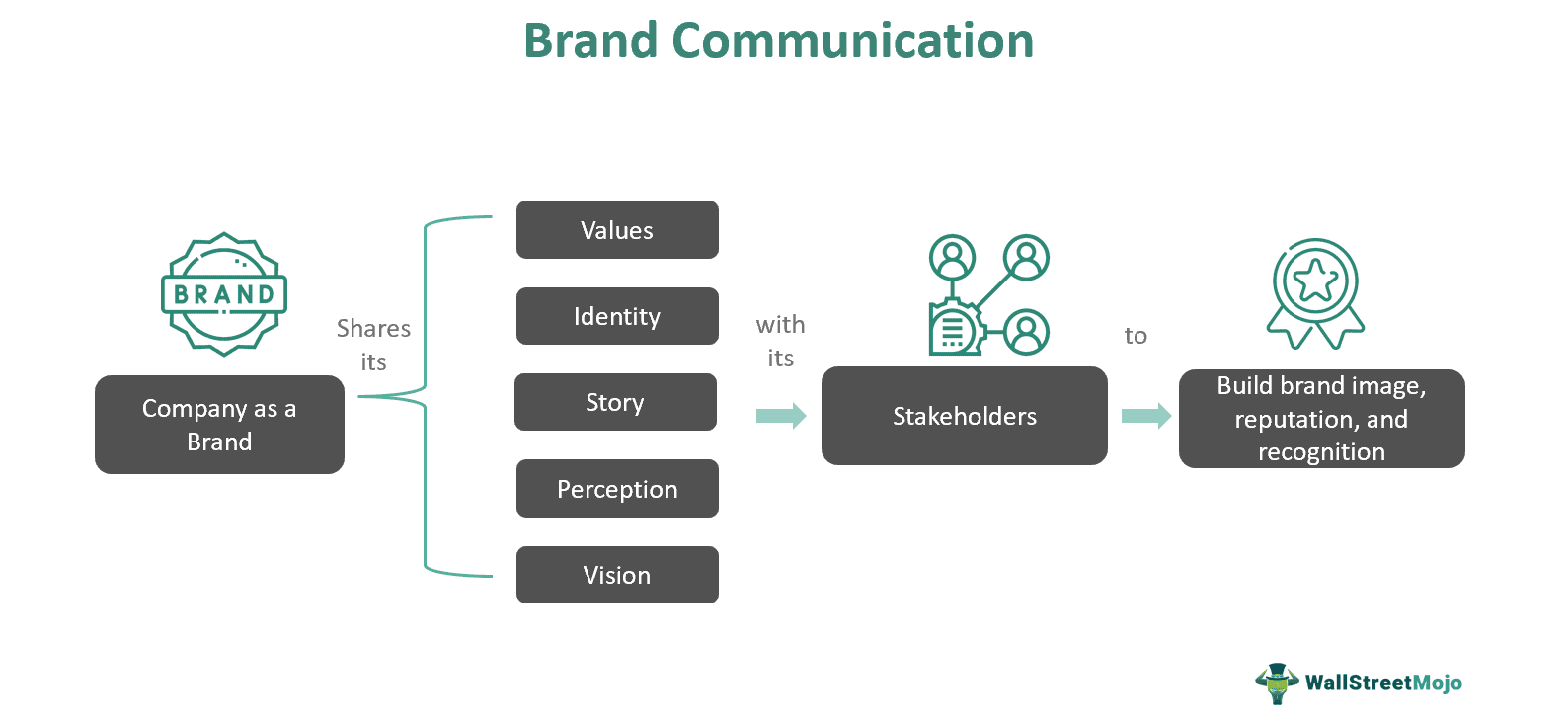
Companies often employ suitable brand communication strategies to build and strengthen long-term relationships with parties that hold a vested interest in their business. Management teams use a company’s brand voice to influence customer engagement and loyalty toward a brand positively. A good brand communication design enables companies to stand out as a brand, reducing threats from competitors.
Key Takeaways
- Brand communication is a strategic process of conveying a message or information about a brand’s values, identity, initiatives, perceptions,
- and story to varied stakeholders, such as employees, customers, investors, creditors, suppliers, sponsors, communities, and government agencies.
- It plays a key role in driving stakeholder engagement and loyalty toward a brand while promoting brand recognition and strengthening long-term relationships with customers, employees, and investors.
- Companies can communicate as a brand through advertising, public relations, email marketing, content marketing, branded content, social media,
- and employee branding and adopt an integrated brand communications approach.
- Unlike brand communication, marketing communication focuses on promoting products or services to potential customers.
Brand Communication Explained
Brand communication is an ongoing and systematic process of building a positive image of a brand among stakeholders to secure their trust and loyalty toward the company in the long run. It has the following three critical elements:
- Core Message: The primary component of such communication is the critical information or message that a company wants to deliver to its target audience. Thus, the message should be clear, sensible, and valuable to a company’s target audience (viewers, listeners, social media followers, etc.).
- Target Audience: Companies should thoroughly understand the mindsets, lifestyles, perceptions, problems, and behaviors of their targeted audiences, i.e., the people toward whom the messages are directed.
- Creative Content: The way the message is delivered plays a significant role in its impact on the target audience. Creatively crafted information with an emotional connection, when channeled through a proper brand communication strategy, leaves a positive impact on the target group.
When a company communicates as a brand, it does not undertake this activity with the direct intention to sell goods or services; it is done to establish a strong brand presence that consumers respect and value about a company and its products and services. However, brand communication managers face immense challenges in devising appropriate strategies to connect with their stakeholders.
The primary issue arises in setting the right tone of voice that appeals to the target audience while maintaining a balance between the visuals, sounds, and texts used to convey the message. Another problem is the selection of a brand communication strategy that best solves the purpose.
An integrated brand communications approach can help brand communication managers engage with customers at various levels and stages and ensure multi-channel collaboration. It also helps measure performance and highlights areas for improvement.
A key change in the brand communications landscape is the introduction of new digital platforms and continuous improvements in technology. With technological advancements, companies can expand their reach, connect with customers, gather real-time information and feedback, and offer fantastic customer experiences. Technology also enhances content variety and gives companies the ability to make data-backed decisions.
Brand communication strategies affect the finances of a company in many specific ways. Let us briefly discuss them before moving to the next section. Some key benefits of a good strategy include an increase in sales revenue, improved cost efficiencies, and enhanced investor confidence.
Types
There are a number of brand communication strategies that business entities use to convey their message to their target audiences. The different kinds of brand communication mediums include:
- Advertising: The most popular medium of brand communication is promoting brand stories, vision, initiatives, products, and values through paid advertisements on television, newspapers, magazines, online platforms, and radio.
- Content Marketing: Marketing is unimaginable without content, and businesses can share helpful, engaging, and informative blog posts, videos, newsletters, and podcasts to seek the audience’s attention and engagement.
- Public Relations (PR): Many public relations (PR) companies facilitate effective communication of brand values and efforts by promoting a news piece or event related to the company in such a way that it builds brand recognition.
- Branded Content: A company can associate with sponsors, TV shows, movies, sports, etc., to connect with their audience by developing content that easily blends with the values and activities of these partners.
- Employee Branding: A firm’s employees contribute significantly to the formation of their company’s brand image in the external world. Therefore, companies should focus on developing their employees’ careers and helping them gain professional recognition to set an example of a brand that values its people.
- Social Media: Business entities can build strong stakeholder relationships by addressing their audience over social media platforms such as LinkedIn, X (formerly Twitter), Instagram, and Facebook. Companies can share brand values and initiatives, respond to their followers, request suggestions and feedback, and air ad campaigns on these platforms.
- Email Marketing: Sending personalized emails, sharing the company’s vision, recent progress or events, its contribution to society and the environment, and even promotional offers are some of the ways of connecting with the target audience.
- Integrated Brand Communication: This is a comprehensive strategy of combining multiple types of brand communication activities, such as advertising, public relations, email marketing, and social media, to ensure a more effective brand-building approach.
Examples
Brand communication is a planned approach that helps a company achieve its vision in the long run. Given below are some examples of how it adds value to the firm’s brand management and recognition.
Example #1
Suppose Smart Wealth Financial Services was a small enterprise in 2015. It gradually focused on its branding and undertook various initiatives to establish itself and grow as a market leader in the finance sector. For this, it undertook focused brand communication initiatives. They have been listed below:
- The company advertised itself as a lender to young entrepreneurs.
- In 2018, it even started targeting online audiences by providing financial knowledge through blog posts, videos, podcasts, and social media posts.
- Then, in 2021, the company launched its newsletters and employed other email marketing tactics to reach out to interest groups and ensure their engagement.
With such strategies, Smart Wealth Financial Services became well-known as a brand among investors, customers, employees, and other stakeholders by 2023. It built a strong image and differentiated itself from its competitors by educating its audience about the various financial products, processes, frauds, etc. As a result, the company managed to increase its market presence and customer base.
Example #2
An April 2022 post highlighted how Procter & Gamble (P&G) raised prices by five percent across its product categories in response to cost inflation and various other unstable global conditions and still managed to retain its customers.
Despite this increase, its net sales increased by 7% to $19.4 billion, with all categories experiencing organic sales growth. P&G attributed its success to its brand communication strategy of promoting the superior performance of its brands, like Tide and Ariel, which offer savings through quality.
The company announced plans to invest in marketing to convey these value claims while compensating for increased costs with productivity savings. P&G adjusted its pricing strategy to ensure consumers do not feel burdened due to the cost of living crisis. Instead, they explained that the company will offer the same products in different price ranges to retain customers, preventing them from switching to cheaper or other options. It is noteworthy that despite multiple challenges, P&G raised its revenue growth forecast for the fiscal year 2022.
Example #3
Emirates has a great brand image due to its extensive and intensive brand communication initiatives that started way back in 2010. For this, the company significantly increased its corporate communications budget to nearly Dh1 billion in 2010.
Boutros M. Boutros, the Divisional Senior Vice-President of Corporate Communications, elaborated on the company’s strategies, including engaging Strawberry Frog for a new branding approach. Emirates’ emphasis on sponsoring sporting events and other initiatives has contributed to its global reach.
With an annual budget of around $270 million for corporate communications, Emirates ensured consistency in branding across markets, supported by a team of over 150 personnel. Despite challenges from competitors and media, Emirates was confident of its product and brand strength. This illustrates how effective brand communication works for businesses, strengthening their financial position, too, in the long run.
Advantages
Brand communication strategists make constant efforts to reach out to their target audience effectively. It is an inevitable part of brand management that provides the following benefits to a company.
- Fosters Brand Awareness and Recognition: The company can spread its brand identity, values, vision, mission, initiatives, products, and services among the target audience to ensure brand recall and recognition.
- Facilitates Attainment of Business Goal: With consistent and compelling brand communication, businesses can fulfill their long-term objectives and marketing goals.
- Builds Brand Reputation: As a brand constantly interacts with various interest groups, it can influence the target audience’s perception of the company by creating a positive brand image.
- Enhances Brand Engagement and Loyalty: A brand that emotionally connects with its audience through consistent marketing and brand communication efforts can ensure a more engaged and loyal customer base, investors, and employees.
- Increases Market Presence: Businesses that voice their brand successfully capture a considerable market share while increasing their presence and visibility among a broader target audience than usual.
- Differentiates from Competitors: Companies can differentiate themselves from their competitors by promoting their unique values, initiatives, and product offerings.
Brand Communication vs. Marketing Communication
Marketing and brand communications are two closely related concepts in brand management. However, they significantly differ in their approaches and objectives. The differences between them have been highlighted in the table below.
| Basis | Brand Communication | Marketing Communication |
|---|---|---|
| Definition | It is a systematic approach to conveying brand values, stories, information, vision, products, or initiatives with a company’s stakeholders to ensure brand engagement and loyalty. | It is a process of informing customers about a company’s product or service offerings to maximize sales and revenue. |
| Focus | Sharing brand story, identity, values, vision, and ideology with the customers, employees, investors, creditors, suppliers, and other stakeholders is key here. | Promoting products or services to attract customers is the focus. |
| Objectives | The objectives are fostering brand image, recognition, loyalty, and awareness among the target audience. | Increasing market share, driving sales, and attracting customers are the objectives here. |
| Target Audience | Stakeholders, including customers, employees, sponsors, suppliers, investors, creditors, communities, and government agencies, and the target audiences in this case. | Existing and prospective customers in the relevant target markets are the target audiences in this case. |
| Approach | Emotional connection, storytelling, problem-solving, and knowledge sharing help build a brand communication plan. | Emphasizing product features, uses, benefits, and offers through direct marketing and advertising enables companies to build a marketing communication plan. |
| Impact | It has a long-lasting impact on the audiences and helps companies build long-term relationships with various stakeholders. | Boosting a company’s immediate sales in a given period through such communication often has a short-term impact. |
Frequently Asked Questions (FAQ)
Frequently Asked Questions
What is a brand communication platform?
It refers to a structure or framework that companies formalize and use to define and explain how brand messages should be communicated across the chosen media. It outlines requirements with respect to voice, tone, target audiences, content strategy, communication channels, and performance evaluation, among other things. A platform ensures uniformity in brand messaging.
What is a brand communication strategy?
A brand communication strategy is a planned, systematic, and holistic approach to delivering a message to a company’s stakeholders in such a way that it leaves an impression on them, helping them recall and recognize the brand in the future.
What does a brand communications manager do?
A brand communications manager is responsible for guiding marketing specialists to ensure the timely and effective implementation of a brand communication strategy. They interact and coordinate with PR teams and product managers to ensure strong branding programs can be initiated and executed.
How to improve brand communication?
Companies must remember that a brand is what others perceive it to be. Therefore, it is essential to let investors, employees, customers, suppliers, and other stakeholders know that the brand values them. Also, while delivering the message to the masses, companies should maintain transparency, honesty, and relevance. However, the brand should make communications engaging and allow open-ended responses from its audience to develop their interest in the brand. It should not be focused on self-promotion but should be helpful to the audience.