


What Is Secure Electronic Transaction (SET)?
Secure Electronic Transaction (SET) is an electronic payment system mainly used for transactions involving debit and credit cards. In addition to being a payment system, SET operates like a security protocol that applies to all payments. Its sole purpose is to ascertain the authentication and confidentiality of transactions.
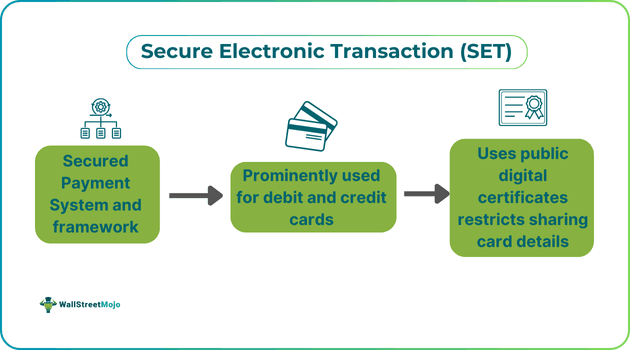
SET works with all parties involved in the transaction by encrypting sensitive financial information. Secure electronic transaction process verifies users through digital certificates so that personal card details remain confidential. SET also ensures that only authorized parties have access to sensitive information. SET is not just an electronic payment system but a security framework.
Key Takeaways
- Secure Electronic Transaction (SET) is an electronic payment system and security framework that ensures authentication and confidentiality in debit and credit card transactions.
- In the late 1990s, Mastercard and Visa developed SET in collaboration with many other internet companies, such as IBM, Netscape, Microsoft, Verisign, and so on.
- SET’s main participants are cardholders, merchants, issuers, acquirers, payment getaways, and certification authorities.
- The framework uses digital certificates but is still vulnerable to hacking, cybercrimes, fraudulent activities, and other forms of potential security breaches.
Secure Electronic Transaction Explained
Secure electronic transactions are standard protocols used in debit and credit card transactions over the Internet. It is observed as both a secure payment system and a security framework that is created to tackle security issues and preserve the authenticity, integrity, and confidentiality of customer information. Mastercard and Visa created SET in the late 1990s.
Still, it was possible because of the collaboration with other internet companies such as IBM, Microsoft, Netscape, and Verisign that provided other elements to the whole system. In simple terms, the SET protocols allow merchants to verify customers and their information without letting them actually see it, and the card information is directly transferred to the credit card company for verification.
The key factor that makes SET safer, secure, and reliable for online transactions and credit or debit card payments is the use of digital certificates. SET uses digital certificates to offer electronic access to funds. Every time an individual with a credit card wants to buy something online and chooses a credit card option as a payment method, an encrypted digital certificate gets generated for participants to verify the transaction.
The algorithms ensure that only the party with the digital key can confirm the transaction. This makes the entire transaction seamless without actually making the credit card details visible to the merchant or any other participant. This ensures that data is protected from hacking and encourages data privacy, security, and secure transactions.
Participants
The main participants of secure electronic transactions are:
- Cardholder – This simply means the buyer or the person in whose name the credit card is issued under Visa, Mastercard, or any bank or financial institution. The cardholder is also the owner of the account the card is linked to and typically uses it to make purchases and payments.
- Merchan – A merchant is simply the other party from which the cardholder is making payment or buying goods and services. To accept online payments, merchants need a well-established connection with the acquirer, another participant in such transactions.
- Issuer – An issuer is generally a financial organization that offers payment cards to cardholders. Issuers are responsible for managing any debt incurred by the cardholder.
- Acquire – As mentioned above, an acquirer is a financial organization that collaborates with merchants to process payment transactions. It is also responsible for authorizing transactions and offering electronic fund transfers to merchant accounts.
- Payment getaway – This intermediary between the card payment networks and SET is a typical participant in most online transactions and regulates payment authorization to ensure security.
- Certification authority – SET mainly relies on certification authority as it uses different digital certificates to authenticate cardholders. Certification authority is responsible for offering public-key certificates.
Examples
Here are two hypothetical examples to understand the concept better:
Example #1
Imagine Penelope is a finance enthusiast and enjoys reading books on finance. She was searching for a rare finance book on the internet to buy it online. Penelope came across two websites, one with no padlock symbol and the other with a padlock symbol. Penelope is brilliant; she knows that a website that does not have a padlock symbol is not safe and secure, so she should not buy the book from there. Penelope opts for the other website.
Now, at the time of payment, Penelope gives her debit card details, but the whole payment system falls under the security framework of SET. It uses low-key public certificates to authenticate Penelope and does not share her card details further with the merchant or any other participants. This way, online transactions are safe and secure. It is a simple example of a secure electronic transaction, but in the real world, many elements are covered in this whole process.
Example #2
For the second example, suppose Penelope purchases a book from a website that doesn’t have a padlock symbol. There is no SET protocol to secure the transaction on the portal. In this case, Penelope’s credit card information would have circulated and was vulnerable as it was visible to every transaction participant.
Such cases are the first step towards being ignorant of cybercrimes and not protecting personal information. This hypothetical example reflects the lack of the SET protocol. It shows how its non-existence can make it easy for hackers and cybercriminals to access the system and steal important information and account details. Although SET offers reasonable assurance, it is still vulnerable to cybercrimes and hackers using the system to steal money and information.
Advantages And Disadvantages
The key advantages of secure electronic transactions are listed below:
- Offers a more secure and reliable payment method
- Helps in transmitting credit or debit card details securely
- Restricts the use of customer information and so protects it from any unauthorized access
- Authenticate participants through digital certificates in the transaction
- Maintains the integrity of transaction data using digital signatures
The main disadvantages of SET are given below:
- Although it is a secured payment system, it is exposed to potential security breaches.
- The whole framework is highly dependent on the technological infrastructure.
- The risks of fraudulent activities still exist.
- SET is vulnerable to hacking and cybercrimes.
- Cybercriminals can find loopholes in the framework and use them against the system to steal credit card details.
Frequently Asked Questions (FAQs)
Frequently Asked Questions
What is the difference between a secure sockets layer (SSL) and a secure electronic transaction (SET)?
Both SSL and SET mainly focus on securing online transactions, but they have different objectives. SSL is more concerned with ensuring a secure communication channel and encrypting data during transmission. Still, SET is a secured payment system that operates as a highly exhaustive security framework to secure electronic transactions, offering end-to-end encryption.
What are the four types of digital certificates used for secure electronic transactions (SET)?
SET as a security framework uses four types of digital certificates: · Cardholder certificates · Merchant certificates · Payment getaway certificates · Authority certificates
How do secure electronic transactions work in e-commerce?
The step-by-step process of SET in e-commerce follows as – – Initialization: Customer selects credit card to pay. – Encryption: Payment details are encrypted using the merchant’s public key. – Certificate Exchange: The merchant shares a digital certificate to verify identity. – Payment Info: Encrypted details are sent back to the merchant. – Authorization: Transaction is forwarded to the payment gateway for fund verification. – Confirmation: The payment gateway confirms approval for both parties. – Completion: The merchant fulfills the order after approval.