


What Is A Trade-Off Analysis (TOA)?
Trade-off analysis is a process where different requirements and options are compared and chosen when there is conflict among stakeholders. It involves determining the effects of the simultaneous increase and decrease of one or more key factors of a project.
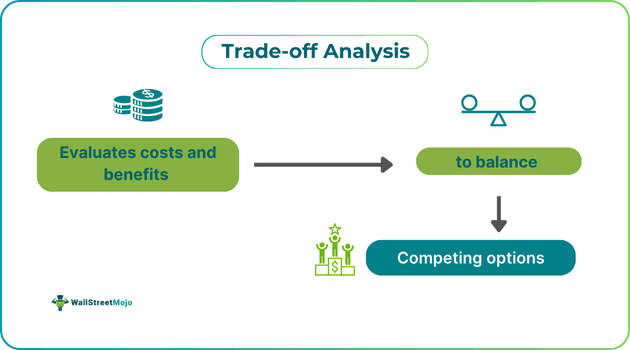
The process involves making decisions based on comparing the costs and benefits of different options to select the best. Both external environmental factors and internal factors can influence the analysis. It would be an ongoing process throughout the project’s life and is based on the project’s constraints.
Key Takeaways
- Trade-off analysis is a process that involves comparing different options based on different criteria to arrive at an optimal solution. It may involve increasing or decreasing one or more factors to be compared simultaneously.
- Common techniques of the analysis include cost-benefit analysis, multi-criteria decision analysis, sensitivity analysis, and Pareto optimization.
- It helps optimize resource allocation, reduce costs, and increase efficiency.
- Analyzing projects can help navigate limitations on resources, time, and cost through task prioritization and schedule optimization. Ignoring them could lead to conflicts, unrealistic expectations, and budget overruns.
Trade-Off Analysis In Project Management Explained
Trade-off analysis in project management is a process where different options are compared based on cost, risks, time, and performance to identify the best solution. The process may involve adopting a factor, reducing or increasing its key characteristics, and comparing it with another factor whose characteristics have been increased or decreased. The effectiveness, hence, depends on the accuracy of metrics and factors used for comparison.
In project management, it helps optimize resource allocation, reduce costs, and prioritize tasks. This improves the project’s execution efficiency and speeds up the process. It also helps make informed decisions when issues crop up.
Evaluation of trade-offs optimizes project outcomes despite the existence of constraints. The constraints may be in the form of quality, cost, time, or even resources, and analyzing them helps managers prioritize tasks and manage associated risks efficiently. It promotes calculated decision-making and accountability among employees, which ultimately results in stakeholder satisfaction.
Ignoring trade-offs, however, can result in unrealistic expectations and a high chance of failure. If quality, cost, and time factors are not considered, there are high chances of budgetary overruns and under-delivery of the project. It could also lead to conflict among team members.
Types Of Trade-Off Analysis Techniques
Given below are some of the common analysis techniques used and they are:
- Cost-benefit analysis: Cost-benefit analysis evaluates the total benefits arising from a project against the project’s total cost. It evaluates the outcome of an option and the favorability of the action.
- Multi-criteria decision analysis: Multi-criteria decision analysis is a specific method of comparing options based on multiple criteria. It is utilized when complex and conflicting options must be chosen.
- Pareto optimization: Pareto optimization involves mathematical optimization of problems that involve more than one objective function that needs simultaneous optimization. It shows the advantage of an option by showing the worse-off side of the other option.
- Sensitivity analysis: Sensitivity analysis studies how the uncertainty factor of an output can be divided and allocated to various sources of uncertainty in its inputs. It measures how the input variables impact the model outputs.
Examples
Let us look at some of the examples to understand the concept better.
Example #1
Let us discuss a hypothetical example of trade-off analysis in software engineering. Suppose Daisy is a project manager working for a software company, and she has to analyze trade-offs in a project. There are six significant steps that she goes through to conclude:
The first step is to understand the context. She analyzes whether there are issues and the options available, along with the considerations that have to be taken care of. The second step is to define the alternatives. She further examines the alternatives from multiple perspectives. The third step is to define the criteria. Here, she analyzes how to evaluate the options and their qualities and constraints.
Step four is to set the criteria weights where she weighs which criteria rank higher than others in criticality. The fifth step is to set the scores where each alternative is evaluated and scored. The final step is to analyze and make a decision based on the results. The output of total results is analyzed, and scores are reviewed to make a decision.
Example #2 – A Real-Life Example
The TOA is applicable in various fields, including sustainable agriculture and related policies. A study of 119 studies revealed that the TOA focuses more on productivity than on factors like environmental and socio-cultural services. It also overlooks stakeholder involvement, uncertainties of outcomes, and multi-scale effects.
The study suggests incorporating cross-scale effects and relevant indicators that contribute to human well-being and stakeholder engagement. Evaluating risks and clarifying stakeholder roles could enhance the legitimacy of the process and promote positive agricultural transformations.
Benefits
Given below are some of the benefits of this approach:
- Analysis helps in the evaluation of projects in terms of cost, quality, and effectiveness.
- It helps in the execution of events concerned with the project within a specific time.
- It helps in balancing different competitive elements in a project.
- It helps in making decisions, weighing the cost, time, quality, and choosing the best path forward.
- It helps project managers and the company navigate the limitations of resources.
- It helps prioritize tasks, focusing on the critical ones and setting aside tasks that can be delayed.
- They are helpful in schedule compression and analysis, and they help to determine which techniques serve better.
- Proper analysis can contribute to the sustainability of the project.
- A systematic analysis can help the project meet standard levels of quality and exceed stakeholder expectations or at least satisfy them.
Frequently Asked Questions (FAQs)
What does one seek out in trade-off analysis?
An analysis could be done to eliminate conflicts and reduce costs or duration. It could also improve the quality of the output to satisfy stakeholders optimally. The reasons could vary depending on the project and the manager.
What is cost trade-off analysis?
Cost trade-off analysis is the process of arriving at a choice from options with varied costs. It helps control costs and efficiently use resources.
What is trade-off analysis in software engineering?
It is a process that helps engineers make decisions on design, outcomes, options, and project requirements. It is also helpful in choosing the optimal execution strategy and when conflicts arise.
What is the best value trade-off analysis?
Best value analysis is a method of evaluation used by the source selection board in federal government contracting. It helps find the bidder with the most advantageous proposal to the government.