
Brand Collateral Meaning
Brand collateral refers to a collection of visually appealing material and digital assets that a company uses to connect with its target audience. These assets effectively communicate the brand’s story, journey, and values. Moreover, such media items must be designed in a way that is parallel to the brand strategy, personality, and core values.
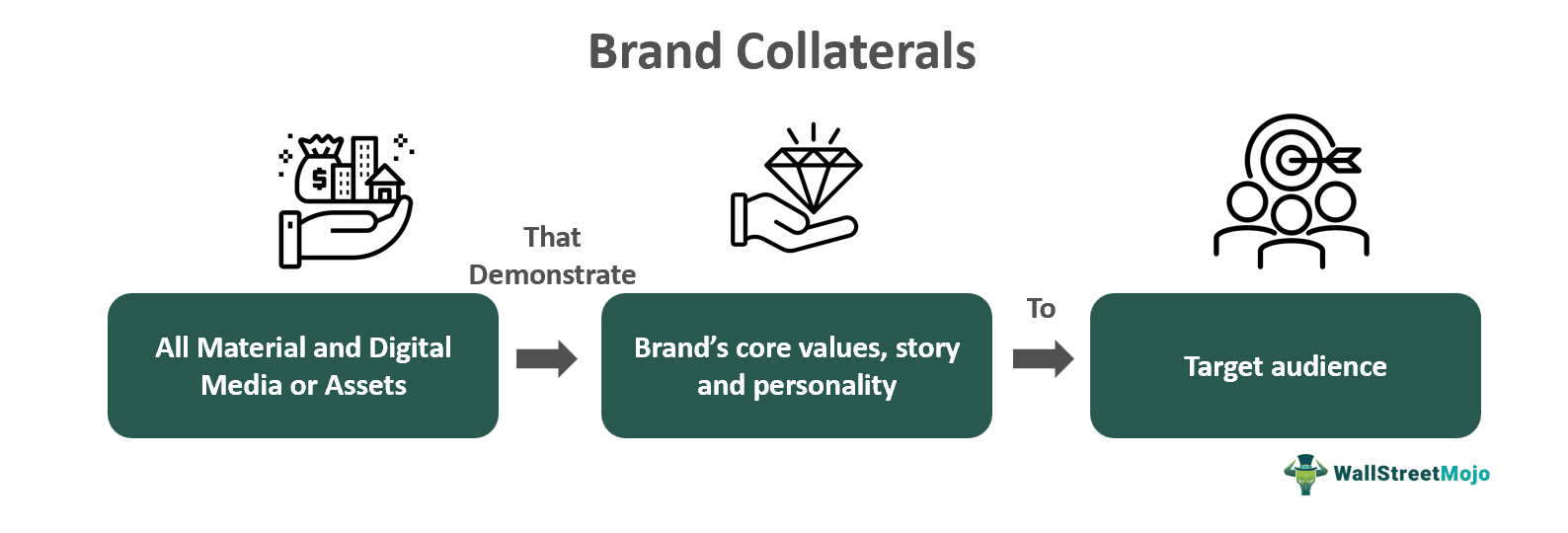
Companies are recognized as brands due to the consistent use of various tangible evidence such as names, logos, graphics, imagery, patterns, fonts, designs, and colors. Such efforts help the firms to increase their sales, strengthen relationships, and connect with people emotionally. Furthermore, it enhances brand awareness and loyalty, creates a brand identity, and differentiates themselves from their competitors.
Key Takeaways
- A brand collateral is a collection of all physical and virtual media or assets that the business uses to reach its target customers, investors, and other stakeholders. It conveys a brand’s values, story, and personality.
- Such media items represent unified elements like name, logo, design, pattern, color theme, graphics, and imagery.
- Its list includes print, stationery, digital, publication, mockup, promotional, presentation, signage, packaging, uniforms, IDs, and vehicle livery.
- These assets help companies create brand identity, recognition, loyalty, and awareness. Also, it facilitates the differentiation of products and services from competitors.
Brand Collateral Explained
Brand collateral is a collective media or digital and physical assets that voice a company’s core values, beliefs, story, milestones, and personality. It includes anything that represents a brand in alignment with its strategies using a single name, logo, design, and color theme. This also encompasses imagery, fonts, patterns, and graphics. Some prominent examples of such collaterals are brochures, mockups, newsletters, posters, magazines, and carry bags. Other examples include product packaging, websites, social media ads, banners, and billboard advertisements.
However, every type of brand collateral design has a unique purpose and relevance in business Together, they create a strong brand presence and ensure the sustainability of the firm in the long run. A brand collateral idea should be creative and meaningful and must cover all three elements stated below:
- Define the company’s core values and purpose.
- Address or appeal to the target audience or consumers.
- The unique selling proposition of the business, which sets it apart from its competitors.
Strong branding helps the company enhance its sales and profitability. In addition, it helps the business gain the trust and confidence of its stakeholders.
Types
Brand collateral items can be categorized into the following different kinds based on their purpose and idea:
- Digital: The online presence of a company significantly matters in business expansion beyond the physical boundaries. It includes websites, newsletters, social banners, online advertisements, and animated content.
- Stationery: Such physical collaterals comprise newsletters, business cards, notepads, and envelopes.
- Mockup: Brands use a standard full-size model to represent the design and purpose of their project, known as brand collateral mockup.
- Print: Brand advertisements and promotion of products, services, and events through mailers, flyers, brochures, and posters are part of the brand collateral list.
- Publication: Companies publish their branding efforts, milestones, success stories, and journey periodically in magazines, reports, editorials, and press advertisements.
- Promotional: Organizations occasionally gift pens, calendars, bottles, and other items with brand logos and names to their associates, customers, and employees. Also, they promote their brand through banners, points of sale, and sponsorships.
- Signage: Businesses use various signs for public and commercial displays of the brand, including internal buildings, external buildings, wayfinding, and exhibition displays.
- Packaging: Businesses use the same logos, imagery, and color combination on the packaging of goods or services of a particular brand to enhance recognition and recall value.
- Presentations: Other brand collaterals undertaken by companies are presented through visual presentations such as showreels, PowerPoint presentations, case studies, and videos.
- Vehicle Livery: A modern way to promote brand awareness is through the use of vinyl graphics for advertising the brand on the vehicle’s outer body.
- Uniforms and IDs: Companies show unity among their employees and representatives. This ensures that their uniforms and identity cards show their belongingness to the brand.
Examples
Let us now understand its significance and use through the following examples:
Example #1
Suppose AB Pvt. Ltd. is a company that belongs to XYZ brand. The company thereby uses various brand collaterals, including social media advertisements and campaigns, e-newsletters, flyers, and brochures under the brand name XYZ. By maintaining consistency in logo, colors, imagery, and design, AB Pvt. Ltd. aims to create a solid, professional, consistent, and positive brand value recognition and recall among the audience.
Example #2
Tabasco has strong brand recognition worldwide due to its various brand collaterals, including digital, print, and out-of-home media initiatives. Mcllhenny Company has run creative visual advertisements over the years to enhance its brand engagement and presence. Recently, the company has come up with a new campaign to reinforce the brand, distinguishing each product based on its heat and flavors under the supervision of Kathy Redick, the art director of CD. Given below are some snapshots of interesting new brand collaterals of Tabascco:


Importance
The various reasons that a business gives due consideration to such media collection are as follows:
- Represents Brand Identity: It helps companies create a solid brand identity to ensure recognition among the customers, investors, employees, and other stakeholders.
- Builds Professional and Positive Brand Image: A consistent use of brand collaterals helps businesses to feature a professional branding approach. It helps develop a strong brand image among the public.
- Promotes Brand Awareness and Loyalty: Such assets make the public aware of a particular brand and initiate their loyalty towards its products and services.
- Communicates Brand Values: Companies can demonstrate their value proposition and beliefs through their brand collaterals.
- Initiates Sales Conversations: Items such as brochures, pamphlets, and advertisements serve as a medium to show what the company is offering to its customers.
- Differentiates Business From Its Competitors: These assets can easily create a differentiation between the products or services of the competing firms, preserving their originality.
- Strengthens Customer Relationship: Companies can build robust customer relationships by facilitating brand recall, recognition, loyalty, and awareness.
- Ensures Emotional Connect: When the companies have a substantial brand value as represented by their branding efforts, the stakeholders feel emotionally attached to the brand.
- Improves Sales and Return On Investment: The overall aim of using such collaterals is to successfully close more sales deals and improve the firm’s ROI in the long run.
Frequently Asked Questions (FAQ)
Frequently Asked Questions
How to make brand collaterals?
The art directors and creative team often create brand collaterals. These teams could be internal to an organization or operating as an individual advertising and branding firm. However, the key is to align and integrate such media items into the brand’s core values, strategies, and goals.
Can we use humor in our brand collateral?
It is proven that anything presented humorously leaves a long-lasting impact and recall ability on the audience. Therefore, brand collaterals involving humor can maximize the chances of success.
How to know if a brand collateral is working?
The results of using a particular brand collateral can be gauged through various metrics like change in brand recognition, website traffic, conversion rate, and audience engagement.
How often should businesses update or refresh their brand collateral to remain competitive in the market?
To stay current, businesses should update their brand assets regularly, typically every one to two years. Updates are necessary if there are significant changes in the brand’s positioning, messaging, or visual identity.