


What Is A Written Agreement?
A Written Agreement is a legal document that acknowledges transactions between the parties involved, enacting as proof and tangible evidence of their consent to the terms and conditions specified in it. The parties sign this document to show their mutual agreement to the mentioned clauses within the contract.
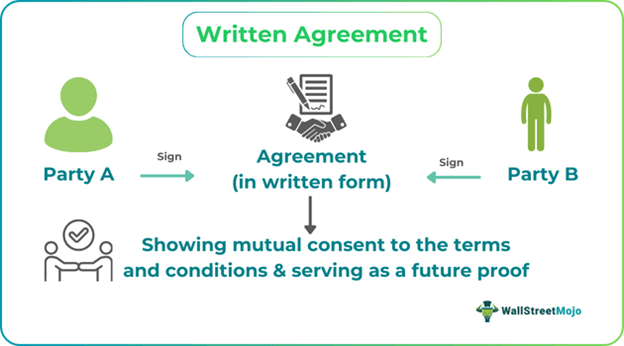
Using a legal written agreement, either of the parties has the right to make the other one fulfill their part of the deal. Written agreements have a wide scope, are commonly used and are widely encouraged in any form of business and professional contracts, meetings, settlements or transactions. Written agreements recognize the entire framework of a deal.
Key Takeaways
- Written agreements are well-drafted, recorded and detailed legal documents binding the involved parties, who sign them to show mutual consent to the terms and conditions mentioned there.
- Most commonly, they are partnership agreements, sales contracts, employee contracts and nondisclosure agreements, but again, it has a wide scope and is also used for several different reasons and settlements.
- The written agreements protect the interests of parties, serve as legal proof, facilitate better communication, are well-detailed, and help mitigate risks.
- Such an agreement must be well reviewed and understood by the attorneys of the involved parties before they make the signatures.
Written Agreement Explained
A written agreement contract is a well-drafted and detailed legal document binding two or more parties with the terms and conditions with respect to the deal. In the events of disputes, these agreements act as proof of mutually agreed-upon terms, giving each party the right to get the work done by the other per commitment. The most common types of written agreements are sales contracts, employee contracts, partnership agreements, and nondisclosure agreements. Written agreements have been and are still broadly used to record and recognize different business and non-business transactions occurring between people.
Whenever two or more parties agree to exchange goods or services for monetary payment or come together to become a part of any understanding, they create legal documents that are formalized, well-drafted and cover all the terms and conditions, including minute details about the transactions. In case they do not have this document, there will be no proof or tangible evidence that any such agreement ever existed, leaving either party with nothing valid to enforce the terms and conditions.
Businesses use these agreements to make every transaction and contract airtight with minute details. It also facilitates better communication between parties, helps both of them be aware of the terms so they can manage and mitigate risks and, most importantly, protects the parties’ interests by legally binding them. These agreements can be made as brief or as complicated as possible, depending on the nature of the transaction and the interest of the parties. It is highly advised that parties have their legal advisor or attorney present to review the agreement before signing it.
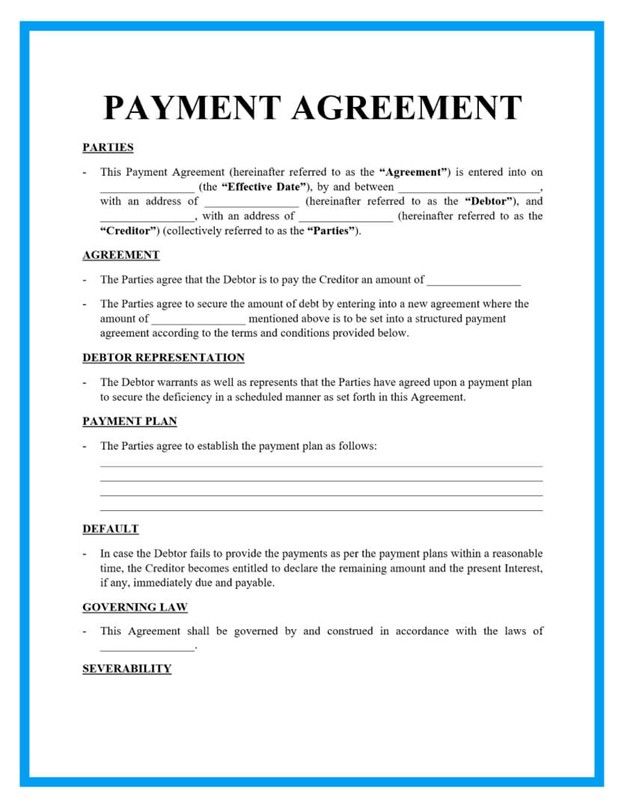
The sample of a written agreement is as follows:
Examples
Let us check the instances below to understand how written agreements make carrying out a deal feasible:
Example #1
Suppose Tiffany shifts to New York and starts looking for a small apartment to rent. She meets Jacob, who shows her an apartment that he owns. Tiffany likes the apartment and decides to move in. However, she asked Jacob to prepare a rent agreement, which Jacob first did not agree to draft as he trusted the verbal communication more. But Tiffany insists on having a well-drafted written rent agreement that both (she and Jacob) must sign, agreeing to the terms and payment. Finally, Jacob agreed, and they both signed the written agreement.
The rent agreement has all the minute details covered, and now Tiffany feels secure as both parties are clear on the terms and conditions they must abide by. Without a proper rent agreement, Tiffany might not question even if Jacob asked for a higher rent than what was agreed in the first place. Also, there was a possibility of Jacob blaming her for any damages that were already in the apartment. With an agreement in place, Tiffany now had a well-drafted written agreement that she could use as proof and counter Jacob if required.
Example #2
Effective May 20, 2024, every business appointing independent contractors or freelance service providers in New York State must sign a written agreement if the services provided exceed $800. The written agreement should have all the details mentioned, and if the employer fails to comply with this new rule, they can face penalties of up to $25,000. The $800 threshold could be either by itself or an accumulated sum with other contracts with the same employer and contractor within the last 120 days.
The New York businesses must store these written agreements with them for six years. Likewise, the freelancer or independent contractor has six years to complain to the Commissioner of Labor. This rule does not apply to services offered by sales representatives, attorneys, licensed medical professionals and construction contractors.
Benefits
Having such an agreement is beneficial for all the parties involved in the deal. Let us have a look at some of them below:
- It serves as tangible proof and solid evidence in the events of disputes and misunderstandings.
- This type of agreement offers security and peace of mind for all the parties involved with all the details properly mentioned.
- Reduces the risk of dispute when the scope of services, time frames and tasks are outlined in the this agreement for payment.
- Written agreements have a separate section of dispute resolution, which states how any dispute between the parties could be resolved.
- Legally recognize the agreement under the governing laws.
- It also mentions how any of the parties can terminate the agreement.
Written Agreement vs Verbal Agreement
The key differences between written and verbal agreements are as follows:
- Written agreements are well-drafted in detail, written and recognized. In comparison, verbal agreements are oral promises.
- Written agreements are the best evidence to prove that an agreement has occurred and is difficult to withdraw. In contrast, verbal agreements have no such value or proving grounds.
- Written agreements are common and widely used worldwide for recognizing a deal, related terms and conditions, and mutual consent of the parties. On the contrary, verbal agreements cannot be trusted, so they are not practically enforceable by law.
Frequently Asked Questions (FAQs)
Frequently Asked Questions
What are the key elements of a well-drafted written agreement?
The key elements of a written agreement are – 1. Parties – Mentions and identifies the involved parties 2. Purpose – Defines the purpose of the agreement 3. Terms and conditions – Every small detail and important information is covered. 4. Dispute resolution – Specifically outlines how any form of dispute will be resolved. 5. Termination – Conditions under which the agreement can be terminated 6. Governing Law – The governing law that governs the whole agreement.
What are the common mistakes and traps to avoid in a written agreement?
The common mistakes and traps to avoid while dealing with a written agreement are – – Using online templates with generic content – Not mentioning any details – Ignoring the regular updates with time in the written agreement – Not taking the help of a legal professional to review it
What are the risks of not having a written agreement?
The risks of not having a written agreement are – – Risks of dispute increase because both parties rely on their memory of what they promised – No written agreement means that no involved party can enforce anything or go against each other in the event of non-compliance. – A potential high risk arises at the time of payment, and parties can decline to pay.