


What Is Personal Retirement Savings Account (PRSA)?
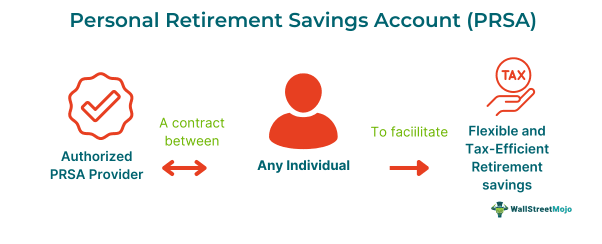
A personal retirement savings account (PRSA) refers to a long-term savings and investment plan that facilitates individuals to start a pension fund with flexible terms and conditions. The account holders’ contribution to PRSA, whether lump sum or regular payments, can be claimed for a tax deduction.
Thus, it helps individuals like employers, self-employed people, professionals, and employees to save money for the future, i.e., when they retire or become 60 years old, while availing various tax reliefs. Also, the account holders can resume the same PRSAs even if they switch to their jobs. Moreover, no charges have been levied for changing a PRSA plan.
Key Takeaways
- A personal retirement savings account (PRSA) is an investment plan that allows individuals to grow money while planning their retirement savings in a tax-efficient and flexible manner.
- It can be taken by anyone, including homemakers, caretakers, self-employed people, professionals, and employees, by entering into a contract with the authorized PRSA providers as accredited by the Revenue and the Pensions Authority.
- The two kinds of PRSA plans include standard PRSA and non-standard PRSA, while the former has a maximum 5% cap as charges applicable on such contribution, 1% annual fund management fees; the latter has no such limits or conditions.
Personal Retirement Savings Account Explained
A personal retirement savings account (PRSA) serves as a savings and investment vehicle that facilitates a contract between the holder and a government-authorized PRSA provider recognized by the Revenue and the Pensions Authority. Such a plan aids individuals to save money for their retirement while allowing flexibility and tax efficiency. Indeed, the money is invested in the investment funds, and the government provides personal retirement savings account tax credits to contributors of different age groups up to a specific limit, as stated in the table below:
| Age Group | Tax Relief Limit Decided By Government |
|---|---|
| Below 30 Years | Upto 15% of Earnings |
| 30 – 39 Years | Upto 20% of Earnings |
| 40 – 49 Years | Upto 25% of Earnings |
| 50 – 54 Years | Upto 30% of Earnings |
| 55 – 59 Years | Upto 35% of Earnings |
| 60 Years and Above | Upto 40% of Earnings |
However, as per the new amendment in the Finance Act, as of January 01, 2023, an employer can contribute up to Euro 2 million as pension Standard Fund Threshold (SFT) for their employees or directors.
In the meantime, given below are some of the other notable features of this retirement scheme:
- An account holder can claim retirement benefits if they become permanently incapable, physically or mentally, to continue with their occupation or any other related work.
- The PRSA amount will be paid off in full to the beneficiaries without transferring the funds to ARF in case of the account holders’ death while in service.
- The employer can claim tax reliefs on the PRSA contributions made during a specific accounting period for the employees.
- The retirement benefits can be claimed up to a maximum age of 75 years.
- 25% of the PRSA value is allowed to be withdrawn in a lump sum upon retirement.
- While the first 200,000 Euros is tax-free, the other 300,000 Euros are chargeable at the standard tax rate, and PRSA value above 500,000 Euros will be subject to the marginal tax rate and social charges.
Now, the PRSA saves individuals from capital gain tax, exit tax, or deposit interest retention tax on the money accumulated in such an account, hence providing a tax-free return. Moreover, it provides sufficient flexibility to the holders in the ways of making contributions, whether monthly, quarterly, half-yearly, or annually, which can be changed anytime. Also, they can increase, decrease, miss out, stop, or start the periodic payments at their ease. Indeed, individuals can have complete control over such plans and their work lives with such schemes in place.
Who Can Get?
A PRSA can be opened by anyone, whether they are employed or not, the ones who don’t have any employer-provided pension scheme or who require additional retirement savings. Hence, the plan is available to employees, professionals, employers, self-employed individuals, jobseekers, caretakers, homemakers, and others. The contributions under such a plan are made by the PRSA holders or even by their employers. Indeed, employees who are working for a minimum of 20 hours every week immediately become eligible for a PRSA plan.
Types
The PRSA is an excellent alternative for financially securing old age, irrespective of the holder’s employment status or occupation. The individuals can select from the following two forms of PRSA:
- Standard PRSA: A standard PRSA involves a maximum limit on the charges applicable over the payments made towards such plans, i.e., up to 5%, and another 1% is chargeable annually on such investments under management. Moreover, the investments in PRSA are restricted to only pooled schemes like life company unit funds and unit trusts.
- Non-Standard PRSA: On the contrary, the non-standard PRSA has no restrictions over the maximum charges that the PRSA provider can levy and no barriers over the investment of PRSA funds.
Examples
Let us now gauge the significance of PRSA as a retirement savings plan for individuals through the given examples:
Example #1
Suppose Mrs. Norris is a homemaker who has separated from her husband and runs a boutique from her home. At the age of 38, she opened a PRSA with XYZ Bank, where she deposits $15,000 annually. While her annual earnings are $80,000, she is eligible to claim tax exemption for the complete PRSA contribution, i.e., $15,000, which is lower than $16,000 (20% of her earnings) as per the government’s personal retirement savings account tax credit limit for the age group 30-39 years.
Example #2
The Irish Congress of Trade Unions has shown concerns regarding a loophole in the proposed auto-enrolment pension scheme legislation. They highlighted that approximately one in twenty employees with pensions solely possess a PRSA lacking employer contributions. According to the union body, under the outlined bill, these workers may not receive employer contributions for a minimum of seven years post the commencement of auto-enrolment.
This discrepancy arises because the bill mandates seven years before applying minimum employer contribution rates to all pension schemes. This issue could potentially impact nearly 800,000 workers aged between 23 and 60 who are currently not enrolled in an occupational pension scheme. Despite receiving government approval, uncertainties linger regarding the scheme’s implementation, particularly concerning potential timing conflicts with a general election.
Frequently Asked Questions (FAQs)
Frequently Asked Questions
Are personal retirement savings accounts worth it?
<p>While around half of the households in the US don’t have any retirement plan or pension fund savings, PRSA becomes essential for these individuals to secure their old age financially. Such investment products not only provide a tax advantage to the holders but also offer sufficient flexibility in terms of contribution (periodic or lump sum), switching jobs, and selecting or changing different PRSAs.</p>
What is the difference between personal retirement savings account and personal pension?
A personal pension plan is a private arrangement to get regular retirement income under a contract with the bank, unit trust, or insurance company. A PRSA is a flexible investment product that provides a chance to invest and save money for retirement on one’s terms and conditions.
Is a personal retirement savings account mandatory in Ireland?
Suppose an employer doesn’t have any specific occupational pension plan for its employees in Ireland. In that case, the government mandates the provision of PRSA while allowing employers to deduct contributions from employees’ gross salaries and compute net pay and taxes. Also, the employee can directly apply for such tax exemption from revenue.