


What Is SEC Form 15?
SEC Form 15 refers to a document that a listed company files with the Securities and Exchange Commission (SEC) to get itself unregistered for public trading. Also termed the Certification and Notice of Termination of Registration, this type of voluntary notice helps companies cease SEC reporting.
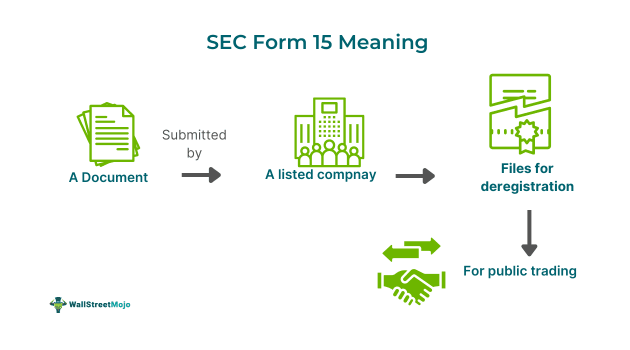
The small businesses listed on the SEC choose to terminate themselves from the SEC registration as they find the SEC reporting troublesome with a handful of shareholders. Indeed, the listed firms that will be soon delisted due to their financial distress or bankruptcy can voluntarily file for their discontinuation as registered corporations.
Key Takeaways
- SEC Form 15, or Certification and Notice of Termination of Registration, is a document that a listed company submits to the Securities and Exchange Commission (SEC) to get deregistered from public trading.
- SEC Form 15 is often considered by the small firms that couldn’t manage the periodic reporting with the SEC according to the norms of the Securities Exchange Act of 1934.
- Even those businesses that are facing financial hardship and would eventually get delisted by the SEC can file such a notice.
- Companies need to check their eligibility according to the SEC requirements before applying for deregistration.
SEC Form 15 Explained
The SEC Form 15 is a notice that allows a company to request the Securities and Exchange Commission (SEC) for the delisting of its specific securities from a National Securities Exchange for being no longer publicly traded. The firms that have been listed on a public exchange for various years can resort to applying for their deregistration due to the high reporting cost, reporting complexities and burden, and potential delisting by the SEC because of financial trouble. For this purpose, the corporations must fulfill all the filing requirements specified by the SEC.
While a company can file for such deregistration after 90 days of not reporting to the SEC, the waiting period after such filing is 10 days. Although there are various benefits for companies that get delisted, firms should be aware of its limitations as well. The deregistered firms could face challenges in attracting investors, seeking equity capital, or selling stocks after that. Moreover, it would not lead to the elimination of other regulatory compliance and legal expenses. Indeed, the cost of termination increases the financial burden.
Requirements
As per SEC Form 15 rules, the parameters are for the eligibility of the companies. These requirements are explained below:
- The company shouldn’t have any of its securities listed on the National Securities Exchange.
- The holders of records for a specific class of stocks should be fewer than 300.
- The firms that have any ongoing offerings are not allowed to submit Form 15.
- The company should have consistently reported with the SEC, including Form 8-K, 10-K, and 10-Q, and followed the reporting requirements.
How To File?
The companies that opt to file SEC Form 15 must follow a systematic process to avoid any rejections from the SEC. The fundamental steps for such an application are discussed below:
- Inform the Securities Exchange: The company must primarily inform the respective exchange about its plan and reason for filing for the termination of registration. After this, the particular securities exchange releases a notice of delisting, permitting the firm to proceed further.
- Deposit SEC Form 15: The firm then needs to fill out Form 15 with details about the specific stocks to be delisted and the relevant reasons for the same and submit it to the authority.
- Wait Patiently: The filer should wait at least 10 calendar days after applying. However, the firm is prohibited from making any securities trades during this period.
- Terminate the Registration: If the SEC accepts Form 15, it becomes effective, allowing the company to proceed with terminating the registration process by filing a separate form and clearing any outstanding payments.
- Ensure SEC Reporting: The corporation has to keep on submitting all the quarterly and annual reports, such as filing Form 10-Q, 8-K, and 10-K, until its holders on record are below 300 and their assets are less than $10 million.
Examples
The companies usually file for SEC Form 15 for different reasons; let us understand its relevance for corporations through the following examples:
Example #1
Suppose PQR Inc. It is a company listed on the National Securities Exchange. It has 289 shareholders on record and has assets worth $9.7 million. Now, since the company finds the periodic SEC reporting troublesome when executing its core business operations, the business files Form 15 with the SEC while mentioning the proper reason for such a step. Also, the company has yet to offer any current offerings, which makes it eligible for such an application. The management took this step after releasing a notice to its stakeholders to inform them about the same 30 days of SEC filing.
Example #2
On January 26, 2024, Navidea Biopharmaceuticals announced its Form 15 filing with the SEC to delist its common stock and discontinue its reporting responsibilities under the Securities Exchange Act of 1934. The company’s recent delisting from the NYSE American intends to reduce its reporting costs and complexities, facilitating Navidea’s concentration of resources, money, time, and efforts on its primary business activities.
Notably, the company is engaged in developing precision immunodiagnostic agents and immunotherapeutics, utilizing its Manocept platform for targeted disease identification and treatment. Indeed, its deregistration will not affect its business operations. However, in the press release, the company issued a forward-looking statement emphasizing the inherent uncertainties and being cautious about future projections.
Common Mistakes To Avoid
While submitting the SEC Form 15 template, companies need to be careful of the details, requirements, process, and timing of such a filing to eliminate the scope of the following blunders which could lead to the rejection of such an application:
- Most companies need to meet the eligibility standards and requirements specified by the SEC (as stated above).
- Usually, the firms don’t mention the reason they will not be liable for reporting to the SEC.
- Another common issue arises when businesses fill in the wrong details or miss out on some information.
- It is crucial to discuss the decision to file an SEC Form 15 with the stakeholders, including investors and creditors, 30 days before taking this step.
- Timing matters a lot in such an application; therefore, filers should always wait at least 10 days after filing Form 15 with the SEC.
Importance
The Certificate and Notice of Termination of Registration is a critical document that facilitates a small corporation or a business with troubled finances to get itself unregistered from public trading. It is essential for the following reasons:
- No SEC Reporting Burden: The companies that find it challenging to submit reports with the SEC periodically can avoid such load by filling out Form 15 with the SEC.
- Voluntary Deregistration: The firms that are on the verge of bankruptcy or facing financial hardship to such an extent that they will be automatically delisted from public trading can opt for self-termination.
- Ensures Flexibility: The corporations could use their resources, time, money, and efforts to improve their business operations and growth, which would otherwise be consumed in SEC reporting.
- Curtails Legal Obligations: Trading publicly increases the legal liabilities since the companies need to adhere to the reporting prerequisites of the Securities Exchange Act of 1934.
- Exhibits a Positive Sign to Stakeholders: In some instances, a voluntary deregistration application increases the trust of the stakeholders in the business since it shows that the company has optimal funds to conduct its business operations.
- Reduces Cost: The periodic reporting with the SEC involves various fees; thus, such costs can be saved through the termination of registration.
Frequently Asked Questions (FAQs)
Frequently Asked Questions
What Does SEC Form 15 mean for common stockholders?
Investors should be cautious of companies applying for Form 15 since they may resemble their unhealthy financial condition and potential bankruptcy. Moreover, after being delisted, the transparency of the company’s position is compromised to a certain extent. However, investors can take it optimistically, assuming that the company is stable and can manage its finances independently.
What is SEC Form 15 12B?
The filing of Form 15 under section 12(b) of the Securities Exchange Act requires the filer of the Certification and Notice of Termination of Registration to submit the financial data, including management compensation, corporate structure, and the last three years financial statements.
What Does SEC Form 15 do?
Form 15 provides information on a company’s intention to discontinue filing various periodic reports with the SEC and delisting particular securities from the exchange for public trading. It notifies the SEC and the company’s stakeholders of the deregistration.