
What Are Branding Trends?
Branding trends are activities and newly formed patterns that the society has adopted and accepted or is following currently across fashion, design, and pop culture in products and services evolving and shifting the general consumer taste. These trends are incorporated by companies in their ads, designs, and marketing materials to create a brand identity.
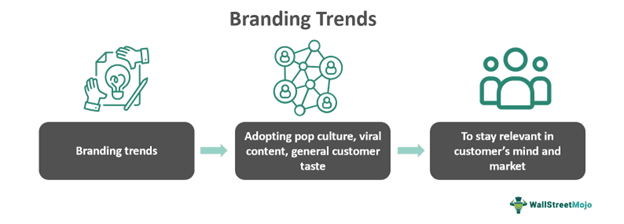
A branding trend may last for a few weeks or have long-term usability in the market. It depends on how deeply and well people are connected and influenced by the branding trend. A branding trend has no official owner, and hence, everyone in the market can adopt it in their business, eventually making it last longer. Branding trends always replace one another.
Key Takeaways
- Branding trends are activities and operations followed by companies to stay relevant, dynamic and in the eyes of their potential customers in the market.
- It can evoke anything viral or simple across industries and sectors such as fashion, food, clothing, design, and pop culture and brings a shift in the general consumer taste.
- Some of the top branding trends are humor, minimalism, personalization, artificial intelligence and focusing more on eco-friendliness and environmental safety.
- Businesses are expected to evolve with time and adapt their branding trends to remain relevant and survive in the market as it is highly competitive.
Branding Trends Explained
Branding trends are strategies and marketing techniques that follow what is currently prevailing and adored by the market formed by a primary appreciation of a large portion of the population. A company is just a business until it creates a special identity for itself and becomes a brand. But the journey of becoming a brand and staying a brand requires a lot of effort, analysis and constant change with the marketing campaign, advertising and recognition.
It is not necessary for a company to only follow the current market trend; they can choose to adopt an old trend or create a new trend or strategy for themselves, but it will always be at the risk of failure. A brand, when using the right trend, enables people to connect with it on a more personal level, and it allows them to improve their market visibility, recognition, sales and customer satisfaction.
Today, with modern marketing tools, every single detail is checked by marketers to incorporate the right trends for the underlying products or services. To remain relevant and survive in the market, companies trying to become brands and brands looking to remain competitive must adopt these branding trends with time. In modern marketing, nontraditional ways of drawing attention and making sales are not useful and only happen to a few businesses.
Top 10 Branding Trends
The top 10 branding trends in the world are –
- Artificial intelligence – AI will remain a dominating force in branding trends not only in the present but for a reasonable future period. AI has a wide scope of applications not only assisting in designing, marketing and branding strategies, but companies will use it to cover their day-to-day operations.
- Ethical and sustainability – With certain climate change issues, big organizations and brands are trying to genuinely work towards an eco-friendly environment, collaborating with other platforms, and bringing change in product design, packaging and manufacturing. At the same time, it becomes a selling point, people tend to associate with such eco friendly brands.
- Humor and satire – With the rise of social media, memes and reels have become more relatable and leave a strong impression on people’s minds. At the same time, a brand with a good humor strategy is more likely to draw attention than others. A friendly fight among competitors and brands making jokes about themselves or stating a social or satirical commentary lasts.
- Minimalism – It definitely stands among the top branding trends that have created its place. It definitely is not suitable for all brands but is more focused on clear messaging and quality of product and service deliverance.
- Personalization – Consumers have always appreciated custom-made and personalized products across industries. It gives a feeling of ownership and control. With changing times, brands are trying to penetrate different layers of customization and personal touch for their customers.
- Valuable content – People spend so much time on the internet that, in a wide sense, everyone is a potential customer. Every day, tons and tons of content is being viewed, shared and created, but good content with effective messaging always stands out, and brands are focusing on it more.
- Nostalgia – It is one of the most underrated emotions. People do like to revisit memories that remind them of a particular time, place or memory. Brands like to focus on a particular decade, like the 80s or the 90s, and bring those ad campaigns to life.
- Automation – This branding trend, again, is not for all brands but is effective as people in general like to have swift processes with much hassle and levels while making a purchase or taking a service. Automation saves time and effort, and hence, it is a major branding trend.
- Design and aesthetics – It’s been ages, but still, design, aesthetics, cool packaging and product logos, font colors, physical attributes, and the feel of the product itself play an important role and have remained an important branding trend in the global market.
- Social media – This may seem like an overutilized branding trend with Instagram posting, influencer marketing, video marketing, and user-generated data. There is a long way to go with it; many untapped markets can be explored.
Examples
Here are two examples of branding trends –
Example #1
Suppose a cosmetic company follows an ethical and sustainable branding trend. When the government banned the use of plastic, the company started manufacturing paper bags, paper tubes and paper-based disposable boxes to carry items. This way, the company is following a branding trend of eco friendly and environmentally sound strategy. Cosmetic brands run ads that every time a customer buys their product, it will only come in paper-based boxes coupled with bags and tubes.
Such branding trends help companies make a strong statement about how much they genuinely care about the environment and reducing their carbon footprint. People like to associate with such brands to support a cause. It is a simple branding trend example. Every person has their agenda; it is highly possible that cosmetic company paper bags look beautiful and aesthetically sophisticated, and people like to carry them in public places.
Example #2
World-renowned companies like FILA, Hello Kitty and Toy Story have seen an early jump to the hotel branding trend. Due to the pandemic, many people lost their loyal customers, but they are making a comeback; brands are experimenting with hotels and the hospitality industry. With an increased number of consumer brands leveraging on the lack of physical business, and are now investing in their hotels.
The hospitality industry witnessed a surge of consumer brands entering the hotel sector in 2020, but in 2022, there will be more innovation in it. For instance, Hyatt has planned to partner with the ANTA Group to open the world’s first FILA-branded and Hello Kitty-branded hotel, and the Tokyo Disney resort has opened the gates for a Toy Story-based hotel.
Importance of Trends for Brands
The importance of branding trends are –
- Trends bring novelty and relevance to the brand’s products and services
- Following trends grabs the attention of the market and gives a first-mover advantage
- When a company with a brand reputation follows a trend, it reflects its dynamicity of letting go of traditional branding techniques
- Adopting a current trend immediately connects people with the brand or its ad campaign and its marketing material
- There lies an audience that only buys or follows a brand because it is flowing with the trend, hence increasing sales and profitability
- With branding trends, brand awareness, trust and sustainability in the market are also uplifted
Frequently Asked Questions (FAQ)
Frequently Asked Questions
Can humor be considered one of the branding trends?
Yes, humor is inevitably one of the most important branding trends. With social media and pop culture influence coupled with memes and reels, humor is one of the crucial purchase drivers for brands. According to TikTok shared tips, Funny is a top video category, and humor is considered a top motivation for purchase intent by 30% of the users.
Is minimalism justified as a branding trend?
Yes, minimalism is a justified branding trend; it is not a new concept that has been present in the rich marketing history. Consumerism has changed; people are more interested in what the business essentially delivers. The key benefits of minimalism are clear messaging, standing out, brand recognition, and focusing on user experience.
What role do AI tools play in branding trends?
The integral role of artificial intelligence tools in branding trends is – – Optimizing branding techniques and driving business performance – Collect branding data and perform an in-depth analysis to understand consumer preferences – Spotting branding trends and incorporating them into the business’s current campaigns – Focus on creating new strategies to stay relevant in the customers’ minds