


What Is Sales Comparison Approach (SCA)?
The sales comparison approach (SCA) is an appraisal method in the real estate industry. It helps appraisers and real estate agents evaluate a property’s value by comparing it with recently sold ones with similar configurations or characteristics. This helps these professionals gauge the value of different property features.
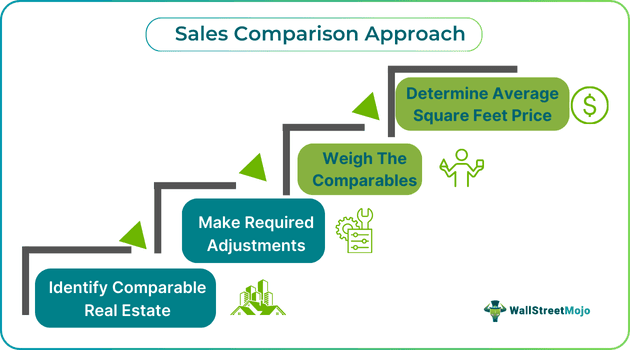
While applying the sales comparison approach formula, real estate brokers consider multiple factors. The age of the building, the location of the property, recently sold listings, and the condition of the property are a few such factors. Therefore, SCA is considered one of the most reliable forms of comparative market analysis.
Key Takeaways
- The sales comparison approach (SCA) is a property valuation methodology in the real estate sector. It compares the value of similar properties sold in the market with similar features and geographies.
- SCA is often considered the foundation of comparative market analysis. It can also be customized to add or subtract value based on the amenities or facilities available with the purchase of the property.
- Location, features, recently sold properties, and condition are some of the factors that can affect the valuation under SCA.
- Since it is not an official form of appraisal of a property, agents or sellers might have to hire a professional appraiser.
Sales Comparison Approach In Real Estate Explained
The sales comparison approach (SCA) or the market data approach is a real estate appraisal methodology. It assumes that a property’s value is arrived at after considering a multitude of factors that combine to make the final value.
SCA is often considered the foundation of comparative market analysis (CMA). Real estate agents use CMA to gauge a property’s value before commencing their appraisal process. While real estate agents might not be able to give their clients an official appraisal of a home, they can use a CMA to give the seller a fair idea of the value of their home.
Real Estate agents apply a direct sales comparison approach. They compare the property with recently sold properties with similar features and geographical locations. These properties are comparable or often referred to as “comps.”
When determining the SCA, a wide array of factors come into play, such as the property’s location, current market state, features, area, condition, and age. SCA is considered the opposite approach to some equally popular methods, like the cost approach or the income approach.
According to SCA calculations, each property has a unique value based on its amenities and features. Hence, it might be close to impossible to find matching comparables. This is especially true for special-purpose properties like hospitals, museums, amusement parks, cemeteries, and hotels.
Therefore, using this approach gives agents and sellers a ballpark figure of what the property might be worth in the current market scenario and its list of amenities.
Steps
The steps in the SCA process cover a wide range of factors. They are:
- Comparables Identification: The foremost step in the SCA process is to identify the homes that are the closest match to the home the seller or agent is looking to sell. Choosing a common type of home, like a cottage or an apartment, is a good idea to start with, as comparable properties can be found easily.
- Determining Common Attributes: Once a comparable property or properties are determined, agents generally find standard features between properties. Factors that are taken into consideration at this point in the process include square feet pricing, geographical location, age, market price, and property condition. As a result, agents and sellers can find typical and different factors between the properties being compared.
- Comparable Value Adjustments: Sales comparison approach adjustments allow agents to make changes to different variables based on market trends and other factors that can affect the final price of the property. Downward trends in the housing market, inflated processes, income levels, and mortgage terms and conditions are common adjustment-inducing factors.
- Final Price Estimate: Based on all the data available to the seller or agent of the comparable properties, adjustments, and other market factors, they can calculate the final price estimate of the property.
Appraisal Adjustment Factors
Different factors that can have an adverse effect on the sales comparison approach formula are:
- Location: The location of the property can play an integral role in determining its price. For instance, properties around airports, public transport, and other ways that increase connectivity are often priced higher than properties without these attributes. Social amenities, traffic patterns, and shopping facilities are other factors that contribute to better pricing.
- Recent Listings Sales: Properties sold recently within the same vicinity or with similar attributes can be reliable sources of information for determining not just the square feet price but also the overall market mood. This also gives sellers and agents a fair understanding of the area’s movement patterns.
- Neighborhood: The value of real estate, especially residential ones, relies significantly on the features of the neighborhood. These include the presence of amenities like schools, parks, recreational facilities, and entertainment centers. Other factors like the crime rate, natural factors, and pollution levels can also play a considerable role.
- Age: The age of the property can significantly affect the price it fetches, either positively or negatively. It majorly depends on the style of the home and the amount of rework it might need after buying. The other factor that has a considerable effect is the style of the house. For instance, a vintage home might fetch a more significant sum than a modern apartment due to its aesthetically pleasing features.
Condition: In most cases, the condition of the house plays the most critical role in the SCA process. It includes factors such as interior and exterior paint, interior floors, roof condition, electrical panel condition, heating systems, and more.
Example
Now that the theoretical concepts of the sales comparison approach formula are established, it is time to address its practical applicability through the examples below.
Example #1
Laura is a real estate agent who is helping a young couple, Justin and Selena, close a deal. The couple wants to sell a 1,200-square-foot apartment located in a gated community with a school, shopping mall, and recreational center. Laura compares this apartment with two similar properties that were sold in a neighborhood close to the property.
Those properties were sold between $150,000 and $175,000. However, Laura noted that both of those properties did not have the amenities of a gated community that Justin and Selena had. Moreover, their properties did not need any repairs either. Therefore, the final estimate for the property was projected at $200,000.
Example #2
An ideal property is always a headache as it tends to develop issues and attract renovation and repair expenses. A Michigan Tax Panel assessed an idle commercial property and decided to cut its price by $500,00 every year due to the costs it attracted.
Moreover, it was also ruled that the best and most logical use of the property would be to demolish the suggested improvements and hold it for future development projects.
Advantages and Disadvantages
The direct sales comparison approach has two ends of the spectrum, similar to most concepts. Its advantages and disadvantages include:
Advantages
- The whole identification and assessment process is based on actual transactions, so the relevance factor is relatively high.
- Since it is a straightforward concept, it is simple for real estate agents and sellers to follow. Moreover, it simplifies the documentation process.
- Despite being a general rule, it still allows for customization in calculating costs related to a property’s unique features.
- The range of the concept’s applicability is broad.
- The SCA can also be used in the future as a reference point. It will help sellers or agents monitor changes over time.
Disadvantages
- Since SCA is not an official form of appraisal, sellers might need to onboard an appraiser for special-purpose properties and properties with complicated valuations.
- The lack of data due to the market conditions or the asset type might hinder the analysis.
- A significant setback of the SCA is that short-term market fluctuations are often not reflected in the calculations.
- It is often criticized for depending on subjective interpretation of available data.
- Some properties might be challenging to adjust based on the data available.
Sales Comparison Approach Vs Cost Approach Vs Income Approach
The distinctions between the most common approaches in real estate valuation – the direct sales comparison approach, the cost approach, and the income approach are:
| Basis | Sales Comparison Approach | Cost Approach | Income Approach |
|---|---|---|---|
| Definition | SCA conducts the valuation of a property based on the value of similar properties sold recently. | The cost approach values a property based on the cost it incurred to build it. It is akin to asset minus depreciation calculation. | The income approach calculated the value of the property based on its ability to generate passive income. It is most compatible with commercial or rental properties. |
| Applicability | It is used for residential properties where comparative data of similar houses is available. | It is used for new or unique properties where comparison options are either limited or challenging. | The income approach is the most conducive for commercial or rental properties. |
| Methodology | Comparing the sale prices of similar properties and adjusting the differences between them gives the assessor a fair idea of the property’s value. | It calculates the cost of replacing the property with a similar structure after subtracting depreciation. | The estimation of the property is based on the net operating income. |
| Pros | SCA shows the latest market scenarios based on sales of similar properties and their comparison. | It is conducive to unique properties or properties with little or no comparables. | The income approach’s accuracy and practicality for income-generating properties make it most reliable for these types of properties. |
| Limitations | It might be challenging to accurately calculate a property’s value, as each property has unique features. | The subjective nature of depreciation for such properties can be complicated and unreliable at times. | Accurate market trends and projections are challenging to calculate. Hence, agents have to work with calculated assumptions instead of concrete numbers. |
Frequently Asked Questions (FAQ)
Frequently Asked Questions
What is the basic principle of the sales comparison approach?
The fundamental principle that helps with the sales comparison approach is the principle of substitution. According to this principle, the buyer shall not pay above or below the value of a property with similar features or amenities. It also allows for customization to add or subtract values.
Can all properties be valued using the sales comparison approach?
The SCA is best for properties with comparable data. Therefore, it might not be the best approach to value unique properties such as amusement parks, schools, or hospitals. It might also not be helpful for relatively new properties that have little to no comparable data.
Who uses sales comparison approach?
The sales comparison approach is commonly relied upon in real estate. Real estate appraisers and agents use the SCA to gauge a property’s value. Sellers and buyers rely on these numbers to finalize the amount they are ready to pay or receive for the property.