


What Are Brand Metrics?
Brand metrics refer to the various measurable tools used for tracking and optimizing a brand’s health and performance. Constantly monitoring brand insights can help businesses evaluate the efficiency of their advertising campaigns and marketing strategies to have a competitive edge and keep up with market trends.
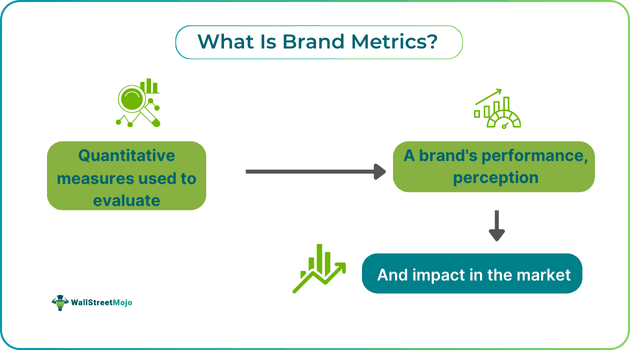
Companies that establish a brand have to maintain and grow their reputation in the market. Therefore, gauging brand measures from time to time can help these businesses establish brand key performance indicators (KPIs) and achieve a leadership position. Moreover, brands need to balance perceptional, performance, and behavioral metrics.
Key Takeaways
- Brand metrics are the quantitative parameters that facilitate the monitoring and evaluation of the success of a brand’s marketing campaign and initiatives to determine the overall health and performance of the brand.
- Every brand measure is tested under the SMART model for being strategic, market-driven, actionable, repeatable, and touchpoints.
- The top 10 brand metrics include brand awareness, brand loyalty, brand perception, brand sentiment, brand loyalty, brand equity, brand preference, brand association, brand engagement, purchase intent, and net promoter score.
- It is essential for achieving brand success, growth, positive reputation, good health, superior performance, and leadership.
Brand Metrics Explained
Brand metrics are the parameters that allow companies to track and monitor the performance of their advertisements and marketing strategies to analyze the overall performance and health of the brand. Every brand measure must have the following SMART features:
- Strategic: These measures should match the company’s strategic goals and objectives.
- Market-driven: To get an accurate picture, the brand metrics should consistently be implemented from the market’s perspective.
- Actionable: Also, these parameters should be practical and must initiate some action.
- Repeatable: These metrics should establish standards so that the marketers can repetitively use these metrics.
- Touchpoints: The brand measures should comprise all the market aspects ans customer experience to serve as a holistic approach.
In the realm of hardcore competition in the business sector, every company thrives to become a leading brand in the market. Businesses usually adopt creative and different marketing campaigns to attract the attention of their target customers. However, brand measures bridge the gap between the success of these campaigns on paper and reality. However, these metrics may need more accuracy if the data acquired is of poor quality, inadequate or incorrect. Moreover, rapidly changing trends require constant monitoring of such metrics to keep up with the pace of market dynamics. Also, quantifying certain qualitative aspects like customer satisfaction, loyalty, and value is a tricky task.
Top 10 Brand Metrics To Track
Brands often experiment and implement various marketing strategies to attract potential customers and retain the prevailing ones. Also, to measure the success of such brand campaigns, they use the following measures:
- Brand awareness: It identifies the percentage of people in the target market who are aware or familiar with the brand. It can be measured through aided brand recognition and unaided brand recall measures.
- Brand loyalty: It gauges the customer base that has been constantly buying the products and services of a particular brand irrespective of the price and ease of shopping.
- Brand engagement: It determines whether the audience revisits or engages with the brand campaigns.
- Brand association: It analyzes the experiences and thought processes behind consumers’ decisions to buy products from a particular brand, including their association with the brand’s quality, durability, price, or other aspects.
- Brand perception: Such metrics provide an overview of what the customers think about a particular brand. The most accessible tool for brand perception is the customer satisfaction survey.
- Brand sentiment: Brands can use such measures to determine what the audience thinks of a marketing campaign and how they connect with a brand through such initiatives.
- Brand equity: It determines the goodwill or superior value that a brand is recognized for when it is compared with its competitors. It can be a tangible or intangible brand value.
- Brand preference: This measure identifies the potential customer base who prefers a specific brand more than its competitors.
- Purchase intent: It gauges the degree to which the customers are showing interest in a brand’s product or service and are willing to make a purchase.
- Net promoter core (NPS): Another way to gauge customer satisfaction is through NPS, I.e., letting them score their experience with the brand on a scale of 1-10 to know whether they will act as brand promoters, passives, or detractors.
Examples
Brand metrics enlighten companies as to whether their marketing campaigns and advertisements are headed in the right direction. Let us now understand the use of these measures in practical scenarios through the following examples:
Example #1
Suppose an insurance company runs a brand advertising campaign to spread awareness of life insurance among the age group of 25-40 years. The brand claimed to provide the cheapest covers to the target group and promoted itself as a brand that has the highest claim settlement ratio in the industry. The brand hired XYZ Advertisers to start a six-month marketing campaign. In this strategy, the advertisers aired online advertisements featured on social media and websites with a click-to-action button. At the same time, the advertising company ran multiple brand ads on television and put up hoardings around the nation to spread awareness.
Moreover, as the visitors who click on the CTA button are redirected to the brand’s website, they need to fill in their basic details first to view the life insurance plans. This is how the advertising company collected data to gauge the brand’s reach. After six months, the advertising company made the visitors fill out a survey form to identify the level of aided brand recognition and determine the number of people who are able to recognize the brand among other brands. Thus, it helped the advertiser to figure out the efficiency of its marketing campaign for this insurance brand.
Example #2
Alphabet (Google) ranks first in customer loyalty, boasting a 73% popularity rating and an average customer review score of 3.1 stars. Lowe’s follows closely with a 75% popularity score, leading in YouGov ratings. Intel secures the third position, which is notable for its low volume of customer service-related searches. Apple claims fourth place despite a notable increase in online support queries. Additionally, four major tech giants—Alphabet, Apple, Amazon, and Microsoft—are represented in the top 10. Coca-Cola and PepsiCo occupy the fifth and sixth positions, respectively, with PepsiCo excelling in net promoter score (NPS) and social media engagement.
Importance
Building a brand out of a small firm takes a lot of effort, money, and time for the businesses. Brand metrics help companies set milestones for their marketing strategies in this race. Hence, it holds significance in brand development for the following reasons:
- Insights to campaign ROI and performance: These measures help the brand assess the success of its marketing campaigns by determining the return on investment of such initiatives.
- Establishes a healthy brand: With widespread brand awareness, recall, and recognition, the company can form a strong brand image among its stakeholders.
- Brand growth and success: These parameters monitor the performance of brand campaigns at regular intervals, so companies can fix issues and improve their marketing to ensure the brand’s success and growth in the long run.
- Competitive advantage: Since these metrics are quantifiable, brands can compare their marketing strategies with their competitors’ to constantly improve and achieve perfection, gaining a competitive advantage and market leadership.
- Gauges the impact of key initiatives: When businesses adopt new ways of attaining customer engagement, such as by launching a social cause campaign, they can measure the effect of such efforts on their sales and customer acquisition through brand metrics.
- Measures the success of a new product launch: Such parameters become crucial to understanding the market response to a new product’s launch and promotion.
- Discover performance loopholes and take corrective actions: On the journey to becoming an industry leader, brands can use these metrics to identify setbacks and adjust their marketing strategies to cope with underperformance.
Frequently Asked Questions (FAQ)
Frequently Asked Questions
How to track brand metrics?
The success of a brand can be analyzed through the following steps: 1. Define the brand objectives and key performance indicators (KPIs) 2. Gather data from various sources such as sales, customer reviews, surveys, analytics, etc. 3. Apply the various brand metrics and tracking tools 4. Analyze and monitor the brand performance and health frequently.
What is the brand metrics pathway?
The brand metrics pathway applies brand equity parameters to identify the effect of a brand’s marketing campaigns and initiatives on existing and potential customers and analyze the brand’s financial position and health in the long run.
What are the benefits of brand metrics?
The foremost advantage of using brand metrics is analyzing the historical performance of brand campaigns to plan and decide on future marketing efforts and strategies accordingly.
What does the awareness index within brand metrics measure on Amazon?
One of the Amazon brand metrics is the awareness index, which assesses brand awareness among the overall Amazon audience by evaluating the actual signals of Amazon visitors on a daily basis. However, such data is aggregated every week.