


What Is Return Shipping?
Return shipping refers to returning an online purchased product to the company or seller due to damages, defects, below expectations, or the customer’s need to return it. It serves to give the customer correct quality without defects products while increasing their loyalty and satisfaction.
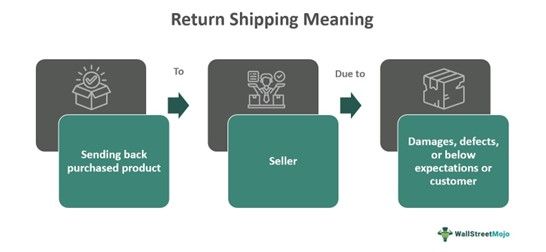
It became simple and useful to customers if companies provided tools to a prepaid shipping label for the returns process to guarantee the return of the package to the designated address of the retailer or the company. It is important in global e-commerce as 30% of products ordered online are returned.
Key Takeaways
- Return shipping is the method of returning an item post-purchase due to expectations, defects, or damages to provide high-quality products and increase customer loyalty and satisfaction.
- Customers return products due to unwanted gifts, better prices, delayed delivery, duplicate orders, mismatches, damages, product failure, change of mind, and unmet quality expectations.
- To avoid it, use – conduct professional quality checks, accurate product descriptions, high-definition photos, augmented reality, and clear return policies, & detailed product sizes.
- Its consequences are- environmental pollution, customer trust loss, increased operational costs, revenue loss, labor costs, packaging waste, and shipping costs.
Return Shipping Explained
Return shipping can be stated as the procedure of sending a damaged de, defective, or low-quality product back to the seller after purchasing it. It works after the customer has received the purchased item and finds any defect, damage, bad quality, or not as wanted. After that, the customer begins the process of return by getting a return shipping label from the seller or retailer or the company pertaining UPS return shipping label, eBay return shipping label, and PayPal return shipping. After that, the customer has to pack and attach a returning label to the damaged product to ship it back to the seller using the designated courier.
It has multiple negative implications, including loss of trust, increased handling and return process costs, inventory management, and eroded customer loyalty. On the other hand, easy returns management and policy show the company cares for its customers and is ready to resolve all issues of damaged or faulty products. It also increases the company’s efficiency and reduces various costs. Thus, it increases customers’ trust, adding to word-of-mouth publicity and revenue generation.
Financially, it may be taxing if the return policy is messed up. Still, it leads to cutting costs, enhanced brand reputations and customer loyalty, adding to the profits of the seller.
Reasons
Given retailers’ worries, presented here is the list of reasons made by customers to return the shipped products:
- Customers found that the description and the delivered product had mismatches.
- The product delivered to the customer was damaged.
- The product failed to fit or was of the wrong size for the customer.
- The customer had a change of mind after the product purchase.
- The customer received the wrong product.
- The product did not meet the quality expectations of the customer.
- The recipient of the product had received it as an unwanted gift.
- The customer was offered a better price for the product after purchasing the product.
- The delivery of the item took too long to remain useful.
- The customer used cleverness to order multiple products of the same type to choose the best fit and return the other ones.
- The customer’s order became duplicated many times leading to unwanted products.
- The retailer’s website had wrongly listed or misrepresented the product delivered to the customer.
Consequences
For retailers and manufacturers, there happen to be many negatives of shipping returns, as shown below:
- The processing and managing of shipping returns leads to increased operational costs.
- The returned and unsellable items result in revenue loss.
- The receiving and sending of items to and from customers increases the shipping costs.
- The returned items need extra labor to inspect and restock adding to enhanced labor costs.
- Packaging waste and increased transportation supplement the effect of ever-increasing pollution, negatively impacting the environment.
- After suffering from poor returns of damaged or wrong items, customers lose trust and loyalty towards the seller.
Examples
Let us use a few examples to understand the topic.
Example #1
An online article published on 7 March 2024 discusses Loop’s collaboration with Easyhip as a partner. The post-purchase platform of e-commerce by Loop started working together with Easyhip, which is the leasing logistics and global shipping provider. Their partnership has allowed clients of the Loop to gain competitive pricing along with a wider courier network, increasing the process of return through user-friendly platforms, Shopify integration and customizable policies of the Loop.
Further, Easyhip has been offering the widest mesh of more than 550 couriers, including FedEx, USPS, and DHL. As a result, clients get a maximum of 91% savings on their shipping costs. Consequently, the collaboration has empowered e-commerce businesses with effective, affordable shipping solutions and multi-carrier tactics, leading to optimized logistics and facilitating global returns.
Example #2
Let us assume that a shaving kit made by the company Shavy was bought by Ronnie for Dalmart online retail store. After purchasing and opening it at home, Ronnie realizes that he purchased the wrong item and initiates a return through the website of Walmart. After using the facility of generating return labels, Ronnie prints the return label for the union courier branch. Such unique, innovative technology tracks the status of the returned items in real-time by providing timely updates to Dalmart and Ronnei.
As a result, the returned Shavy kit reaches Dalmart’s warehouse quickly and safely due to the optimized strategy of multi-carrier shipping. Therefore, Dalmart efficiently processes the return and credits the return amount to Ronnie immediately. Thus, it leads to a satisfied customer and manages to sustain Ronnie’s customer loyalty towards Dalmart.
How To Avoid It?
Let us learn the ways in which retailers can reduce or avoid the return of the shipment:
- Use highly accurate product descriptions to match the product to let them know that they will get the product as per the description.
- Multiple-angle photos in high definition of the product must be used to give a full idea of the product.
- Provide detailed guidelines and charts for product size to give customers the option to choose the right size for their needs.
- Add social proof, customer reviews, ratings and testimonials from users of the product to give customers a real insight into the product’s user experience.
- Augment the customers buying with pre-purchase customer assistance.
- Embed tools like augmented reality or virtual try-ons help customers visualize the products when used by customers.
- Customer expectations must be managed through vivid and easily understandable return policies.
- Analyze and address all reasons for products to ascertain the exact issue and problem with the product, leading to return proactively.
- Tighten and put in place highly professional and accurate quality checking of the products to eliminate any defect and damage in products before shipping.
- Encourage customers to keep the products after buying them using coupons or discounts on any future purchases.
- Implement the policy to swap or exchange products to give customers an easy option to exchange the damaged product with another quality product.
Frequently Asked Questions (FAQs)
Frequently Asked Questions
How much is Wayfair return shipping?
The Wayfair return shipping prices vary as per the size or volume and weight and place of return of the item. Moreover, one can easily contrast the costs of shipping their items using the shipping calculator of Parcel Monkey to find the most affordable and competitive rates.
Who pays for return shipping on eBay?
The return shipping on eBay has to be borne by the buyer in most cases, but in some cases, if the seller agrees to cover them, then the seller pays it. Further, the payment terms generally are specified in the return policy of the seller or the item’s description.
Does Amazon return shipping cost?
Generally speaking, amazon does not charge any money for return shipping costs; however, it does depend on the return policy of the seller. If the seller has specified to charge return shipping cost, then one has to pay; otherwise, some do not ask customers to pay.
How to get a return shipping label?
To get a return shipping label, one has to do the following: – Wayfair account must be logged in. – My orders section must be visited. – A refund method must be chosen to begin the process of return. – Finally, get the print of the return shipping label obtained by Wayfair.