


What Is Space Economy?
Space economy refers to the range of economic activities and resources connected to space exploration, research, and development. This sector’s sole purpose is to provide a base for other industries to make technical advances using satellites and other space-related technologies.
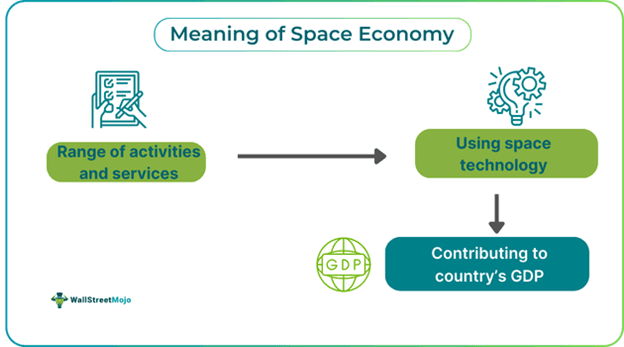
This new space economy provides a cornerstone for various sectors to access facilities such as telecommunications, navigation, remote sensing, and others. It also assists governments and private firms in space exploration projects. Additionally, it helps forecast weather conditions in different regions.
Key Takeaways
- The space economy refers to the series of activities and services related to space exploration, research, and development.
- It develops technology that is essential for the growth of other industries and businesses.
- Government-based organizations and large corporations dominate this economy.
- They have enough resources to absorb the costs and risks emerging in this industry.
- Some of the major components of this economy include manufacturing, services from satellite operators, and other consumer services.
- Critical factors in this segment include satellite technology, space tourism, space infrastructure, and space exploration.
Space Economy Explained
Space economy is a segment of the space industry that includes activities such as exploration, research, utilization, manufacturing, operations, and development of space applications. In other words, other industries rely on this economy to further advance their business. Also, it provides technologies for project development purposes and accelerates returns on investment. However, there is a huge cost involved in the research and exploration. As a result, this new space economy is mainly dominated by government sector firms.
This economy has some key industries within it. It includes satellite technology, space tourism, space infrastructure, space exploration, and related resources. Since the Cold War, the significance and chances of space economy growth are visible in the defense sector as well. It has provided a range of space technologies to improve navigation and precise target systems. However, it also involves technical risks and the availability of space.
As per the OECD space economy guide, the main components of this industry include manufacturing, services from satellite operators, and other consumer services. Under this, there are other actors like primes, Tier 1, 2, 3, and Tier 4 actors. While the primes are responsible for the development of space control systems, they also deliver these services to government and commercial users. Likewise, the Tier system plays a hierarchical role in the growth of the entire space economy.
Tier 1 is responsible for the design, assembly, and manufacturing of subsystems. Above that, Tier 2 comprises manufacturers of major subsystems and has the upper hand over Tier 1. In the same lane, Tier 3 and 4 are the producers of the components and assemblies. Furthermore, they also deal with electronic, electrical, and electromechanical parts and materials.
Examples
Let us look at some examples of how the space economy operates and the application of the same globally.
Example #1
Suppose John, a businessman in the steel industry, envisions expanding his operations by exploring new mineral resources. He soon realizes that relying solely on human labor for this process is costly, risky, and inefficient. To overcome these challenges, he partnered with a renowned space services provider that specializes in remote sensing technology. Using advanced sensors, the provider helps John gather detailed data on potential mining sites by detecting mineral deposits from space.
As his business grew, John also planned to integrate satellite technology to enhance the precision of his exploration efforts further. He hired a team of data scientists to analyze satellite data and identify regions with high concentrations of valuable materials. If successful, John aimed to expand his mining operations into these promising locations, increasing his overall production capacity.
Example #2
According to a news article published in July 2024, the global space economy grew by 7.4% in 2023, reaching a total of $570 billion. The report included data from 54 nations and international organizations, highlighting the significant role of both the public and private sectors in the space industry. Commercial revenues made up 78% of the total economy, amounting to $445 billion, with key subsectors like Positioning, Navigation, and Timing (PNT) leading the growth.
Benefits
The space industry has multiple benefits for various industries and businesses. They provide a benchmark for other companies to expand and grow in their respective fields:
- Scope for advancement and innovation: One of the prime benefits of this economy is visible in the development arena. Many industries take advantage of satellite technology and space services to accelerate their ongoing business models and leverage them for their benefit. This economy drives technological innovation in the fields of material science, robotics, electronics, communication, and other systems.
- Assists in defense: To a greater extent, governments of various nations use space systems to strategize their defense mechanism. With the space services, it is possible to understand the weather conditions of the border regions and early warning signs in a war emerging crisis.
- Emerging job and revenue opportunities: As space technology agencies invest in development and exploration projects, human personnel are hired to perform them. As a result, there are many job opportunities and revenue streams.
- Fosters international cooperation: In some instances, nations collaborate on various space development projects to foster growth in both countries. This develops a certain level of bonding, trust, and cooperation between them, further enhancing their international relations.
Frequently Asked Questions (FAQs)
How did the space race impact the space economy?
Space race has a greater impact on the entire economy as it has provided a competitive edge for rivals to develop. The space sector has witnessed a consistent increase in private investment in the past years. Also, the development of space micro-launchers and other commercial activities has enabled other players to benefit from it. A similar and equivalent effect is visible in the orbit through operational satellites.
How much is the space economy worth?
The space economy is currently worth $630 billion and has an average growth rate of 9 percent. It is also expected to surpass the global growth rate of the GDP (Gross domestic product).
Why is space exploration good for the space economy?
There are multiple advantages of space exploration for this economy. In fact, it forms the crust of the entire industry. Let us look at how:
- It provides a boost to businesses in their research and development
- It supports and assists in disaster response
- There is diffusion of innovation among individuals to explore segments of space.