


When you start a new business, forecasting revenue and expenses can feel like making up numbers. You have no past sales to look at, so it is hard to know how many customers will buy, how quickly sales will grow, or what some costs will actually be.
However, a forecast does not need to be perfect. It just needs to show how the business could perform based on reasonable assumptions about customers, pricing, sales activity, and operating costs.
In this guide, I’ll walk you through exactly how to build that revenue and expense forecast step by step using simple, practical assumptions.
5 steps to build a realistic revenue and expense forecast
The numbers in your forecast should not come from what you hope the business will earn. They should come from how you expect to make sales and what it will cost to run the business.
The following steps will help you turn those assumptions into a practical first-year forecast:
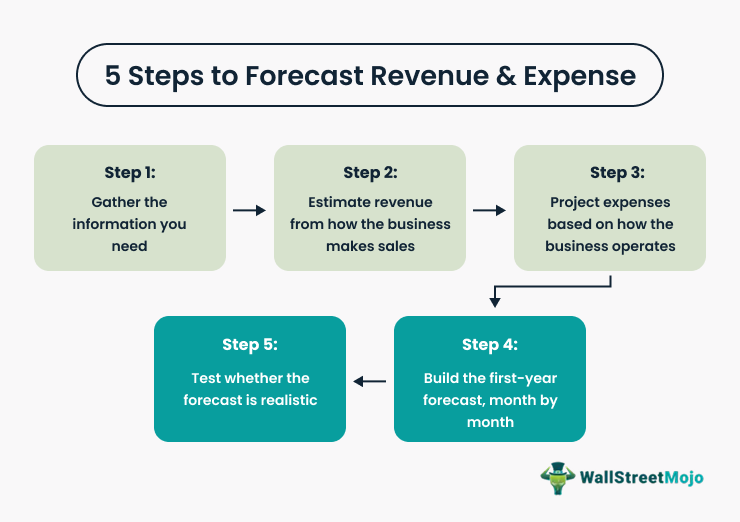
Step 1: Gather the information you need
Before you start calculating, gather inputs that can help you make more realistic estimates.
Start with the figures you can confirm. These may come from:
- Your planned price list
- Quotes from suppliers or contractors
- Rent and utility estimates
- Software and equipment prices
- Competitor pricing
- Customer interviews, early enquiries, or pre-orders
- Amount of work you can manage monthly
Do not try to calculate the full forecast yet. Simply note what you already know and what still needs to be estimated.
For example:
| Information needed | What you have |
| Selling price | Planned price of $50 |
| Possible customer demand | Five early enquiries |
| Material cost | Supplier quote of $18 per unit |
| Monthly rent | Quoted at $1,200 |
| Sales growth | Still needs to be estimated |
This gives you a clear starting point. Use confirmed figures where possible. For anything uncertain, enter a reasonable estimate and note what it is based on so you can update it later.
Step 2: Estimate revenue from how the business makes sales
Identify what creates revenue in your business. This may be products sold, projects completed, customers served, subscriptions, appointments, or billable hours.
Then, estimate how many sales, customers, projects, or subscriptions you expect each month, how much each sale is worth, and how much work the business can realistically handle.
The basic formula is:
Sales volume × average price = revenue
For instance, a bookkeeping service charges $300 per client each month. The founder already has two interested contacts and expects two more clients through local networking.
The first-month revenue would be:
4 clients × $300 = $1,200
Next, estimate the sales volume for each following month. Increase it only when there is a clear reason, such as more leads, repeat customers, an additional sales channel, or extra staff.
| Month | Clients | Monthly price | Revenue | Reason for change |
| Month 1 | 4 | $300 | $1,200 | Existing contacts and early enquiries |
| Month 2 | 6 | $300 | $1,800 | New referrals |
| Month 3 | 7 | $300 | $2,100 | Continued lead generation |
Do not assume the business will grow by the same amount every month. Adjust the number of sales for seasonal demand, slower months, and limits on staff, equipment, opening hours, or production.
The goal is not to predict sales perfectly. It is to illustrate how the business would move from its first customers to a realistic monthly revenue level and what must happen for that growth to happen.
Step 3: Project expenses based on how the business operates
Once you have estimated your revenue, list the costs of delivering those sales and running the business.
Begin by separating your expenses into three groups.
- One-time startup costs: This covers equipment, licences, deposits, website setup, and initial inventory.
- Costs that rise with sales: It involves materials, packaging, shipping, commissions, and contractor time.
- Regular operating expenses: That’s rent, salaries, insurance, software, utilities, marketing.
Include the costs you expect to pay before or around launch. Record each one in the month it will actually be paid rather than spreading it across the year.
Next, calculate the expenses that increase as sales grow:
Sales volume × cost per sale = direct cost
For example, if serving each client costs $20 in software and processing fees, four clients would create a monthly cost of:
4 × $20 = $80
Then add the expenses the business will continue paying each month, even when sales are lower. Include your own pay if you expect the business to support it.
A simple first-month estimate may look like this:
| Expense | Amount |
| Laptop and website setup | $1,500 |
| Client-related costs for four clients | $80 |
| Insurance, marketing, and other monthly expenses | $650 |
| Total first-month expenses | $2,230 |
The startup cost appears only in the first month. The client-related cost changes with the number of clients, while the regular expenses continue each month unless something changes.
In addition, include any additional expenses that are needed for growth. This can involve recruitment, additional machinery, software, or expanding to a new facility. Set each cost in the month that the cost is expected to start. Wherever possible, use supplier quotations, bills, or current prices.
If an amount is uncertain, add the best estimate available and explain what it is based on.
You now have both sides of the forecast: the revenue the business could make and the expenses the business needs to support it.
Step 4: Build the first-year forecast, month by month
Instead of estimating the whole year at once, start with Month 1.
Enter revenue (calculated in Step 2), followed by the costs associated with those sales, regular operating costs, and any one-off costs you expect that month.
With the bookkeeping example, it might be like this for the first three months:
| Month | Revenue | Costs linked to sales | Regular expenses | One-time costs | Total expenses |
| Month 1 | $1,200 | $80 | $650 | $1,500 | $2,230 |
| Month 2 | $1,800 | $120 | $650 | $0 | $770 |
| Month 3 | $2,100 | $140 | $650 | $0 | $790 |
Build each month using the same approach. Carry forward any figures that stay the same and update only those affected by a change in your assumptions.
For example, regular expenses may remain unchanged for several months, while costs linked to sales increase as sales grow. One-time costs should appear only in the month they are expected.
Do not increase revenue automatically every month just to make the forecast look stronger. Any increase should be supported by an assumption you can explain.
Once all 12 months are complete, total the monthly figures to calculate the expected revenue and expenses for the full year.
You now have a first-year forecast showing how revenue and expenses are expected to change from month to month.
Step 5: Test whether the forecast is realistic
Once the forecast is complete, test what happens if one important assumption turns out worse than expected.
Create one more cautious version based on the assumption that has the most uncertainty. For example, reduce monthly sales by 20%, delay sales growth by two months, or increase a major cost by 10%.
Update the affected months and compare the new figures with your original forecast. Check:
- Which months now have expenses higher than revenue
- How large the shortfall is
- How many months the business will need extra cash
Then decide how you would manage that gap. You might need to delay a purchase, reduce early spending, adjust pricing, slow down hiring, or arrange more startup funding.
Don’t test every possible outcome. One cautious version is enough to show whether the business can handle a slower start without immediately running into financial trouble.
Conclusion
You now have a first-year forecast built from realistic assumptions about how the business will make sales and spend money.
You can use it to plan your early spending, identify months when expenses exceed revenue, and estimate how much funding you may need. Once the business starts operating, compare the forecast with your actual results and revise it as required.
Many first-time founders build their forecasts in spreadsheets. That can work, but setting up formulas, updating the numbers, and keeping everything consistent takes extra time and effort.
That’s why using Upmetrics’ financial forecasting software can make the process easier. It helps you build monthly projections, test different assumptions, and update the forecast without managing complex formulas manually.
So build your first forecast with the information you have. Use it to guide your decisions, and improve it as real numbers become available.
Frequently Asked Questions
How long should a revenue and expense forecast be?
Most new businesses should prepare a monthly forecast for the first 12 months. If you are creating a business plan for a lender or investor, you may also need annual projections for the following two or three years.
What if my actual sales are different from my forecast?
That is normal, especially in the first year of operation. Compare your actual results with the forecast each month, then update the remaining months based on what you’ve learned. A forecast should change as your business grows and you have better information.
How often should I update my revenue and expense forecast?
Review your revenue and expense forecast once a month. Update estimates if there are major changes in your pricing, costs, staffing, or expected sales. Then adjust the future months accordingly.