


Restrictions on the supply of American AI accelerators to China are beginning to reshape the balance of power in the local market. One of the main beneficiaries has been the Chinese manufacturer Biren Technology, whose revenue in the first half of 2026 grew by almost 2,000% to $183.9 million, compared with just $8.7 million a year earlier.
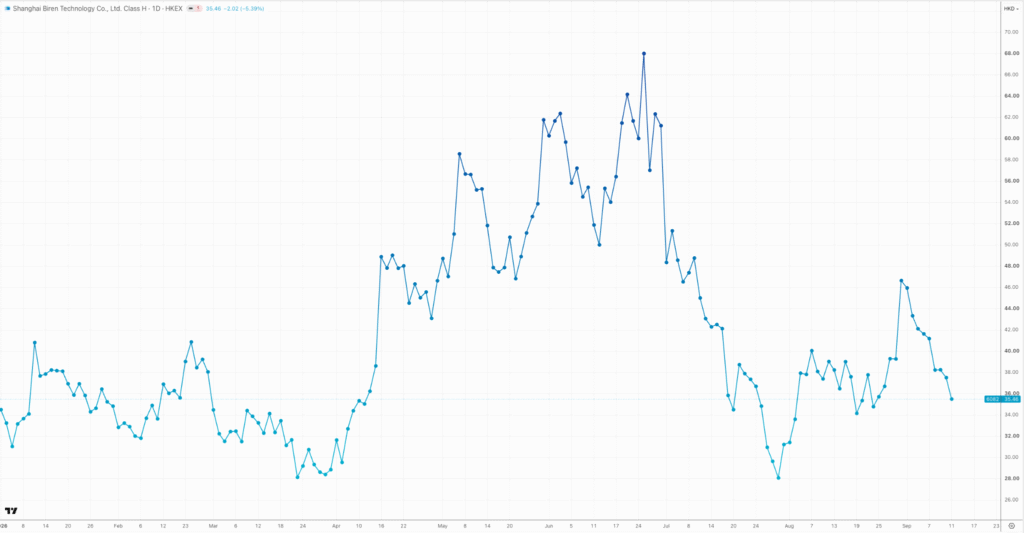
This surge is directly linked to the changing competitive environment. After Nvidia and other American suppliers were forced to reduce AI chip shipments to China due to U.S. export restrictions and China’s retaliatory measures, local companies were able to ramp up sales more quickly. Even before the restrictions were tightened, Nvidia managed to supply the country with about 2.2 million H20 accelerators, each costing $12,000-$15,000. Against this backdrop, Biren’s shipments remain small for now, but the direction of travel is clear.
The company’s financial results are already beginning to reflect this increase in demand. Biren’s gross profit reached $78.6 million, with a gross margin of 42.7%. At the same time, the company remains unprofitable. In the first half of the year, its net loss amounted to $56.2 million, driven mainly by active investment in new accelerators, rack solutions with optical connections, and the company’s own software stack, Birensupa, which is intended to become an alternative to Nvidia CUDA.
Thus, Biren is now entering its most challenging stage. Its nearly 2,000% growth comes off an extremely low base, while the company’s share of the Chinese AI accelerator market remains below 3%. To turn current demand into a sustainable business, it will have to simultaneously scale production, improve its software ecosystem, and compete with larger local players, including Huawei, Kunlunxin, and Cambricon.
One of the main constraints could be manufacturing capacity. Even if demand remains strong, Biren needs to secure sufficient capacity from SMIC or other manufacturers. Access to advanced manufacturing capacity is becoming increasingly important in the AI chip market, where demand is growing faster than supply.
Meanwhile, the global industry landscape is also changing. Nvidia, despite restrictions in China, continues to strengthen its position through technology and deals, while investors tracking the Nvidia stock chart have seen shares hold up well even as export curbs bite into its China revenue. The U.S. Department of Justice is reviewing its $17 billion licensing deal with AI chip startup Groq, under which Nvidia received non‑exclusive rights to the company’s technologies and hired part of its management. The very fact of such a deal demonstrates the high value placed on promising AI accelerator architectures and how aggressively the major players are willing to defend their technological advantage.
Competition is also expanding beyond computing chips to the broader infrastructure surrounding them. The Spanish startup iPronics raised $125 million to develop optical switching for AI data centers, with Nvidia among the investors. As data centers house hundreds of thousands of accelerators, the speed and reliability of the connections become no less important than the performance of the GPUs themselves.
This trend explains why Biren is also working on rack‑mounted solutions and optical interconnects. The market is gradually shifting from selling individual accelerators to offering comprehensive systems that include chips, networking, software, and workload management. It is this model that has made Nvidia the dominant player, and Chinese competitors will have to replicate at least part of this ecosystem.
For investors, Biren’s 2,000% growth looks impressive, but what’s far more important is what lies behind this figure. The company has gained a rare window of opportunity thanks to geopolitical restrictions, which have effectively opened up part of the Chinese market to domestic suppliers. Now it needs to prove that this growth can be turned into sustainable market share and eventually profitability.
If Biren can scale production and narrow the technological gap, China could gain another major supplier of its own AI infrastructure. If not, the momentum that has put Biren among top stock gainers could fade, while its explosive growth may prove largely attributable to a low base and a temporary shortage of alternatives. The next few years will show whether the company can turn the opportunity created by these market shifts into a competitive business.