


Digital signage for a small business usually means one to five screens: a menu above a café counter, a price list beside a bakery case, a promotion in a shop window. It pays off when content changes at least weekly, enough people see the screen, and someone owns the updates. Below: start-up costs, where one screen earns its keep, a six-step setup, and 2026 market data.
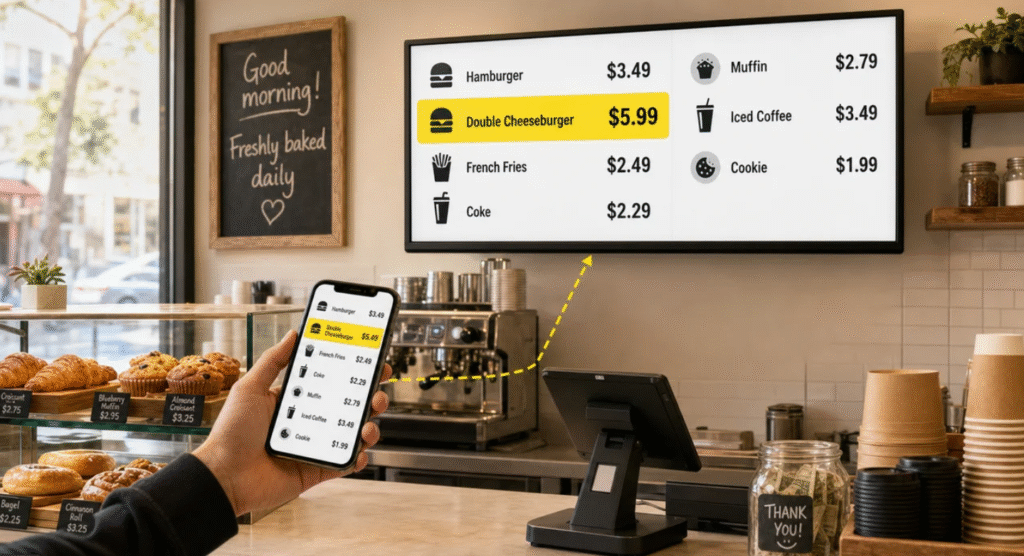
What Small Business Digital Signage Costs to Start
Small business digital signage can start at almost nothing. A TV already on the wall, a 30–100 streaming stick and a free single-screen plan cost little beyond electricity in the first year. Buying new, a 43-inch consumer TV runs 200–400 and a 55-inch model 400–700, while a commercial display of the same size costs 800–1,500. The screen is rarely the expensive part.
To see how those figures are built, Decker’s signage software team keeps a guide to digital signage cost for small business screens that separates per-screen pricing from the media player and commercial display costs, so a café owner can price one to five screens before calling an installer. Electricity, content and maintenance sit on their own lines in that breakdown. A 130-watt screen running 12 hours a day at the July 2026 US commercial rate of 14.53 cents per kWh costs about $6.80 a month to power.
Software adds 5–15 per screen per month on mass-market plans. For comparison, vendor estimates put a single shop’s printed materials at 1,200–2,400 a year, with each menu reprint costing around $40.
Where One Screen Pays Off and Where It Doesn’t
One screen pays off where the content changes every week and customers already stop to look. It fails on a wall nobody passes.
Signs matter more than most owners assume. In a 2012 FedEx Office survey of 1,000 American adults, 76% had walked into a store they had never visited because of its signs, 68% had bought something because a sign caught their attention, and nearly 60% said a missing sign kept them out.
Digital display boards for business work in a few familiar places:
- Coffee shop: the menu above the register and a seasonal drink by the pickup counter.
- Bakery: prices beside the case and a 4 p.m. discount on the day’s last batch.
- Convenience store: a promotion loop in the window facing the parking lot.
- Small hotel: one lobby screen for check-in times, the breakfast menu and local events.
The menu is the main job almost everywhere food is sold. One signage platform’s 2026 fleet data shows menus on 82% of quick-service screens, 72% of gas-station screens and 62% of full-service restaurant screens.
A display TV for business does not have to be a commercial panel. A consumer TV is rated for 4–6 hours of viewing a day at 200–350 nits, and its one-year warranty is often void once it runs commercially. A commercial display is built for 16 or 24 hours a day, reaches 500 nits indoors and up to 3,000 nits for a sunny window, and usually carries a three-year warranty. Digital signage software for small business then decides whether a price change takes thirty seconds on a phone or a walk to the screen with a USB stick.
How to Set Up Digital Signage for a Small Business in an Afternoon
Setting up a first screen takes about 20 minutes with a TV already in place and under an hour from scratch. The order matters more than the hardware:
- Pick the spot first. Above the counter, in the window or where people queue. If fewer than about 50 people pass it a day, choose another wall.
- Check power and Wi-Fi at that spot. A missing outlet or a weak signal is the usual reason a first install slips by a week.
- Buy for the hours you run. Under six hours a day indoors, a consumer TV is enough. Open to close, or facing glass, a commercial display pays for itself in avoided replacements.
- Choose the player with uptime in mind. One platform’s 12-month telemetry found a median uptime of 99.31% on one player family and 96.63% on another, with 5.3 versus 15.2 offline events per screen a year. A player that keeps content cached locally holds the menu on screen when the internet drops.
- Build content from a template. One message per slide, prices readable from the back of the line, nothing that takes more than five seconds to understand.
- Set a schedule and an owner. The same telemetry puts the median age of on-screen content at 16.8 days, and the slowest quarter of screens at 94 days or more. A screen without a named owner drifts into a poster.
Recording sales for two to four weeks before launch gives a baseline to measure against.
Cheap Digital Signage: Where the Savings Are Real
Cheap digital signage is genuinely cheap at one screen: a reused TV, a stick and a free plan cost about 6–8 a month in power. The savings end in three places. A consumer TV running 14 hours a day wears out sooner and falls outside its warranty. A free plan usually covers one screen. USB updates turn every price change into a trip to the wall.
“Free” signage software is rarely free past the first screen. A second display, a second person who publishes, or a schedule across two locations is usually where the paid plan starts.
Low-cost digital signage works as a pilot: one screen for a month, then a decision on the second.
What the 2026 Market Data Says About Small Screen Networks
The market is growing, but the typical small network stays tiny. Analysts value digital signage at 30–31 billion in 2025. IMARC projects $49.4 billion by 2034 at a 5.4% annual growth rate, and Grand View Research projects $58.4 billion by 2033 at 8.2%. Hardware takes 59.1% of revenue, North America 35.6%, and Grand View names high upfront cost as the main brake on adopting digital signage solutions for small business.
Berg Insight counted 91.5 million installed digital signs in 2023 and expects 149.4 million by 2028. Yet one platform’s data across 10,520 paid accounts, most of them small businesses, shows a median of one screen per account, an average of about four, and eight or fewer screens for 90% of accounts.
Decker’s October 2026 review of vendor price lists and US energy data puts a typical indoor screen at 400–2,500 upfront and about 15–50 a month once software, power and upkeep are counted. In a separate survey of 515 operators, 56.1% paid 11–20 per screen per month for software and 20% paid 21–50. Commercial electricity rose 3.4% year on year by July 2026.
The numbers agree on one point. Small businesses get the most from digital signage when the network stays small and the content stays current: one screen updated every week earns more than five screens showing last year’s offer.