


You’ve approved the mock-up, but your retailer now wants a controlled dieline, barcode quiet zones, case-pack math, and ISTA drop-test proof, tasks your current “printer” doesn’t handle. That gap between artwork and a true retail specification torpedoes more first launches than weak recipes or slow marketing.
This guide reviews the seven best packaging suppliers for a CPG product launch. You’ll see who shines at low-MOQ pouches, custom rigid bottles, and pallet-level transit testing, so you can choose a partner that delivers a finished retail spec, not just pretty ink, before your shelf date hits.
What counts as a full-service packaging supplier
A full-service CPG packaging supplier delivers a controlled specification, not just artwork, from the first CAD sketch to pallets at your co-packer. It issues the dieline, selects materials that survive the filling line, prototypes for fit, validates barcodes and seal strength, runs ISTA transit tests, manages production, and books the final freight.
Suppliers cluster into five business models you’re likely to meet on that search:
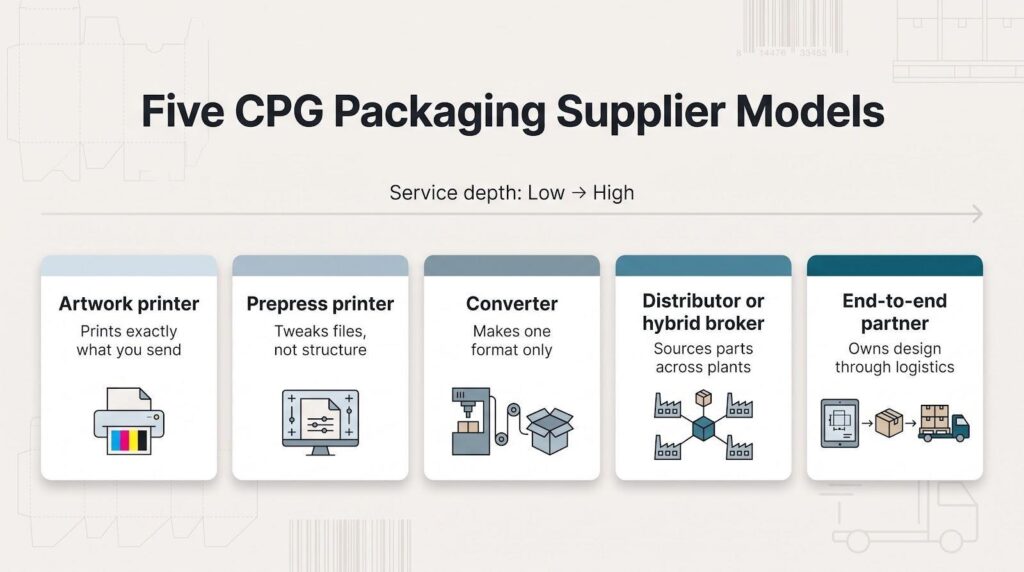
- Artwork printer – prints exactly what you send.
- Prepress printer – tweaks files but leaves structure alone.
- Converter – manufactures a single format such as cartons or pouches.
- Distributor or hybrid broker – sources multiple components across plants.
- End-to-end partner – owns design, engineering, production, QC, and logistics.
Zenpack is a textbook model-5 “end-to-end partner”; its Olive Oil Jones case study shows an ISTA-tested corrugated structure engineered for three glass-bottle formats, and its Fitbit case study shows a multi-material rigid box that passed the ISTA 3A test.
Published case studies like these give you a ready-made checklist of engineering, compliance, and logistics tasks to benchmark other suppliers against when you scope your RFP.
How the seven suppliers were evaluated
Each company was assessed against nine criteria rooted in real launch headaches, not marketing claims.
- Design & engineering depth
- Scale & capacity
- MOQ flexibility
- Lead-time agility
- Sustainability credentials
- Regulatory/compliance expertise
- Global logistics support
- Pricing transparency
- Named CPG case studies
The review rests on supplier capability pages, news releases, and public case studies. Only published proof (white papers, sustainability reports, named launch wins) counted. No private interviews or paid placements influenced the picks.
The goal is simple: give you an apples-to-apples snapshot you can stack against your own priorities before you request a quote.
1. Zenpack: best for design-to-production continuity
Zenpack operates like an in-house packaging team without the headcount. Its guide to packaging for product launches lays out a backward-mapped timeline that locks in the shelf date, covering discovery, prototyping, golden-sample approval, and batch QC. One kickoff call then connects structural engineers, designers, and supply-chain staff across San Jose, New York, Taipei, and Dongguan.
Zenpack Packaging for New Product Launch Webpage Screenshot.
Its FAQ lists a typical timeline of 8–12 weeks for design, 4–8 weeks for production sampling, and 3–4 weeks for mass production. That schedule lets brands lock structure, artwork, and testing before retail deadlines close in.
Zenpack’s published workflow for packaging a new product launch shows how these steps merge into one master timeline. The approach excels when a program mixes paperboard, molded pulp, magnets, or luxury inserts that other vendors would split across factories.
Budget note: projects start above entry-level print costs, and custom tooling appears on a separate line item. Confirm who owns each mold or die before issuing a PO. If you value single-team accountability from sketch through freight booking, Zenpack remains the most integrated option in this cohort.
2. ePac Flexible Packaging: best for fast, low-MOQ pouches
When shelf date is the only clock that matters, ePac’s digital presses can ship roll stock in 10 business days and finished pouches in 15 once artwork is approved, according to the company’s FAQ.
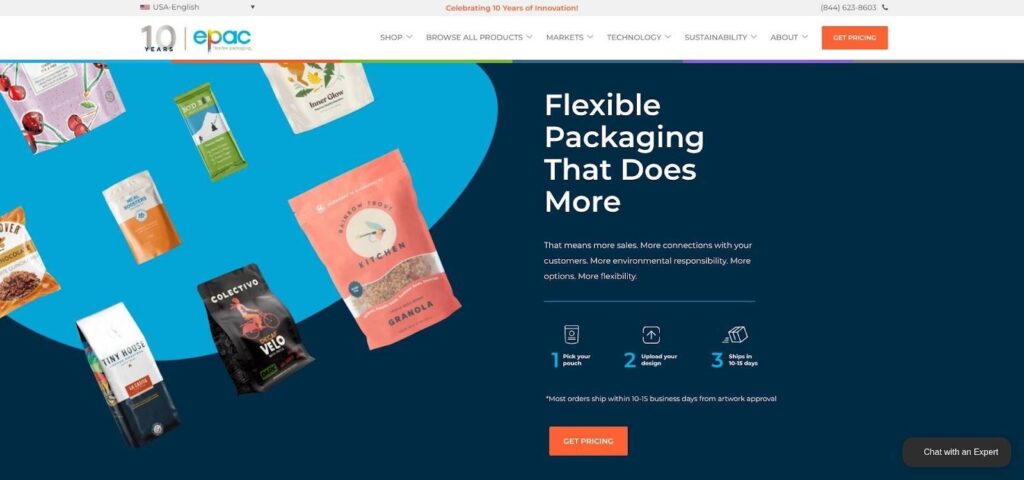
ePac Flexible Packaging Homepage Screenshot Highlighting Low-MOQ Pouches.
True pilot runs stay affordable because ePac runs multiple SKUs in one job with no plate or setup fees, so five flavours can ride one job ticket. The result is lower inventory risk and faster market feedback.
Scope is the only caveat. ePac focuses solely on flexible formats, so bottles, cartons, or moulded parts require a different partner. Secure plant certifications early and confirm barrier specs meet your shelf-life goals. Address those points upfront, and you gain one of the quickest pouch pipelines in the industry.
3. TricorBraun: best for rigid packaging with global reach
According to its corporate site, TricorBraun operates more than 100 locations across the Americas, Europe, Asia, and Australia and taps a vetted supplier network to source glass, PET, closures, and dispensers at the plant that best balances cost and lead time. Its Design & Engineering team locks structure and colour standards, while sourcing teams prototype or tool full-scale moulds under the same brief.
The model lets you start with stock bottles for a pilot run, then move to a proprietary design once demand grows. Inventory programs and regional warehouses reduce cash-flow shocks by letting you pull smaller release orders.
Watch-outs: per-SKU MOQs and mould ownership vary by component. Get those details, along with preferred freight lanes, in writing before you issue a PO. Clear paperwork allows TricorBraun to scale packaging as fast as your forecasts.
4. Berlin Packaging: best for stock-to-custom rigid solutions
Start with Berlin’s catalogue of in-stock bottles, jars, and closures you can decorate tomorrow. When volume justifies ownable IP, Berlin’s in-house design division, Studio One Eleven, re-engineers those parts into proprietary geometry and validates line speed before hand-off.
The same team sources tooling, manages first-article inspection, and folds each new component into Berlin’s global warehousing program, so you can release smaller orders without cash-flow spikes.
Watch-outs: mixing stock and custom parts can stretch schedules if one component lags. Confirm when design fees convert to supply agreements, and get per-SKU MOQs in writing. Handle those details early, and you gain a packaging runway that scales from pilot jar to sculpted flagship bottle on a single invoice.
5. PakFactory: best for multi-format secondary packaging
PakFactory assigns a dedicated product specialist to coordinate every carton, insert, sleeve, and rigid gift box, so all secondary packaging arrives on the same truck as the hero pouch or bottle. The team writes a structural brief, builds 3-D CAD, and ships prototypes you can fold, fill, and shake. Once you sign the dielines, PakFactory routes production through its network of more than 50 certified facilities to match run size, finish, and budget.
Because they own the master timeline, inserts, sleeves, and master cartons finish together with no piecemeal freight. Push for plant transparency and certificates (FSC, food-contact, ISTA), and request a quote that separates printing, assembly, and freight. Lock those details, and you gain a single conductor keeping every secondary piece in tune with the primary package.
6. Atlantic Packaging: best for transit testing and load stability
Atlantic’s ISTA-certified Packaging Solution Center in Charlotte, North Carolina recreates vibration, drop, compression, and climate exposure before the first truck rolls. Engineers model the full pallet, adjust stretch-film patterns, and right-size corrugate so the unit load survives real routes.
Atlantic Packaging Solution Center Page Screenshot Showing Transit Testing Lab.
Atlantic’s published case study with Coca-Cola Consolidated covers the stretch-film standards it validated for the bottler’s unit loads.
Atlantic focuses on secondary and tertiary packaging, so you’ll still need a primary-package specialist for bottles or pouches. If chargebacks, damage rates, or sustainability KPIs rise, the Solution Center can debug the entire unit load, not just tweak a single panel.
Book lab hours early because peak seasons fill fast. Confirm sample quantities in writing. With those slots secured, you leave with data-driven packaging that ships safely, sustainably, and at lower cost.
7. ProAmpac: best for scaled flexible and fibre programs
When a pilot pouch turns into eight-figure volume across three continents, ProAmpac’s 84 manufacturing centers of excellence and nine graphic design centers can absorb the surge. The network spans flexible film, coated paper, and fibre-based formats, so you can adjust barrier, appearance, and recyclability without adding vendors.
Technical teams run shelf-life modelling and drop simulations before press time. Program managers spread demand across sister plants to avoid capacity crunches, providing insurance against a single-site shutdown if a viral video spikes orders.
Trade-offs: opening MOQs are higher, and onboarding is formal. Define scope, target plant, and post-merger capabilities up front, especially after the March 2026 TC Transcontinental Packaging acquisition expanded capacity but added complexity. Once aligned, ProAmpac scales flexible and fibre packaging faster than most brands scale their forecasts.
Buyer’s guide: from big idea to retail spec
Know your three packaging levels
Every CPG package is really three packages nested together: primary, secondary, and tertiary.
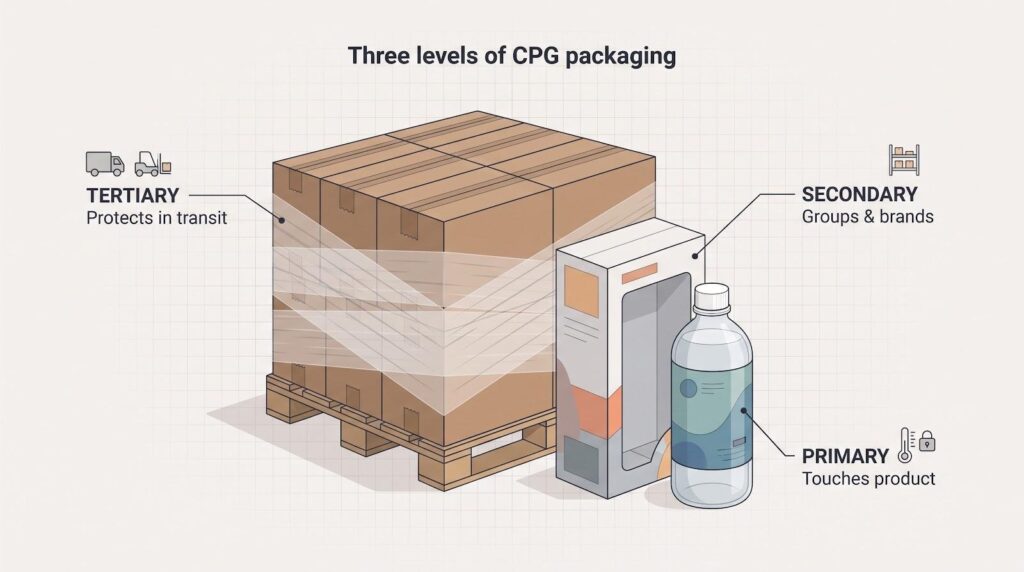
- Primary touches the product (bottle, pouch, jar). It must survive filling temperatures, hold torque or seal strength, and preserve flavour, aroma, or actives until the consumer opens it.
- Secondary groups one or more primaries (carton, sleeve, rigid box). It delivers branding, planogram fit, tamper evidence, and shelf presence while making units easier to handle.
- Tertiary shields everything in transit (corrugated case, stretch film, pallet). It absorbs forklifts, truck vibration, and climate swings so product arrives intact and compliant.
Ask each supplier which layers they control, which they outsource, and who signs the test reports. If the answer is unclear, keep shopping.
What a controlled retail packaging specification should contain
A packaging spec is the launch’s single source of truth. It locks every dimension, tolerance, and test so no one debates “what we meant” once production starts.
- Identity. SKU name, net weight, and a clear product description.
- Dimensions. Internal volume, wall or film gauge, cut-score locations (measured to 0.1 mm).
- Materials. Resin code, paper caliper, coating or barrier layers; “kraft” alone won’t pass a line trial.
- Performance targets. Seal strength, closure torque, drop-test protocol, shelf-life or barrier spec.
- Logistics. Case-pack count, master-carton size, pallet Ti-Hi, and stacked compression rating (figures that drive freight cost and shelf facings).
- Governance. Artwork revision number, golden-sample ID, inspection AQL, change-control signatures.
Artwork package requirements
A print-ready art file speaks a different language than a glossy mock-up.
- Provide vector paths for every logo and outline all fonts.
- Embed images at 300 dpi or higher.
- Set colour mode to CMYK and specify named spot colours.
- Keep separate layers for dieline, bleed, varnish, foil, and white ink.
- Include at least 0.125 in (3 mm) of bleed, and keep copy inside the safe zone.
- Reserve barcode quiet zones per GS1 General Specifications, noting the current revision date.
- Export a layered PDF-X that preserves colour profiles.
Proof and approval hierarchy
Each sample answers a different “what if.” Skip a rung and the ladder wobbles.
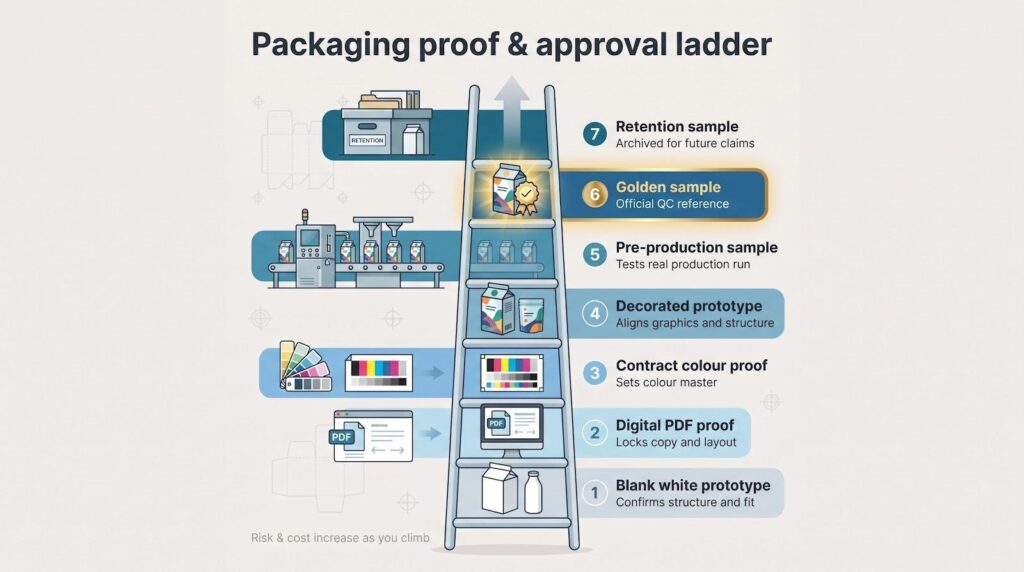
- Blank white prototype. Confirms fit: the product drops in, threads engage, seals hold. No ink distracts from geometry.
- Digital PDF proof. Locks copy and colour breaks; typo fixes here cost pennies, later they cost reprints.
- Contract colour proof. Printed on calibrated stock; brand and supplier sign, date, and archive as the colour master.
- Decorated prototype. Full graphics on the real structure so marketing and operations review the same object.
- Pre-production sample. Runs on the actual machine at speed; checks die wear, colour stability, and cure times.
- Golden sample. Numbered, signed by both parties, stored as the reference for incoming inspection.
- Retention sample. One unit per lot kept after shipment; provides evidence if quality claims surface months later.
How to read MOQ language
MOQ looks simple until you realise suppliers measure it several ways.
- Per-SKU minimums treat every flavour or scent as its own order.
- Total-order minimums lump all SKUs into one line.
- Digital print often lets you mix artworks in the same run, while conventional presses charge plate fees per design. Ask which rule applies before you celebrate a low quote.
Pilot quantities create another trap. A vendor may allow 1,000 units for launch but require 10,000 on reorder because production shifts to different equipment. Clarify reorder minimums and whether you can gang SKUs again as you scale.
Probe hidden commitments: annual volume targets, storage fees for unreleased stock, or penalties for mid-contract artwork changes. Get those terms in writing so your scaling plan, not surprises, sets the cheque size.
Compare total landed cost, not unit price
A $0.10 pouch can cost more than a $0.15 pouch once tooling, freight, and duty enter the equation.
- One-time charges. Tooling, print plates, cutting dies.
- Project services. Artwork prep, prototypes, inspection.
- Unit cost. Base package plus decoration or assembly.
- Logistics. Ocean, air, and domestic freight quoted at today’s index plus fuel; add duty by HS code.
- Carrying costs. Warehousing, release fees, inventory financing.
- Risk. Scrap, returns, and obsolete stock from overbuying.
Stack the totals. The winner is the lowest delivered cost per sellable unit, not the cheapest line item.
Build the timeline backward
Deadlines stack inside other deadlines, so plan from shelf date to today.
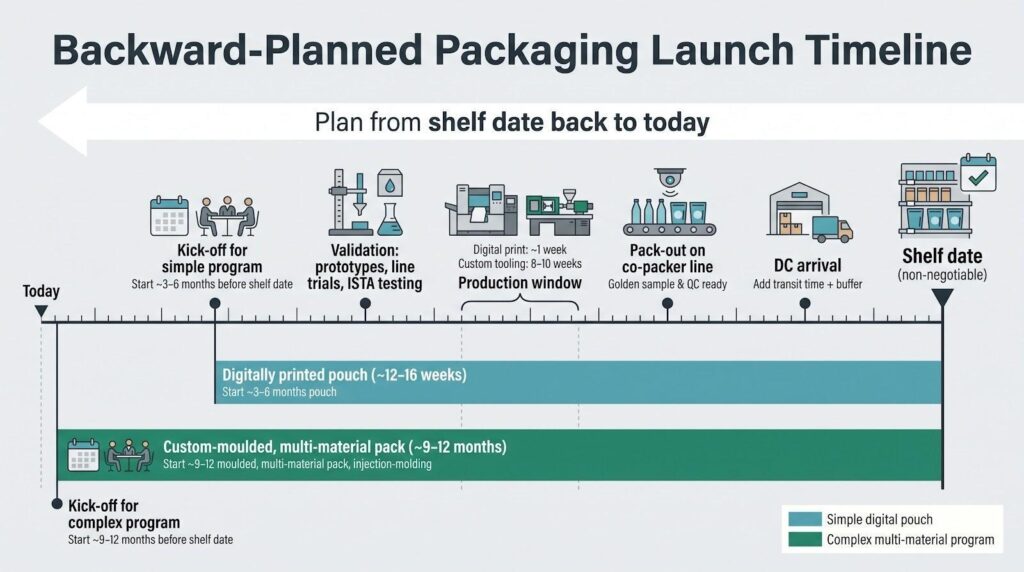
- DC arrival. Mark the day product must reach the retailer’s distribution centre; add transit time plus a buffer for weather or port delays.
- Pack-out. That date lands on your co-packer’s line; schedule backward for golden-sample approval and allow at least two weeks for finance release and QC checklist alignment.
- Production. Digital print may need one week; custom-mould tooling can take eight to ten. Layer press capacity and holiday shutdowns into the calendar.
- Validation. Prototype cycles, line trials, and ISTA testing consume real calendar days, so plan them early; don’t rely on lucky gaps.
- Kick-off. For a simple digitally printed pouch, writing the brief and booking engineering time often start three to six months before shelf date; for multi-material or moulded programs, nine to twelve months is safer.
Lock the Gantt chart, share it with every stakeholder, and review slippage weekly. Backward planning takes discipline, but it costs less than last-minute air freight for 20,000 cartons.
Validate product and filling-line compatibility
Test on real equipment before you commit to inventory. Your package rides a conveyor, meets hot-fill or nitrogen flush, and passes under torque guns and metal detectors. Vet each step before placing a purchase order.
- Fill on the actual line. Watch for foam, splash, or trapped air that can break seals. Measure closure torque and liner compression, then invert samples for 24 hours; any seepage now is cheaper than a recall later.
- Run through detection systems. Metal detectors, X-ray, and check-weigh stations react differently to multi-layer films, foil, or cap inserts. Adjust the spec until false rejects disappear without reducing safety.
- Stage a full-speed line trial. Clock throughput, note jams, and pull random units for drop and shelf-life tests. Sign off only when operations, quality, and the supplier agree that product, package, and equipment run in sync.
Verify compliance and sustainability claims
Trust, but verify every document.
- Certificates. Match FSC chain-of-custody numbers to invoices, confirm ISO 14001 covers the exact plant, and request FDA or EU food-contact declarations for the resin and intended use temperature.
- Scope and dates. An expired certificate, or one tied to a sister facility three provinces away, offers zero audit protection.
- Claim substantiation. Cross-check recycled-content or compostability claims with third-party lab data and log results now for upcoming EPR reports.
- Marketing copy. Route “eco-friendly” or “biodegradable” wording through legal review; the FTC Green Guides penalise vague terms. Precise language prevents retailer chargebacks and consumer lawsuits.
Retail versus e-commerce requirements
A package that dazzles on a shelf can flop in a parcel, and the reverse is just as costly.
Retail priorities
- Three-second shelf impact: crisp front panel, scannable barcode, visible tamper band.
- Structural integrity: straight edges so cartons stand cleanly in planograms.
- Easy replenishment: case packs that open without knives and present every facing.
E-commerce stresses
- 30 in (76 cm) waist-high drops (ISTA 6A) and belt gaps that crush weak corners.
- Dimensional-weight charges that punish empty space.
- Leak risk from pressure changes and inverted handling.
Engineer both journeys at once: add crush panels or internal braces so the retail carton survives a UPS tumble, or ship it inside a right-sized mailer that meets FedEx drop and dim-weight rules. Validate with a full ISTA 6A sequence early; one lab pass costs less than emergency refunds after launch.
Ten common mistakes (and how to dodge them)
Avoid these traps to save time, money, and sanity.
- Lock artwork before structure. Freeze the dieline first; re-plates cost time and money.
- Treat renders as proofs. A 3-D mock-up sells the idea, but only a vector dieline guides dies and glue flaps.
- Compare quotes on different specs. A 5-gram pouch costs less than a 7-gram one, until it tears in transit.
- Celebrate a 1,000-unit pilot without reading the reorder MOQ. The second order may jump to 50,000.
- Ignore freight on empty air. Oversize boxes “ship oxygen,” and carriers bill by dimensional weight.
- Skip real-product compatibility tests. Oil and water behave differently; test with the actual formula.
- Leave tooling ownership vague. Define who owns and stores each mould before you issue a PO.
- Print vague “green” claims. Retailers fine first, debate later; back every claim with data.
- Approve samples without a written QC standard. Without it, “close enough” keeps moving.
- Build no buffer into the timeline. Plan at least one week of slack; overnight freight for 20,000 cartons is painful.
Emerging trends to watch
Stay ahead by tracking these five shifts.
- Smaller, faster batches. Digital presses let brands launch five SKUs today and refresh graphics next month while keeping inventory lean.
- Pilot-to-scale roadmaps. Suppliers now map a 2,000-unit test pouch into a 200,000-unit roll-fed run without changing barrier specs.
- EPR compliance pressure. California SB 54 and Oregon’s Recycling Modernization Act reward formats backed by verifiable material data.
- Supplier consolidation. New acquisitions can boost capacity, but they can also upset quality systems; ask about integration plans.
- Omnichannel durability. One spec must survive both retail shelves and parcel drops as home delivery grows.
Track these shifts, and you’ll choose partners ready for tomorrow, not just veterans of yesterday.
Packaging supplier RFP checklist
A tight RFP eliminates guesswork and spot quotes no one can compare. Confirm each field before you hit send.
- Product & launch. Category, launch date, sales channels. A snack pouch for Whole Foods plus Amazon FBA needs different specs than a glass serum bottle for Sephora only.
- Volumes. Pilot run, six-month forecast, 12-month upside, and number of SKUs; digital printers can gang art now and charge less later.
- Operations. Co-packer name, filling temperatures, line constraints (nitrogen flush, induction seal), ship-to location, preferred Incoterms.
- Files. Attach the controlled dieline, current artwork PDF-X, and any CAD, mock-up, or transit test reports already completed.
- Compliance & sustainability. Required food-contact declarations, FSC or ISO scope, recycled-content targets, EPR data fields.
- Governance. Tooling ownership, change-control steps, inspection AQL, and escalation contacts.
Frequently Asked Questions
What’s the single best packaging supplier?
There isn’t one. The best partner depends on format, launch volume, channel mix, and speed-to-market. This guide highlights seven, each dominant in a different use case.
How early should we start packaging development?
Work backward from shelf date. Digitally printed pouches can launch in 12–16 weeks; custom-moulded, multi-material packs may need nine months or more.
What’s the difference between artwork and engineering?
Artwork communicates the brand. Engineering locks materials, tolerances, and test protocols that protect the product through filling, transit, and shelf life.
Who should create the dieline?
The production supplier or a qualified structural engineer. Graphic designers apply art after that file is frozen.
Is a broker worse than a manufacturer?
Not necessarily. Transparency and accountability matter more than factory ownership.
What’s a reasonable MOQ?
The smallest quantity that runs on production equipment without hurting unit cost: about 2,000 for digital pouches, 5,000 for offset cartons, and 25,000 for injection-moulded jars.
Can we label packaging “recyclable” if the material technically is?
Only if most target consumers have access to facilities that accept and process that material, and the design doesn’t hinder sorting. Vet every claim under FTC Green Guides and local EPR rules.
Do we need a physical golden sample?
Yes. Inspectors use it to accept or reject production; digital proofs can’t show texture, varnish height, or seal integrity.
Who owns custom moulds and dies?
Whatever the contract states. Negotiate ownership, storage, and maintenance before you issue the PO.
Can one package serve retail and e-commerce?
Sometimes. Design for dual use and validate with ISTA testing; otherwise budget a ship-ready overbox or an e-commerce variant.