


What Is Brand Evolution?
Brand evolution refers to a continuous process of enhancing and nurturing a brand’s reputation or image through improvised messaging, logos, marketing strategies, and product offerings that suit the dynamic customer needs, market conditions, and other factors to keep a brand relevant and recognizable among the target audience.
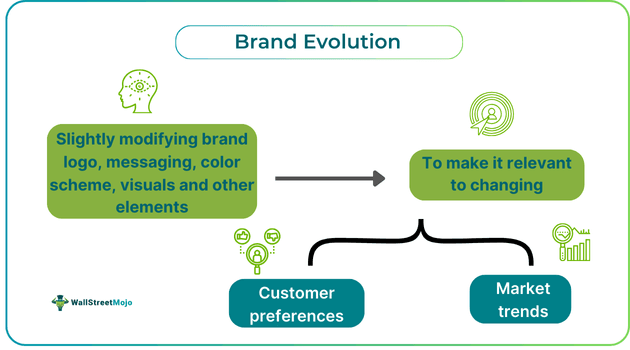
A brand that updates itself over time can better position itself in front of its target audience. Also, as market trends and customer demands rapidly change, revitalization, repositioning, and alignment of the brand with the corporate strategy are needed to engage existing customers and attract new ones.
Key Takeaways
- Brand evolution is a gradual and tactical process of making minor alterations to the brand logo, messaging, color palette,
- and other visuals to ensure that the brand remains recognizable and relevant as the market trends and customer expectations evolve with time.
- It involves six critical stages: unbranded products, brand as a reference, brand as a personality, brand as an icon, brand as a company, and brand as a policy.
- Such a brand refresh is crucial for enhancing customer experience and loyalty, achieving brand revitalization, repositioning, survival, growth, and sustainability, and expanding the target audience base.
Brand Evolution Explained
Brand evolution is an ongoing process of enhancing a brand’s image and reputation by making changes to its visuals, including the brand logo, messaging, color palette, etc., to ensure that the brand remains relevant to dynamic customer preferences and market trends. Companies often refresh their brand’s first look or impression to show that the company is growing and improving with time and technology, and so are its values and objectives.
It further helps businesses keep the current audience engaged and attract new target customers. Some of the most common ways of refreshing the brand are updating its guidelines, social channels, internal communication, and other elements. For instance, MGM’s brand evolution has given it a whole new identity from 1924 to 2024.
The process of evolving a brand includes the following critical steps:
- Creating a team of expert employees who can collaborate and help the company to evolve its brand image.
- Understand the present brand strategy, elements, and target audience.
- Conduct an external evaluation of the competitors’ strategies and branding practices.
- After reviewing the collected data and being on the right page, find out the reasons and purpose of brand evolution.
- Work out the logo to make it more visually appealing and self-explanatory.
- Upgrade the brand guidelines to resonate with the clear brand identity and make the necessary changes to the other brand elements.
- Test the new brand elements by gathering feedback from the customers and running pilot programs.
- Keep the process consistent throughout the branding process for a unanimous brand evolution effort.
Stages
It involves the following major stages over a brand’s lifetime:
- Unbranded Products: This is the company’s initial stage, in which its offerings have no particular name, identity, logo, or symbol. Brand creation becomes necessary at this stage.
- Brand as a Reference: This is the next level, where products are recognized by the name of their manufacturers or producers. Here, customers learn about the source of goods or services and are able to differentiate it from its competitors.
- Brand as a Personality: Here, the brand gains individual recognition or personality in the market and grows as a different brand from its competitors.
- Brand as an Icon: It is a maturity level of the brand identity, where it becomes a consumer-owned brand, and the customers are fully aware of all the information about the products and brand.
- Brand as a Company: At this stage, the brand takes over the company’s identity, and that company is recalled through its brand identity. Thus, there is a need for rebranding or revitalization now.
- Brand as a Policy: At this level of brand evolution, customers develop a sense of belonging to the company, the brand, and its policies, making it a legacy and contributing to its expansion.
Examples
This concept has been a practice for many years, whether it’s the Coca-Cola brand evolution or Flipkart brand refresh. Every brand has evolved to become better and more appealing over the years. Similarly, Starbucks’s brand evolution is an example of its journey to build a legacy in the beverage industry. Let us now have a look at some other similar examples:
Example #1
Suppose MB Jeans is a pioneer in denim clothing for men and women. The brand’s marketing team analyzed the shift in market trends and customer preferences toward rugged and designer denim jackets and pants. This change was majorly driven by the youth, which represents 55% of the brand’s target customer base. Therefore, the brand slightly revised its logo to make it more appealing to its target audience. Also, the brand was given a new color theme that looks more trending than the previous one.
Example #2
On March 12, 2024, Thomson Reuters introduced its first brand update in 16 years to better serve professionals in a dynamic media environment. This brand evolution was initiated with the help of a digital-first agency, the Code and Theory. Indeed, this refresh emphasizes the company’s dedication to using generative AI to assist professionals in focusing on more complex tasks and embracing a work-life balance.
Also, the new brand promise, “To Clarify the Complex,” is based on extensive customer feedback. Further discussing the changes made under this evolution, the company has come up with a redesigned logo, updated visuals, a new color palette, modern fonts, and a refreshed tone. Notably, these improved brand elements will be rolled out over the next year.
Importance
It is essential for the following reasons:
- Brand’s Survival: Brand evolution is critical for the growth and sustainability of a company over time.
- Superior Brand Equity: While the company aims to deliver a better customer experience with a refreshed brand identity, it parallelly improves its brand equity.
- Repositioning: Sometimes, refreshing a brand is a part of its repositioning in the market to create a fresh image or identity.
- Revitalization: The enhanced brand visuals rejuvenate the brand image and provide the target audience with a new perspective on the company and its offerings.
- Strategic Alignment: As the company heads towards expansion and modernization, its strategies also evolve; thus, refreshing the brand elements can keep it aligned with these new strategies.
Brand Evolution Vs. Brand Revolution Vs. Rebranding
These three concepts are related and used in rebuilding a brand’s image and reputation. However, the three hold significant differences, as discussed below:
| Basis | Brand Evolution | Brand Revolution | Rebranding |
|---|---|---|---|
| Definition | It involves a slight modification in brand visuals, logos, color schemes, etc., to ensure that they remain relevant to changing market trends and customer expectations. | It is a strategic rework of the brand’s visuals to keep it up-to-date with the new target demographics and market dynamics. | It is a repositioning strategy that creates a whole new brand identity by changing almost every element, including the brand name. |
| Purpose | Keep the brand recognizable and relevant to the changing customer tastes and market trends. | A strategic shift in the brand’s identity to align it with the changing market dynamics and target demographics. | Repositioning a brand to create a new brand identity that aligns with the company’s new mission and vision. |
| Extent of Change | Slight changes to improve the brand logo, visuals, product offerings, color palette, etc. | Required radical change to break the monotony. | Extensive transformation, including a new brand name, logo, color scheme, tagline, logo, etc. |
| Process | Tactical, gradual, and seamless process of making small changes. | Strategic process. | Strategic and drastic makeover of the overall brand identity. |
| Example | Improved Apple’s logo to match the changing customer preferences. | Starbucks changed its logo four times from 1971 to 2011 to go local to global. | Facebook became Meta. |
Frequently Asked Questions (FAQ)
Frequently Asked Questions
How does the digital age affect brand evolution?
With the new era of digitalization, the opportunities and challenges for the brands to evolve have also flared. Thus, the digital age helps companies to interact and connect with a wider target audience globally. Moreover, search engine marketing strategies enable these businesses to feature and offer personalized products and services to their potential customers by analyzing their preferences and needs. However, the rise in technology has also resulted in extensive competition and surged customer expectations.
Why do customers care about the company’s brand evolution?
Evolving a brand over time is essential for companies and their customers. A brand that upgrades itself with changing market dynamics and customer tastes can earn the loyalty and trust of existing customers and effectively attract new target customers.
What are the key drivers of brand evolution?
Brand evolution involves analyzing internal and external determinants. It is about centralizing customer preferences, such as their needs and expectations while planning the branding strategy accordingly. It should also focus on market trends, opportunities, and challenges.